The most powerful backlinks are the kind that can single-handedly push your page higher in Google’s rankings.
Backlinks are still one of SEO’s strongest ranking signals. But today, not all links count.
The algorithms are getting more sophisticated, and Google actively fights spam. That’s why SEO professionals aim to earn powerful backlinks.
So what makes a backlink powerful?
I’m Elena, and after 5 years of helping brands build high-impact links, I can answer that question.
In this guide, you’ll see how to get them and learn the proven tactics 60+ link building experts use to stay ahead in 2025.
Highlights
- Links from relevant pages outperform links from unrelated high-DA sites.
- High-DR domains (70+) usually pass the most SEO value.
- Editorial, in-content dofollow links carry the most weight.
- EEAT signals like expert quotes and branded mentions are increasingly important.
- Digital PR and niche collaborations beat mass outreach for long-term results.
- AI speeds up research but can’t replace human outreach and vetting.
- Always verify traffic, metrics, and content quality before securing a link.
What Makes a Backlink Powerful?
Not every backlink is made the same. Some barely register—others can noticeably improve your search rankings.
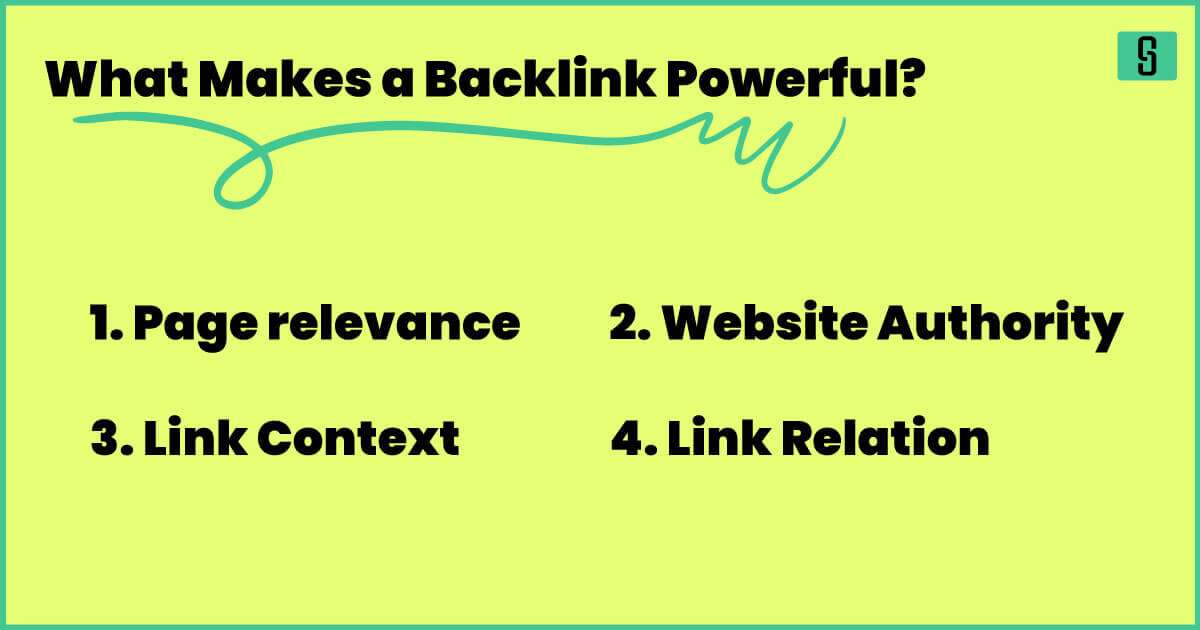
Usually, it comes down to four primary factors:
- Page relevance: The linking page covers a topic similar to your page.
- Website authority: It comes from a website Google already trusts.
- Link context: It’s placed naturally in real content.
- Link relation: The link is dofollow (not tagged as nofollow, sponsored, or ugc), so it passes link equity.
Now, let me explain each one in more detail.
1. Page relevance
The strongest backlinks come from pages on the same topic as yours.
Google doesn’t just look at the domain—it evaluates the content of the specific page linking to you.
When that page covers the same subject, it passes stronger topical signals, which can have a bigger impact on rankings than links from high-authority but unrelated pages.
That’s why your link acquisition strategies should focus on pages that directly align with your content’s theme.
Let’s say you run a fitness site and publish an article on home workouts:
✅ A nutrition blog’s page about meal plans for athletes links to your article: This would be a relevant backlink because both pages live in the health and fitness world.
❌ A car blog’s page about engine maintenance links to your article: Even if the car site is authoritative, this link wouldn’t be as powerful because the linking page isn’t contextually related.
Pro tip:
Before chasing a backlink, ask yourself: Would the people reading that specific page care about my content? If the answer is yes, it’s likely a relevant (and powerful) link opportunity.
2. Website Authority
Simply put, authority in the context of backlinks refers to how credible and influential a website is.
When a high-authority website links to yours, it passes more value because it’s considered a trusted source.
What Makes a Site Authoritative?
- It has a lot of high-quality backlinks pointing to it.
- It regularly publishes helpful and quality content.
- It’s trusted in its space (think industry publications, well-known blogs, big companies, etc.).
Links from these kinds of websites pass more SEO value than links from random low-traffic blogs, directories, or spammy sites.
For example, a backlink from Forbes carries more weight than one from a brand-new business blog with no audience or reputation.
How to Measure Backlink Authority
Unfortunately, website authority isn’t something that Google shares publicly. However, smart SEO analysts have figured out a way to estimate it.
Tools like Ahrefs, Semrush, and Moz created metrics that can help us assess the strength of a website’s backlink profile:
- Domain Rating (DR): Used by Ahrefs. Measures the strength of a site’s backlink profile, scored 0–100.
- Domain Authority (DA): Used by Moz. Similar principle—it estimates how likely a site is to rank, based on link strength and other factors; scale 0–100.
- Authority Score: Used by Semrush. Combines backlink data, traffic, and other signals to assess a site’s overall SEO strength, also on a 0–100 scale.
These scores aren’t official Google metrics, but they’re a handy lever for finding and choosing the strongest backlinks.
The higher the number, the more authoritative the site is (generally speaking). For example:
- DR 70+: Top-tier websites (news sites, major blogs, etc.)
- DR 40–60: Mid-range authority
- DR under 30: Smaller or newer websites
High authority backlinks come from websites with high DA or DR scores.
Insider note:
In most link building workflows, DR (Ahrefs) and DA (Moz) are the most commonly used benchmarks.
But don’t obsess over the numbers alone; context matters too. More on that below.
3. Link Context
Where your backlink appears on a page matters almost as much as what website is linking to you.
The most powerful links are editorial links. Those are placed naturally by the author within the main body of an article, right where they make sense for the reader.
They’re usually added to provide extra value, not because someone paid for them.
Why are they so valuable?
Well, because they:
- Are surrounded by relevant text.
- Sit in meaningful context, giving search engines more clues about your topic.
- Are often earned—another site decided your page was worth referencing.
So, to sum up, high-value backlinks sit naturally within content that’s closely aligned with the topic and flow of the page.
4. Link Relation
A backlink’s power is also determined by how it’s set up in the code.
The link relation (the rel attribute in HTML) tells search engines how to treat a link. It can determine whether that backlink passes ranking value or not.
For a backlink to be considered powerful in the SEO sense, it should ideally be dofollow.
So, what does that mean in practice?
Let’s break down the main types of link relations you’ll come across:
- Dofollow (default): This means that a link has no restrictive rel attribute. If there’s no rel attribute on a link, search engines follow it and pass SEO value (PageRank).
Example: <a href=“https://serpsgrowth.com/”>SERPsGrowth</a>
- Nofollow (rel=“nofollow”): Tells search engines not to pass PageRank through this link. Often used for untrusted or user-generated links (e.g., blog comments) to avoid spam manipulation.
Example: <a href=“https://serpsgrowth.com/” rel=“nofollow”>SERPsGrowth</a>
- Sponsored (rel=“sponsored”): Marks paid or affiliate links. Google introduced this to make the difference between editorial and paid placements more straightforward.
Example: <a href “https://serpsgrowth.com/” rel=“sponsored”>SERPsGrowth</a>
- UGC (rel=“ugc”): Stands for User-Generated Content. Used for links in forums, comments, or other places where site visitors create content.
Example: <a href=“https://serpsgrowth.com/” rel=“ugc”>SERPsGrowth</a>
If a backlink is marked as nofollow, sponsored, or ugc, it will either pass no ranking value or pass a heavily reduced signal.
That means it still has value for referral traffic or brand visibility, but it won’t have a significant effect on rankings.
How do you check link relations?
Depending on your browser, the process might look slightly different, but the idea remains the same:
- Chrome / Edge (Chromium-based): Right-click the link → Inspect. This opens Developer Tools with the HTML highlighted.
- Firefox: Right-click the link → Inspect Element.
- Safari: First, enable the Develop menu in Preferences → Advanced. Then right-click the link you want to inspect → Inspect Element.
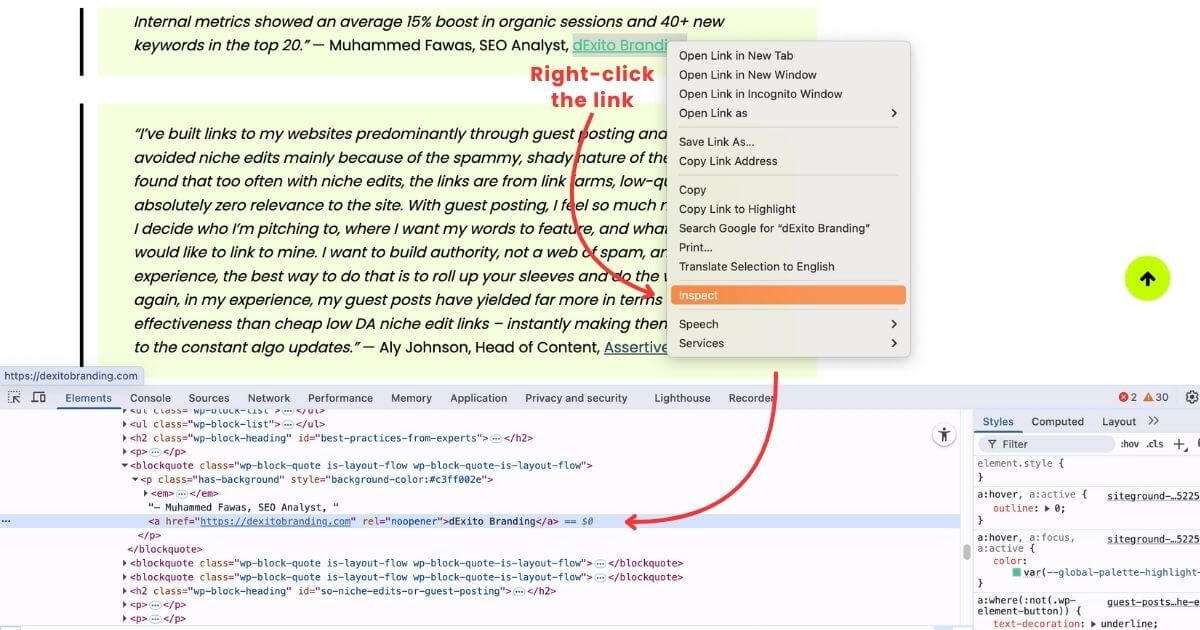
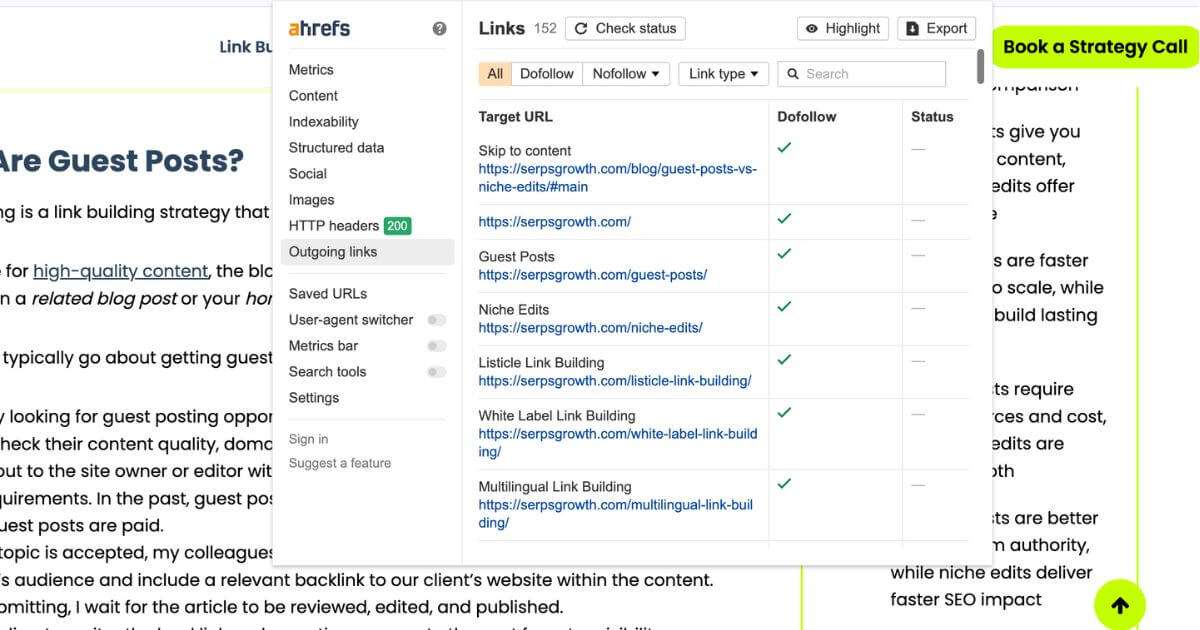
Alternatively, you can install a browser extension that automatically highlights links and shows their rel attributes. Some popular options include SEO Minion, NoFollow, and Ahrefs Extension.
Personally, I use the Ahrefs Extension:
So, What Types of Backlinks Are the Most Powerful?
The most powerful backlinks are editorial, dofollow, and have a DR above 70. Those are naturally earned placements that pass full SEO value.
These often come from:
- Reputable news outlets (e.g., BBC, The Guardian, The New York Times).
- Authority publications (e.g., Harvard Business Review, National Geographic, Business Insider).
- Trusted .edu or .gov domains (e.g., links from a university research page or a local government’s resource section).
- Well-known industry sites (e.g., TechCrunch for startups, Moz for SEO, Food52 for cooking).
When a respected source links to you within relevant content, it signals both trust and topical authority to search engines, making these links far more valuable than anything you can buy or place yourself.
Now, let’s take a look at how you earn these types of links.
Proven Strategies for Earning Powerful Backlinks
From my experience, I can say that to earn the best backlinks for your website, you need a well-planned strategy. Successful link building depends on focused, smart tactics you can use consistently.
So, here’s how to get powerful backlinks that deliver lasting results:
1. Become a Source for Journalists
Use platforms like Featured, Help a B2B Writer, or Qwoted to respond to journalist requests.
If your insight gets featured, you’ll often land a link from a high-authority news outlet or industry site.
2. Guest Post on Authoritative Sites
Pitch original articles to respected websites in your niche. In return, you earn a link back to your website. It’s usually placed in your author bio or within the content.
Focus on quality over quantity; one guest post on a top-tier site can outperform dozens on low-authority blogs.
Want to explore this strategy in detail? You’ll find the full breakdown in my guest posting guide.
3. Create Link-Worthy Assets
Linkable assets are unique, useful, or surprising pieces of content that naturally attract citations and authority backlinks. They include:
- Original research or data studies
- Interactive tools or calculators
- Detailed guides or industry benchmarks
- Infographics that simplify complex topics
The more others reference your work, the more natural backlinks you earn.
4. Broken Link Building
Find broken outbound links (these are the 404 error pages) on relevant, high-authority sites using a backlink checker. Then, offer your content as a replacement. This turns a webmaster’s problem into your opportunity.
Pro tip:
Tools like Ahrefs’ Broken Link Checker or Check My Links (Chrome extension) make this process faster.
5. Niche-Specific Outreach
Reach out to site owners, bloggers, and content creators in your niche to establish genuine relationships.
Once there’s trust, you can suggest adding your link to an existing relevant article. This strategy is called niche edits link building.
With time, when you’re well-connected in your space, these opportunities will come naturally, without the need for cold outreach.
6. Digital PR and Newsjacking
Turn your industry insights or data into a story journalists want to cover to earn PR backlinks.
With digital PR, you proactively pitch stories to media outlets.
With newsjacking, you react quickly to trending topics by adding your expert commentary before the news cycle moves on. Both approaches can land you high-DR, editorial links that money can’t buy.
Buying vs. Building Backlinks: Risks and Rewards
You might have heard that it’s possible to buy links instead of earning them the hard way. It’s true (and it can work), but it’s not without risks.
In SEO, you generally have two options: buy them or build them. Both can boost your rankings, but the approach, costs, and potential downsides are very different.
Buying Backlinks
Buying links usually means paying for a placement on another website. It either happens through a public marketplace, a private network of link partners, or a direct deal with a website owner.
Pros of Buying Links:
- Can deliver quick results if the links come from relevant, high-authority pages that already rank and get traffic.
- Allows precise targeting—you can choose sites, DR ranges, anchor text, and even specific pages to link from.
- Saves significant time compared to organic outreach or waiting for links to appear naturally.
Cons of Buying Links:
- Violates Google’s guidelines—spam filters can spot link manipulations, which can trigger ranking drops or manual penalties.
- Many marketplaces sell low-quality links from sites with fake metrics, little real traffic, or private blog networks (PBNs).
- Long-term placement is uncertain—links may be removed, altered, or sold to competitors later.
- High-authority, legitimate sites often charge hundreds or thousands per link.
Buying random backlinks can work in the short term, but it’s a calculated risk. In my experience, you need to vet every opportunity carefully.
Building Backlinks
This involves attracting links naturally through outreach strategies, content marketing, digital PR, link collaborations, or other non-paid methods.
Pros of Building Links:
- Complies with Google’s guidelines; less risk of penalties for manipulative link schemes.
- Builds long-term authority and trust, as earned links tend to be stable and keep passing value for years.
- Naturally relevant and contextual, since links appear within content where they make sense.
- Strengthens brand reputation. Being cited by trusted sources increases credibility with both Google and readers.
Cons of Building Links:
- Requires time, effort, and consistent content creation—you need assets worth linking to.
- Results are slower, and it can take months before enough links are earned to move rankings noticeably.
- Outreach is often labor-intensive and unpredictable; not every pitch will land a link.
Current Trends and Future Outlook
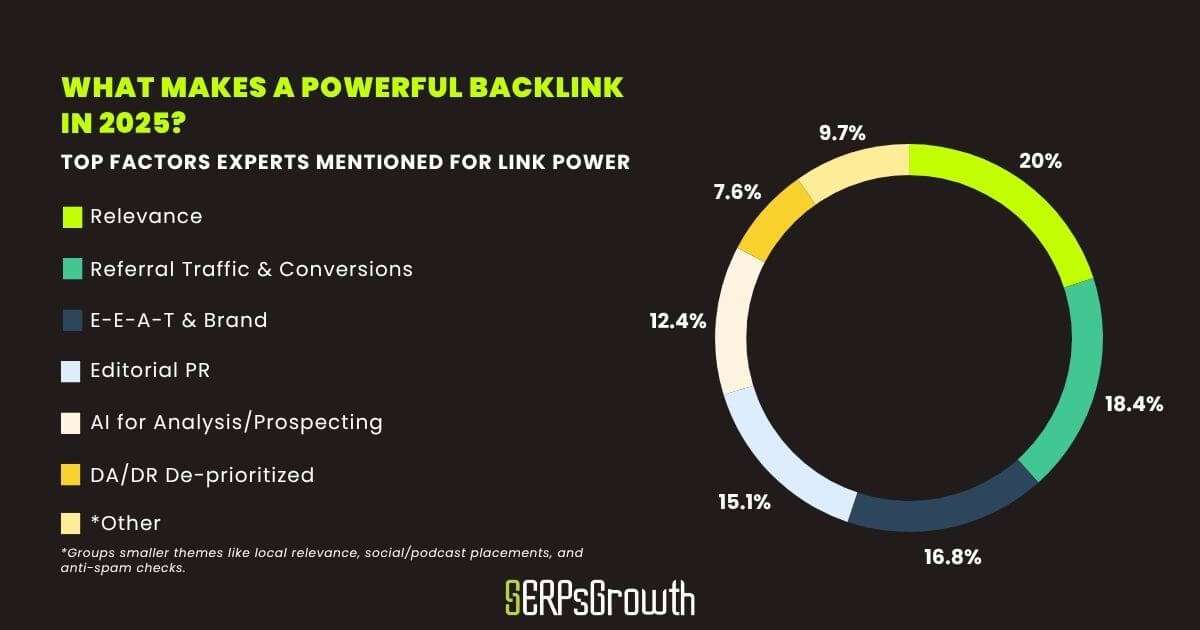
I asked over 60 link building experts to share what’s working right now and where they think the field is headed.
Here are the top factors experts mentioned for link power:
- Relevance: 20%
- Referral Traffic and Conversions: 18.4%
- E-E-A-T and Brand: 16.8%
- Editorial PR: 15.1%
- AI for Analysis/Prospecting: 12.4%
- DA/DR De-prioritized: 7.6%
- Other: 9.7% (anchor strategy, anti-spam and vetting, local/geo relevance, podcasts and social placements, AI overviews/LLM citations, avoiding low-value sources)
*Percentages are based on the share of total keyword mentions across all expert responses, grouped into major themes.
Now, let’s break down their observations in more detail:
1. Topical relevance beats raw DA/DR
Experts agree: a link from a contextually aligned source outperforms an off-topic high-DA site.
Relevance to the target page and audience is the #1 driver of value. Many have shifted away from chasing big metrics in favor of matching topic and intent.
“Today, a powerful backlink comes from a source that aligns semantically, geographically, and intent-wise with your content. If Google can’t clearly understand why the link exists or whom it serves, it’s dead weight, even if it’s from a DR 80 site.” — Matthew Goulart, Founder, Ignite Digital
2. Real audience + measurable outcomes
The value of a backlink isn’t just in authority anymore. Pros measure success by referral traffic, engagement, leads, and even revenue.
Niche roundups, local blogs, and links from pages in the same SERP cluster can outperform big-name sites when they send the right visitors.
“My approach now focuses on “traffic-generating links” over “ranking links.” I use Analytics to track which backlinks send converting visitors, then prioritize similar sites. Links generating zero referral traffic rarely help rankings long-term.” — Eugene Leow Zhao Wei, Director, Marketing Agency Singapore
3. EEAT and brand signals matter more
Strong mentions now include expert quotes, brand storytelling, and even unlinked brand mentions to strengthen trust signals for both Google and AI-driven search. Some see branded anchor text as a growth lever going into 2025.
“Another strategic change is putting a stronger emphasis on branded anchors and even unlinked brand mentions. Off-page SEO in 2025 is less about pure link quantity and more about brand building. Consistent mentions on reputable sites—linked or not—help establish authority, trust, and visibility, especially as AI overviews and chat-based search tools start surfacing results from sources they perceive as authoritative.” — Sascha Hoffmann, Lifecycle Marketing Consultant, SH Media
All of these align with Google’s EEAT principles (Experience, Expertise, Authoritativeness, and Trustworthiness), which play a growing role in how content is evaluated.
If you want a practical way to apply them, we’ve put together an EEAT checklist you can follow.
4. Editorial, in-content placements win
Links placed naturally inside relevant content (whether earned via PR, expert quotes, or data citations) beat any footer, sidebar, or generic directory listing.
“I now avoid homepage links, author bios, or generic directories because they don’t pass trust signals the same way editorial context does.” — Anatolii Ulitovskyi, Founder, Unmiss
5. AI is a tool, not a decision-maker
AI speeds up prospecting, scoring opportunities, and modeling anchor text diversity. But the final vetting and outreach remain human-led.
“AI tools help me analyze competitor backlink profiles quickly and prioritize targets, but I don’t let AI touch the outreach or content writing. You can smell that stuff a mile away now.” — Raphael Larouche, Founder and SEO Specialist, Agence SEO Zenith
6. Relationship-driven, PR-first tactics
The game is moving away from mass outreach. The winners focus on digital PR, collaborations, original research, and placements that competitors can’t easily replicate.
“Link building in 2025 is more about relationships and genuine mentions. I reach out with value, not just requests. Guest posts, expert roundups, and PR outreach remain strong tactics.” — Nick Mikhalenkov, SEO Manager, Nine Peaks Media
7. Stay agile with testing and monitoring
Teams are tracking SERP shifts, running controlled experiments, pruning low-quality links, and doubling down on tactics that create real user value.
8. Quality control is non-negotiable
Fake traffic and manipulated metrics are still a problem. Manual vetting is now standard for spotting fraud in link-selling networks.
“DR manipulation is nothing new, but the latest trend is even more deceptive—faked organic traffic. These sites look legitimate on the surface, but when you dig deeper, the traffic is often bot-generated or irrelevant to the niche. Because of this, my process now involves manual checks of traffic sources, audience relevance, and content quality before even considering a link placement.” — Sascha Hoffmann, Lifecycle Marketing Consultant, SH Media
9. Beyond traditional blogs
Podcasts, YouTube channels, Reddit threads, Quora answers, and niche forums are emerging as valuable link and brand exposure sources. Sometimes, they outperform big DA sites in business outcomes.
10. Local and intent alignment are big wins
Links from local media and niche authorities that align tightly with search intent can deliver outsized results—both in rankings and in conversions.
Wrap Up
If you take one thing from this guide, let it be this: the most powerful backlinks are the foundation of long-term SEO success.
Focus on editorial, dofollow links from highly relevant and authoritative sites. Build relationships with journalists and niche publishers. Create content worth citing. And always measure links by the value they bring—not just the metrics they show.
When done right, powerful backlinks build your brand, audience, and authority in your space.
FAQ
What makes backlinks from .edu and .gov domains the most powerful?
.edu and .gov domains have high authority because they’re well-established and rarely engage in spammy practices. They often belong to universities, government agencies, or other trusted institutions, so search engines like Google consider them a reliable source of information. Earning top backlinks from these sites sends powerful trust signals to search engines and can significantly boost your site’s authority.
How can I earn editorial backlinks through high-quality content?
Create resources people actually want to cite. It could be original research, in-depth guides, tools, or expert insights. Promote them through outreach, PR, and social channels so they’re discovered by writers and publishers who can reference them naturally within their content.
Why do backlinks from top sites, like Forbes and Wikipedia, hold more weight?
These sites have established authority, massive readership, and strong backlink profiles of their own. Links from them carry extra weight because search engines trust their editorial standards and content quality. Plus, they often bring referral traffic along with the SEO benefit.
How do relevance and website quality influence backlink strength?
A backlink’s strength generally comes down to a site’s authority and topical relevance. A highly relevant link from a quality site in your niche is more impactful than a generic link from a big but unrelated site. Relevance tells search engines your content belongs in that topic cluster.