If you want more traffic from Google, you can’t ignore backlinks. And to get strong backlinks, you need high-quality prospects.
That’s where link prospecting comes in. It makes the rest of your link building faster, more targeted, and way more effective.
I’m Elena, and for the past five years, I’ve helped businesses climb the search rankings with proper link building. I know what makes a prospect worth pursuing and what’s just a shiny metric with no real value.
In this guide, I share the link prospecting strategies I use to find link opportunities that actually move rankings.
Highlights
- Prospect approval for link building purposes is the foundation of every successful link building strategy.
- Website relevance and content quality matter more than any single metric.
- Clear evaluation criteria keep your backlink profile strong.
- Competitor analysis, search operators, and Content Explorer are proven ways to uncover prospects.
- Always verify sites manually. Metrics like DR/DA can be manipulated.
What Is Link Prospecting?
Link prospecting is the process of identifying websites that are an excellent fit for your link building goals and worth reaching out to for a backlink.
The aim is to create a targeted list of prospects that:
- are relevant to your niche.
- meet your quality standards.
- give you the best shot at securing a strong backlinks profile.
This is the foundation of every successful link building strategy.
Why Is Link Prospecting Important for SEO?
Link prospecting sets the tone for everything that follows.
Pick the right sites, and you will earn links that make a difference for your SEO strategy.
Pick the wrong ones, and you risk wasting your resources on something that barely drives results, or worse—leads to a Google penalty.
Here are the main reasons why link prospecting matters for SEO:
- Backlinks are an important ranking factor: Google uses them to measure trust, authority, and relevance of your content.
- Relevance impacts rankings: Links from sites in your niche carry more weight than random, unrelated domains.
- Authority passes value: High-authority domains transfer more ranking power to your pages.
- Anchor text optimization: The right prospects give you opportunities to earn keyword-rich anchors that look natural.
- Keeps your backlink profile clean: Targeted prospecting helps avoid spam links that could harm your website’s SEO.
5 Key Steps to Effective Link Prospecting
Now that you know why link prospecting matters so much, let’s take a look at the process that I follow when looking for link opportunities.
To make it practical, I included some real-life examples to show you how I approach link prospecting strategy.
Let’s dive in.
Step 1. Define Your Link Building Strategy
Before you start prospecting, you need to decide what kind of links you’re going after. Your strategy will shape the type of sites you target and how you approach them.
Here are some common link building tactics:
- Guest posting: writing articles for other sites in exchange for a link.
- Niche edits: adding your link to an existing relevant page.
- Resource page links: getting listed on curated “best of” or “tools” pages.
- Broken link building: replacing dead links with your relevant content.
- Linkable assets: creating data, tools, or guides others want to reference.
- Unlinked brand mentions: turning mentions of your brand into backlinks.
- Digital PR link building: Pitching stories, opinions, campaigns, or research to relevant media outlets.
Step 2. Establish Evaluation Criteria for Prospects
Not every site that looks good at first glance is worth going after.
One of the first things you learn when doing link building is that having clear criteria saves a ton of time and keeps your backlink profile strong.
Remember, the goal of link prospecting is to identify opportunities that support white hat link building strategies, ensuring your backlink profile remains clean and penalty-free.
Here are the attributes I look at when evaluating a potential backlink opportunity:
Website relevance
The site’s overall topic should match your niche or be closely related to it. A link from a relevant industry site will carry more weight for SEO.
Let’s say you run a B2B software company. A link from a SaaS review site would be pretty relevant, while a link from a fashion blog would not.
Page relevance
Even if the site is relevant, the exact page you’re targeting needs to connect naturally with your content.
Let’s go back to our B2B software example. Say you just published an article on email marketing best practices, and now you want to build links to boost its rankings.
A link from a page reviewing email automation tools is a perfect fit, as it’s contextually relevant and strengthens your topic.
On the other hand, a link from a general business news page on the same site wouldn’t carry nearly as much weight.
Website quality
Some websites exist solely to sell links. It’s pretty easy to spot them, too. Look for signs of quality, like:
- clear purpose and intent
- original and helpful content
- responsive design
- a professional layout
- a natural link profile
Pro tip:
Watch out for odd Sign Up pages. If it’s a company site where signing up doesn’t make sense, it’s usually a red flag. That site is probably selling links.
Real organic traffic
Organic traffic is one of the most evident signs that a site is healthy and trusted by Google. Steady numbers show stability, while gradual growth suggests the site is building authority over time.
Be cautious with the “hockey stick” pattern—when traffic suddenly spikes or crashes, like this:
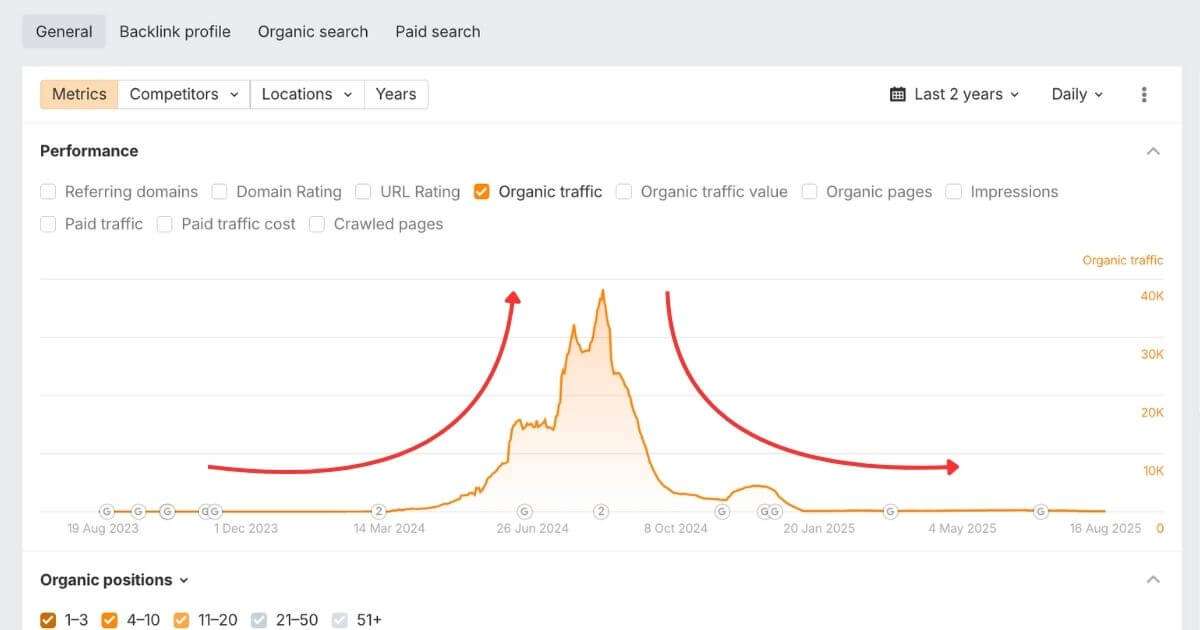
While some fluctuation is normal, sudden changes, like in our example, might point to manipulation or Google penalties.
High Domain Rating (DR) or Domain Authority (DA)
These are metrics from tools like Ahrefs (DR) and Moz (DA). They estimate the strength of a domain’s backlinks profile on a scale of 0 to 100.
- DA/DR of 0–30: Low authority. New sites or domains with very few links.
- DA/DR of 30–60: Medium authority. Sites with a growing backlink profile.
- DA/DR of 60+: High authority. Well-established domains with many strong backlinks.
Here is how it looks in Ahrefs:
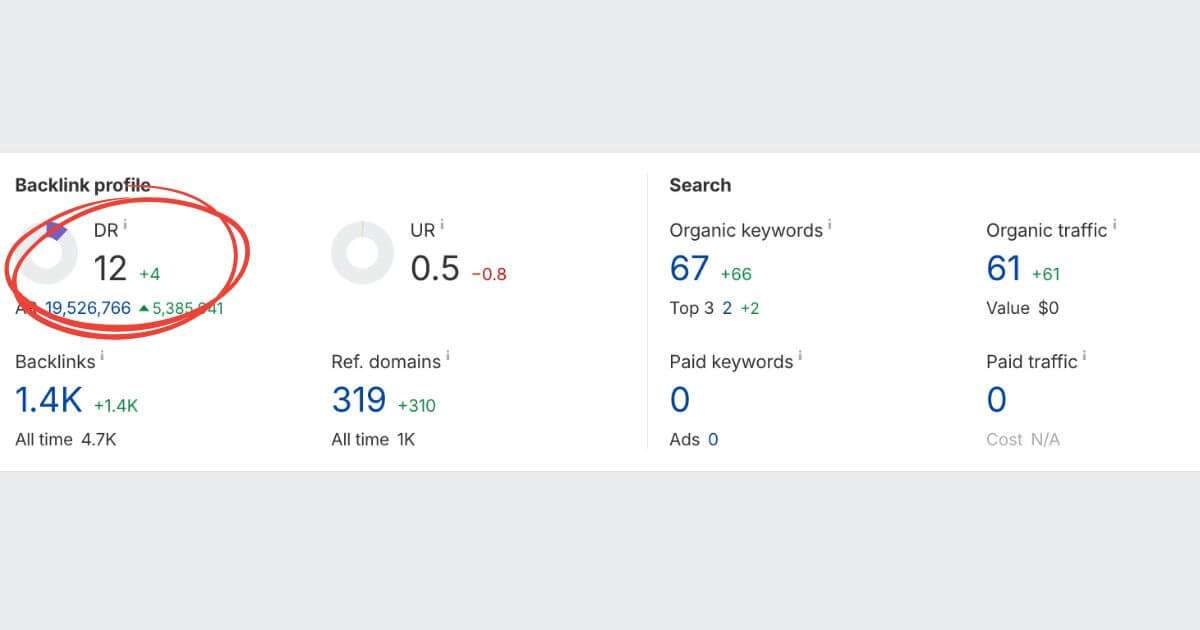
These metrics are useful as a quick authority check but never the only metric you rely on.
High DR/DA with low relevance to your niche isn’t worth much. Plus, these numbers can be easily manipulated with link schemes.
Google doesn’t use these same metrics to evaluate your website; that’s why relevance and overall quality always come first.
Low spam score
Moz has an SEO tool that measures a site’s spam score. It’s an estimate of how risky a site looks based on a breakdown of how many spammy domains link to it.
Here is how it looks in practice:
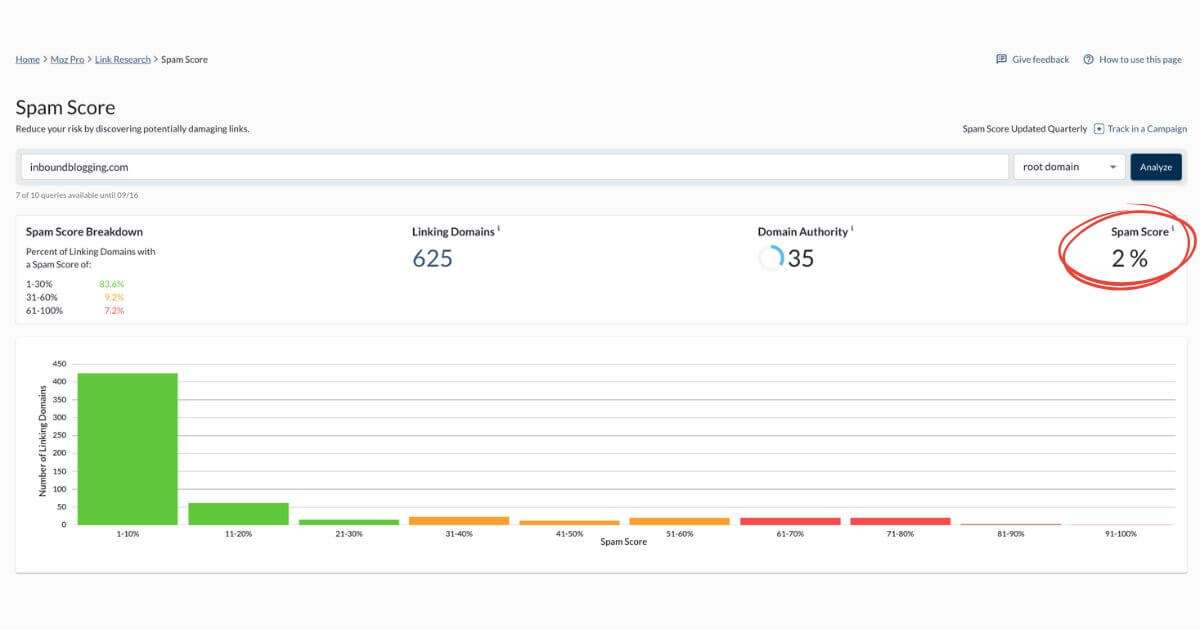
A high spam score is a potential warning sign. To stay safe, focus on sites with a spam score <5% so your backlink profile stays clean.
Out of all these attributes, website relevance, page relevance, traffic, and content quality matter the most. But, in general, the more of these boxes a prospect site ticks, the higher it should go on your outreach list.
Check out my free link prospecting template below:
Step 3. Find Relevant and High-Quality Link Building Prospects
Once you know your strategy and criteria, it’s time to start building your list of potential link targets. Here are some proven ways to find them:
Finding Prospects Through Competitor Analysis
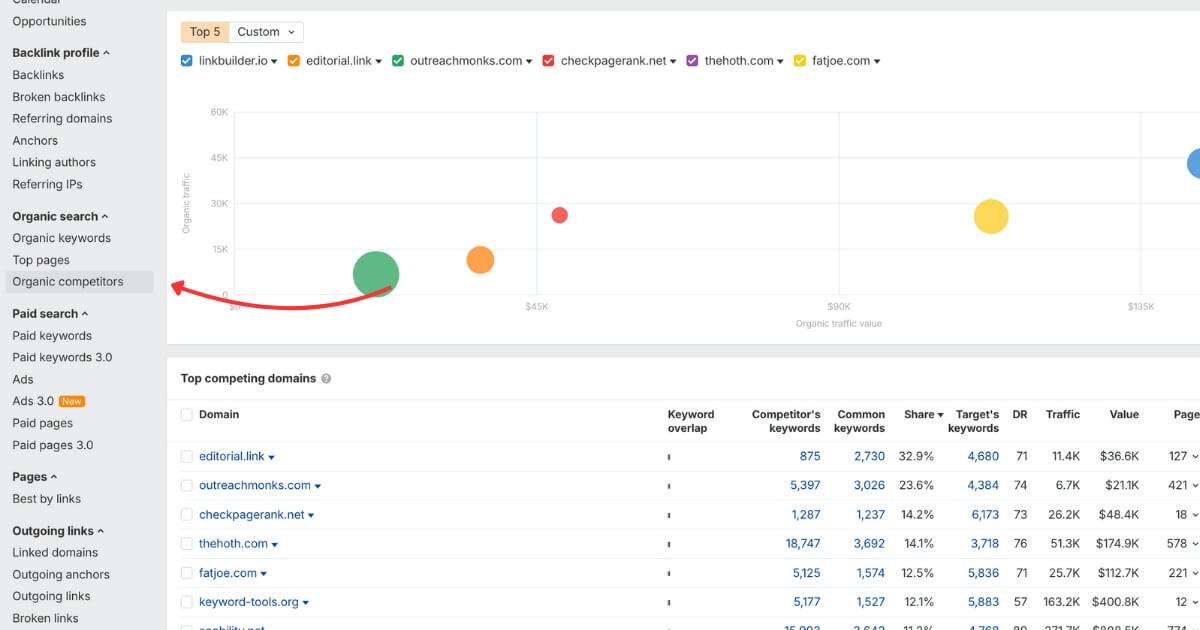
The easiest way to find a good link building prospect is to look at who’s already linking to your competitors. To do that, go to the Organic Competitors in Ahrefs:
Select the top competitors and use the Open in Link Intersect to see which websites link to your competitors but not you:
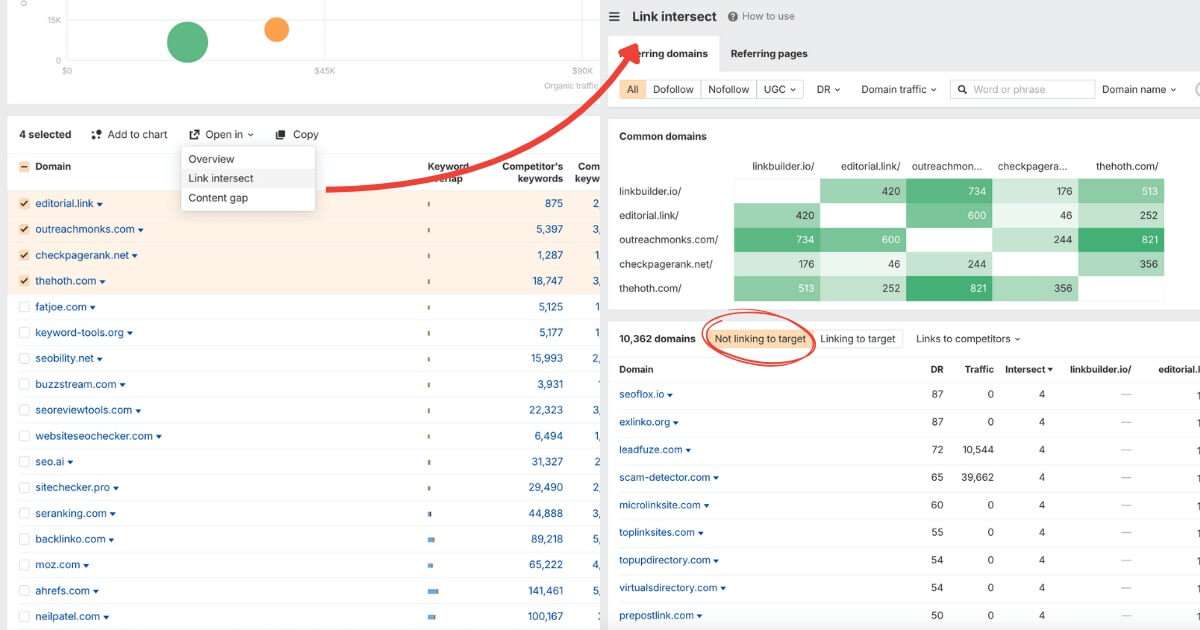
If a site linked to them, there’s a good chance they’ll link to yours, especially if you have more relevant and up-to-date content.
By studying your competitors’ backlink profiles, you can often spot the tactics they’re using to build links. For that, check their Best by links pages and look for anchor text to target URLs:
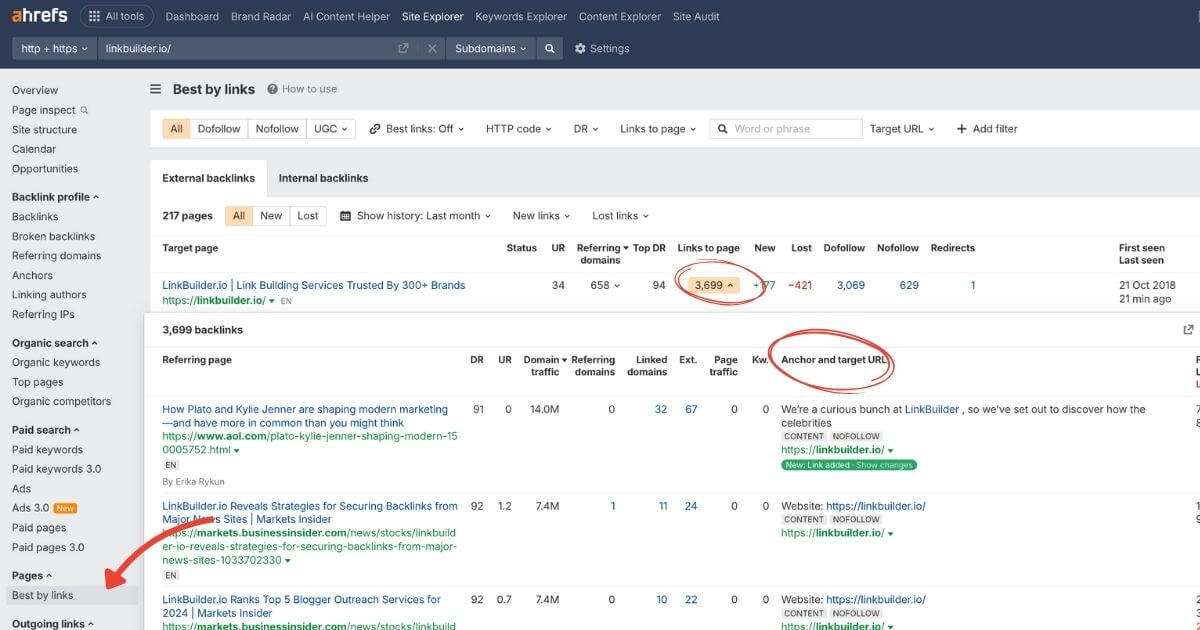
Maybe they’re leaning heavily on guest posts? Or adding links through niche edits? Or perhaps responding to journalist requests via HARO-like platforms?
Once you see the patterns, you can apply similar strategies yourself and close the gap in the search results.
Side note:
I usually stick to Ahrefs to do all my checks, but Semrush and Moz work just fine. But at the end of the day, it’s about what you’re comfortable with and which tool fits your workflow best.
Finding Prospects Using Search Operators
Advanced search operators let you uncover link opportunities in Google that you’d never find with a regular search.
By combining your keywords with special commands, you can zero in on pages that are more likely to link out to you.
Here are some search operators that are best for finding relevant link prospects:
- Intitle:“resources” + your keyword: Finds resource pages that list helpful tools, guides, or articles.
- inurl:links + your keyword: Surfaces pages with “links” in the URL, often curated link lists.
- “your keyword” + “guest post”: Shows sites in your niche that accept guest contributions.
- “your keyword” + “write for us”: Another way to find guest posting opportunities.
- “your keyword” + “statistics”: Great for spotting data-driven pages that might link to your own research.
You can also mix and match operators to refine your search even further.
Once you see an appropriate website, start gathering them in a spreadsheet to keep everything organized and prioritize which sites to reach out to first.
Insider tip:
SERP scraping tools make it easier to build a list of prospects into a spreadsheet.
Finding Prospects With Ahrefs Content Explorer
Ahrefs Content Explorer is another great way to uncover link opportunities.
It lets you search for content on specific topics in your niche and quickly spot potential targets.
I also like it because it can help you narrow results by Domain Rating, organic traffic, or even traffic value—so you’re only looking at prospects that match your criteria.
I will show you two methods that support multiple link building tactics at once.
Method 1
In the Pages tab, you can uncover relevant content for niche edits. Just search for your target anchor text, and the tool will highlight pages where it already appears in the content.
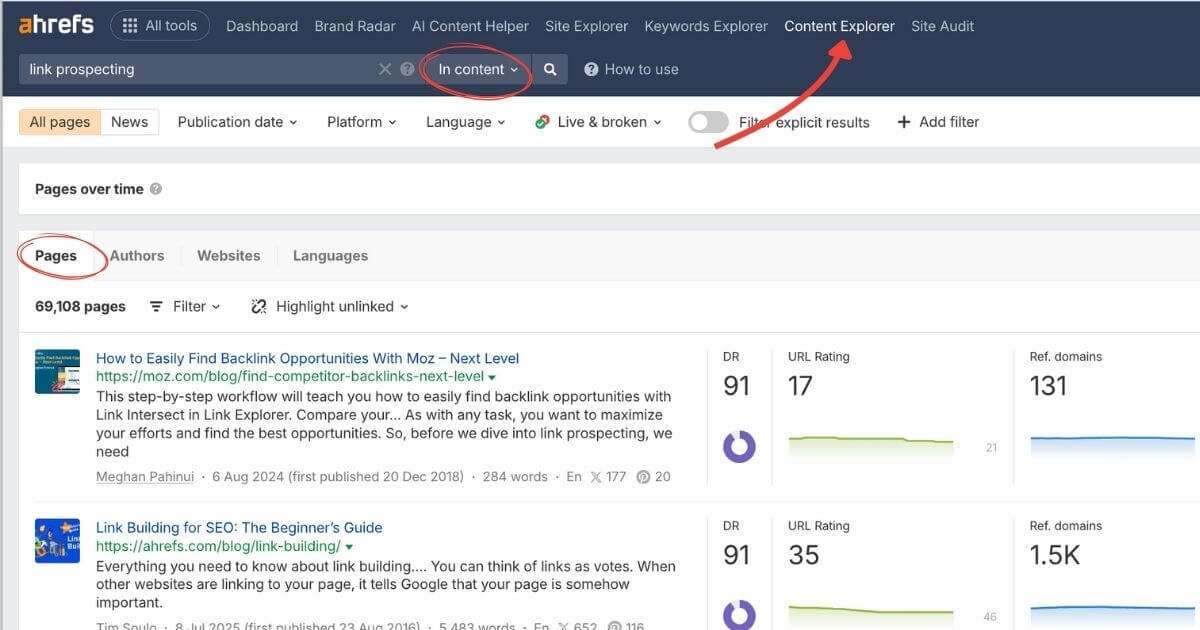
You can then scan those pages for broken links—perfect for broken link building.
Method 2
In the Authors tab, you’ll see who’s publishing content in your niche. These writers and editors are valuable contacts if you’re planning a digital PR campaign.
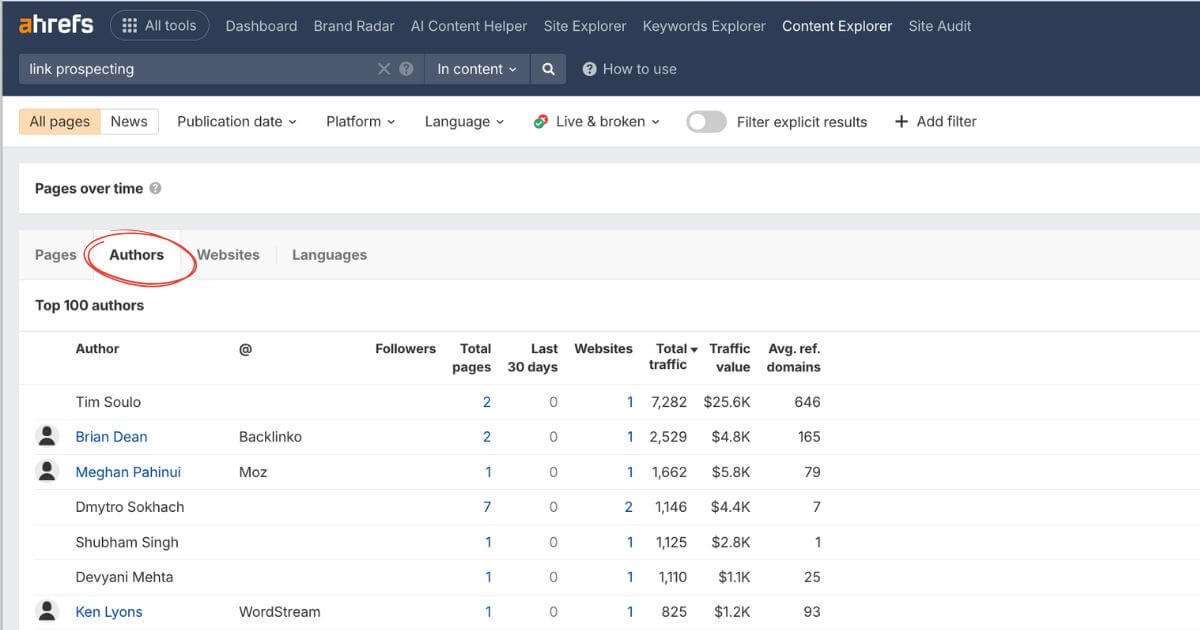
And once you’ve refined your search, you can export the data straight into a spreadsheet to keep your prospect list neat and ready for outreach.
Step 4. Analyze and Evaluate Link Prospects for Quality and Relevance
Once you’ve built your list of potential link prospects, the next step is to filter out the noise and focus on the sites that are worth your time.
If you’ve already set clear evaluation criteria, this process becomes much easier.
The first things I look at are the basics:
- Relevance: The site should be in your niche or directly relevant to your target audience; without this, the link won’t add much value.
- Domain Rating/Domain Authority (DR/DA): As a starting point, I usually work with sites in the DR 40–70 range; strong enough to pass authority but not so high that outreach is impossible.
- Organic traffic: A site with 1,000+ monthly visits shows it’s active and trusted by Google.
These benchmarks are great for an initial overview.
But here’s the catch:
Metrics alone can’t tell the whole story.
They’re easy to game, and many sites selling links will inflate their numbers to look more authoritative than they are. That’s why manual checks are essential.
Generally, I avoid websites that have:
- Thin or low-quality content (often AI scraped), published just to fill pages
- Poor design that feels outdated or thrown together
- Ads dominating the page instead of the content
- Missing About or Author information
- Articles stuffed with outbound links, often irrelevant to the topic
The more red flags you spot, the lower that site should go on your outreach list—no matter what the metrics say.
Step 5. Find Contacts for Your Prospects
Building a list of prospects is great, but here’s the truth:
If you don’t reach the right person, your outreach will probably go nowhere.
Avoid reaching out to generic addresses like info@ or contact@, as they often go unanswered.
Here’s what’s worked best for me:
- Find the decision-maker: I always try to get in touch with editors, content managers, or marketing folks—the people who can publish or approve a link.
- Use email-finding tools: Hunter.io is my go-to, but other email finders can do the trick. You just need to try and test what works for you.
- Check LinkedIn: Sometimes I can’t find an email, but a quick message on LinkedIn opens the door.
- Contact forms: I only use them if nothing else works. They can work, but response rates are way lower.
Once I have the right contacts, I drop them into my outreach spreadsheet—this keeps everything ready for outreach.
Pro tip:
Don’t reinvent the wheel every time. Keep a solid outreach template handy, then tweak it slightly to make each email feel personal:
Common Mistakes in Link Prospecting and How to Avoid Them
To highlight the most common mistakes people make when link prospecting, I asked SEO and link building experts to help me out. Here’s what came up again and again, plus how to avoid them.
Chasing Quantity Over Quality
One of the biggest traps is treating link building as a numbers game. A handful of relevant, high-quality links will do far more for your rankings than dozens of random ones. Instead of bloating your spreadsheet, focus on sites that fit your niche and add SEO value.
“Over time, you will find that high-quality links come more from trust and connection than mass emailing. Quality over quantity is not just a saying in this field, it is the difference between building real authority and spinning your wheels.” — Jared Bauman, Co Founder and CEO, 201 Creative, LLC
Overvaluing Vanity Metrics
Metrics like DA or DR are useful for quick checks, but they don’t tell the whole story. These numbers can be manipulated, and a high-DR site outside your niche won’t move the needle. Always put relevance, traffic, and content quality above vanity scores.
“The most common mistake is to look first at the DR or DA of the domain. Since a very large number of sites have high DR values > 60, but do not have a live audience. Such sites will be useful for diluting the link profile or anchor list, but if it has zero traffic, such a link will not bring potential customers. Search engines evaluate not only the presence of links, but also clicks, time on the page, interaction with the content. A site without readers will not be able to give these signals. Also, the DR metric is now easy to manipulate, DR can be artificially increased by purchasing a large number of links or using PBN. In such cases, the value of such a link for SEO is minimal or even harmful.” — Zachary Rischitelli, Owner, Real FiG Advertising + Marketing
Ignoring Relevance
A backlink from an unrelated site might look impressive, but it won’t help your topical authority. In fact, it could confuse search engines about your site’s focus. Prioritize links from websites and pages that directly connect with your content.
“My number one tip for those starting with link building would be to focus on page-level relevance, not just website-level. Instead of only looking for links from websites in your exact niche, broaden your search to include pages that are topically relevant.” — Agata Gruszka-Kierczak, International SEO Manager, WhitePress
Generic Outreach
Experts agreed that blasting out templated emails is a fast way to get ignored. Site owners can spot a copy-paste pitch from a mile away. Take the time to personalize your outreach, reference their work, and explain why your content adds value to their audience.
“Always personalize outreach by referencing the recipient’s content and explaining why your link adds value. Link building is 80% relationship-building, 20% pitching.” — Muhammed Fawas, SEO Team Lead, dExito Branding
Skipping Manual Checks
Link prospecting tools are great for finding prospects, but they can’t replace human judgment. Failing to review sites manually leads to links from spammy, ad-filled, or irrelevant domains. Always vet prospects for traffic trends, content quality, and trustworthiness before reaching out.
“For those starting out, I’d say build a prospecting checklist with filters like industry relevance, content quality, audience overlap, and whether they actually publish third-party contributions. Use tools like Ahrefs or Semrush, but then manually inspect the top prospects. Link building is one of those tasks where human judgment still beats automation.” — Leah Miller, Marketing Strategist, Versys Media
Wrap Up
The real difference in link prospecting isn’t how many sites you find—it’s how well you filter them.
When you prioritize relevance, real traffic, and genuine content quality, you end up with a prospect list that delivers rankings instead of empty numbers.
Over time, this approach builds not just backlinks, but authority, trust, and a competitive edge that’s hard to copy.
FAQ
What are some tools for link prospecting?
Popular tools include Ahrefs, Semrush, Moz, and Majestic for backlink analysis, Hunter.io for finding contact details, and BuzzStream or Pitchbox for managing outreach.
How do I collect ideal link prospects?
Start with your link building strategy, then use methods like competitor backlink analysis, Google search operators, and tools like Ahrefs Content Explorer. Keep your list organized in a spreadsheet or CRM so you can track progress.
What is the best strategy to make link prospecting more efficient?
Have clear evaluation criteria before you start. This way, you only add sites that meet your standards—saving time and avoiding low-quality links. Batch your research sessions and work in focused sprints instead of picking at it randomly.
What are the best metrics to assess the quality of link prospects in SEO?
Look at relevance (site and page), Domain Rating/Authority, organic traffic, spam score, and overall site quality. Relevance should always come first, with metrics like DR/DA used to prioritize.