Guest posting is still a powerful SEO strategy for gaining backlinks and building brand authority, as long as it’s done right.
I’m Elena, and over the past five years, I’ve helped brands grow through smart and sustainable link building. When I say guest blogging works, I’m speaking from real experience.
In this article, I’ll take you through:
- What guest posting is exactly
- How guest posting works and why it benefits SEO
- Why some people have turned against it
- And how you can make it a winning part of your SEO strategy
So, let’s dive right into it.
Highlights
- Guest posting benefits both writers and hosts when done properly.
- Post on quality sites with engaged audiences.
- Google allows guest posts as long as they focus on reader value, not link manipulation.
- Start small, build relationships, and scale up over time.
What Is Guest Posting in SEO?
Guest posting is writing and publishing an article on someone else’s blog, typically in exchange for a backlink.
Just like any link acquisition method, it can help boost your website’s SEO rankings.
On top of that, you gain brand awareness on a website that already has an established audience in your niche, and you can drive targeted traffic to your own website.
All of this sounds great for the person writing a guest post. But what are the benefits of guest posting for the host website?
The host gets fresh and relevant content for their audience without having to write it themselves. It keeps their content pipeline flowing and can even help improve their SEO if the post is written well and optimized to rank on Google.
Are Guest Posts Bad for SEO?
Out of curiosity, we asked SEO experts on LinkedIn if they use guest blogging as a link building strategy.
The results weren’t surprising: 72% said Yes.
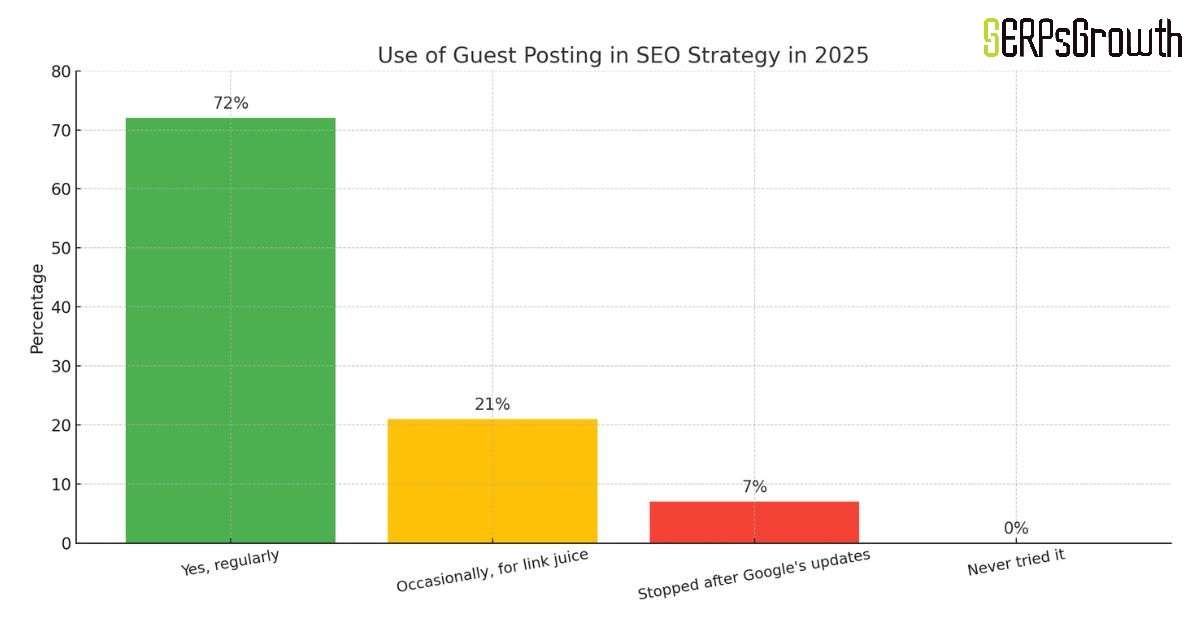
If so many people use this strategy, where does the notion that guest blogging is bad for SEO come from?
According to Google Search Central:
“Google does not discourage [guest articles] in the cases when they inform users, educate another site’s audience or bring awareness to your cause or company. However, what does violate Google’s guidelines on link schemes is when the main intent is to build links in a large-scale way back to the author’s site.”
While guest blog posts aren’t technically link schemes, the line blurs when they’re written purely for SEO and disguised as editorial content.
In July 2021, Google’s Link Spam Update reminded website owners (again) that they won’t tolerate link manipulation practices. Around that time, many websites saw drops in impressions, which made the industry question all link building activities, including guest posting.
However, both the practice and Google’s own words show that guest posts aren’t bad for SEO when properly attributed.
There are a few options:
- use rel=”nofollow” to tell Google not to pass link equity
- rel=”sponsored” for paid placements
- or rel=”ugc” for user-generated content
Many hosts now default to nofollow for all SEO guest post links to stay on the safe side.
The bottom line is:
Don’t try to make promotional links appear as natural editorial endorsements, and your website won’t get penalized.
When done correctly, guest posts can be among the most powerful backlinks you can earn for your website. The key is focusing on quality publications with engaged audiences rather than chasing quantity.
How Does Guest Posting Work?
While guest blogging may seem simple at first, it involves some work for both parties, beyond just writing and publishing.
How Guest Posting Works for the Host
1. Setting standards and guidelines
Almost every blog that accepts guest posts has editorial requirements. Those include:
- writing style
- preferred word count
- formatting
- SEO guidelines writers should follow, including the number of backlinks you are allowed to place
As a writer, it’s your responsibility to find and follow guest post guidelines.
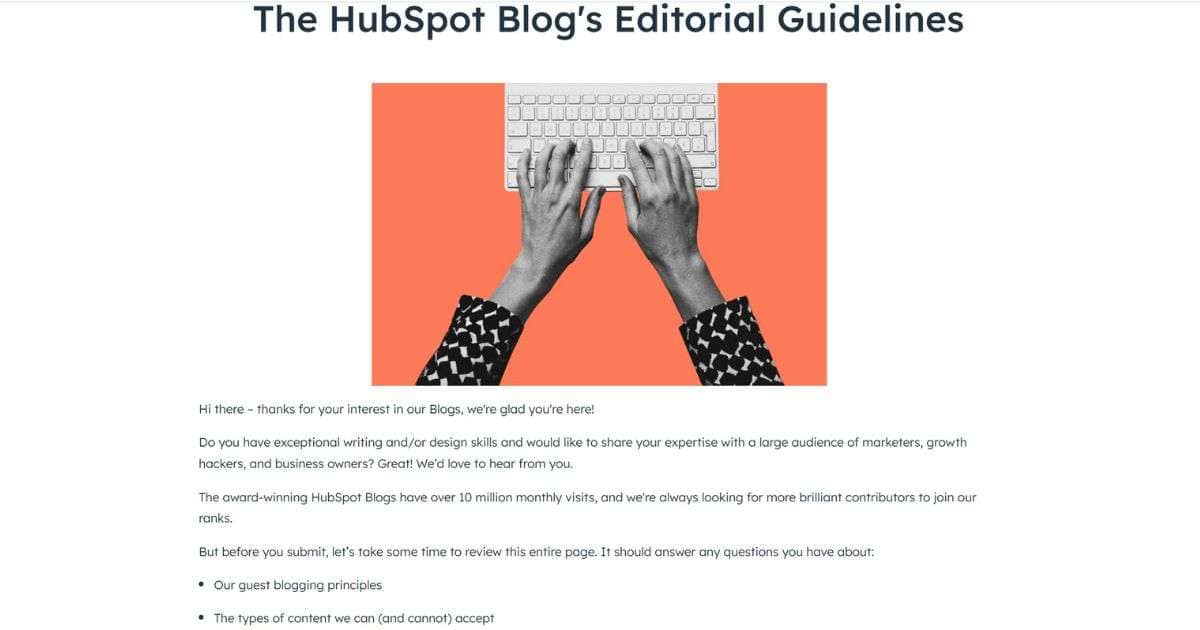
Most hosts publish their requirements directly on their website, often in a Write for Us or Blog Editorial Guidelines section.
If you can’t locate them, use a simple site:yourwebsite.com “editorial guidelines” search operator to find it easily.
You can also reach out to their editorial team through their contact page to request the guidelines.
For example, here’s how HubSpot presents their editorial requirements:
2. Receiving and reviewing pitches
The host receives dozens of pitches from writers every week and has to sift through each one to evaluate which ideas align with their content strategy.
Unfortunately, not all pitches get accepted—it’s not personal, it’s just business.
Even well-written pitches might not make the cut if the timing isn’t right or the topic doesn’t fit their current content priorities.
That’s why successful guest writers don’t put all their eggs in one basket and always send multiple pitches out to different publications.
3. Editorial review and publishing
Once the host receives your draft, they’ll review it to make sure it fits their standards.
Don’t be surprised when your article comes back from the reviewers with comments. It happens to everyone, even seasoned writers.
The host knows their audience better than you do, so their feedback usually makes the piece stronger.
Plus, a publication that gives detailed feedback is one that cares about quality, which is exactly the kind of site you want to be associated with.
How Guest Posting Works for the Writer
1. Research
While googling “guest blogging opportunities” is a good starting point, the search results will most likely show you a list of random websites. The chances that they match your niche and target audience are quite low. Instead, you can narrow your search to your specific industry.
Other best places to guest blog are the blogs you already read and respect in your field. These are sites where you naturally understand the audience because you’re part of it.
You can also look at where your competitors have been published. If they have a guest post on a site, there’s a good chance that its audience would be interested in your content.
2. Guest posting outreach
Guest posting relies heavily on outreach link building to connect with the right publishers. Once you’ve narrowed down your options, it’s time to craft a pitch that gets noticed.
Your pitch needs to prove two things:
- that you understand their audience,
- and that you can fill a gap in their content.
Don’t just propose generic topics or angles that they’ve already covered. Instead, look for fresh takes on familiar subjects.
When you compose your email, avoid copy-paste pitches. They are easy to spot and even easier to skip.
The hosts who get dozens of pitches weekly can tell immediately if you’ve actually visited their site or just found their email address.
3. Writing a guest post and revisions
I’ll say it straightaway:
Guest posts aren’t sales pitches disguised as content.
Editors can smell that from a mile away, so I recommend leaving that thought behind and focusing on writing genuinely quality content.
Weave in your expertise through examples from your experience and unique perspectives that only someone in your position could offer.
As for the backlinks, you need to be subtle with them.
Most blogs allow one to two external links. They should support your main point and provide added value for the readers. For example, it can be a link to a blog article that covers your topic in more detail or a recent report you published on your website.
Creating linkable assets on your own site gives you high-value content to reference in your guest posts, making your contributions more valuable to both readers and hosts.
Expect to make edits based on the editorial feedback, and make sure that the final piece meets their standards.
How to Do Guest Posting in SEO
Now, let’s take a look at the whole process if you want to land quality placements.
Here’s how to approach it step by step:
1. Start With Industry-Specific Searches
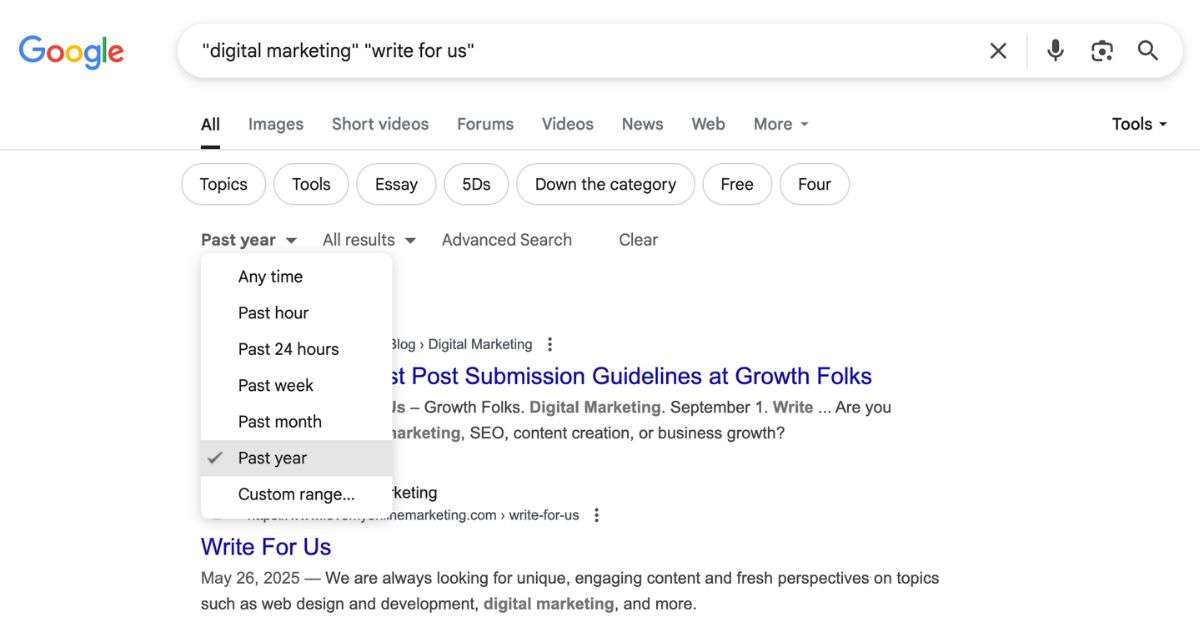
Skip the generic guest post opportunities searches. Instead, use these specific search strings on Google:
- “your nich” + “write for us”
- “your niche” + “guest post guidelines”
- “your niche” + “contributor guidelines”
- “your niche” + “submit article”
Replace “your niche” with terms related to the field you’re in.
Pro tip: Use Google’s date filter to find recently updated “write for us” pages. Click Tools > Any time > Past year to avoid pitching dead opportunities.
2. Analyze Your Competitors’ Backlinks
Use analytics tools like Ahrefs, SEMrush, or the free version of Ubersuggest to see where your competitors have published guest posts.
Look for the Backlinks section in these tools and filter for editorial links (not directory listings or forum posts).
This is how it looks in Ahrefs:

Pro tip: Look for backlinks with anchor text that matches article titles (like “5 Ways to Improve Your SEO”) rather than generic phrases like “click here”—these are more likely to be guest posts.
3. Look at Author Bios
When you read articles in your industry, scroll down to the author bio. Many guest contributors include links to other sites where they’ve been published. Click through to see if those sites are accepting guest posts.
Pro tip: Create a simple browser bookmark folder called “Guest Post Prospects” and save every promising site you find. You can even divide them by niche to stay organized and target the right audience more easily. Aim to bookmark 2–3 new sites every time you read industry content.
4. Use Social Media Platforms
Search X (Twitter) and LinkedIn for posts about guest posting in your niche. Many editors announce open calls on social media before posting them on their websites.
Pro tip: You can also set up Google Alerts for “guest post opportunity [your niche]” and “write for us [your niche]” to get notified when new opportunities are posted online.
5. Create a Spreadsheet
Track each opportunity with columns for:
- website name
- Domain Rating (DR)
- contact email
- content guidelines URL
- editor name
- pitch status
- and response date
This keeps you organized and prevents you from pitching the same site twice.
Feel free to use this progress sheet template to organize your guest post outreach.
Pro tip: Focus on sites with DR 30+ for better SEO value, but don’t ignore smaller sites with engaged audiences.
6. Start Small, Scale Up
Begin with smaller blogs that get fewer visitors. They’re more likely to respond and work with newer guest writers. Once you have built up some published examples, you can approach larger publications.
Pro tip: Target sites with 1,000–5,000 monthly visitors first. They’re small enough to notice your pitch and big enough to provide value. You can check traffic estimates using the free version of Ahrefs traffic checker.
Guest Blogging Tips From Pros
We asked SEO experts online to share their experience and best practices for guest posting. Here is what they have to say:
“Yes, guest posts still matter, but only when done with care. We’ve found that when a guest post is written for the right site, with a topic that actually adds something new, it builds trust and SEO value. Around 25–30% of our backlinks come from guest posts. They work best when the site has a real audience, not just a blog set up for link swaps. One guest post we published on a niche SaaS blog brought in over 200 referral visits in the first month and got picked up by two smaller newsletters. It also helped us rank higher for a long-tail keyword we were targeting. Focus on quality sites and topics your audience actually cares about, and the links will pay off long-term.” — Matias Rodsevich, Founder & CEO, PRLab
“About 38% of our backlinks come from carefully curated guest contributions on niche-relevant, high-authority sites. The key is quality over volume. Our campaigns have boosted client organic traffic by up to 52% within 6 months thanks to high-trust links built this way.
My controversial take is if you’re still buying mass-produced guest posts or writing fluff just for a link, you’re playing with fire. We focus on creating unique, high-caliber content that genuinely earns its spot. That is what still moves rankings in 2025. Happy to be quoted and share more data.” — Matthew Goulart, Founder, Ignite Digital
Wrap Up
Now you know exactly what guest posting in SEO is all about. When done right, it’s still one of the most effective ways to build site authority, reach new audiences, and earn quality backlinks that actually matter for your SEO.
In my practice, guest posts require more effort than other link building strategies, such as niche edit links. However, the results are often more sustainable. Just remember to keep Google’s guidelines in mind and prioritize reader value over link manipulation.
If you’re wondering which strategy is right for you, check out our detailed comparison of guest posts vs niche edits.