Guest posts or niche edits? I see many asking which is better, but that’s the wrong question.
I’m Elena. After 5 years of running link building campaigns, I’ve seen how the wrong choice can waste months—or worse, budgets.
Many companies chase guest posts when niche edits would’ve delivered faster wins. Others rely on link insertions when they really need long-term guest post authority.
This guide breaks down how to pick the right strategy before you lose time or momentum.
Highlights
- Choose niche edits for quick wins with tight budgets and guest posts for long-term authority building.
- Niche edits are faster and cheaper but offer no content control.
- Guest post links take more time to get published, but you have control over the messaging.
- Both methods risk Google penalties if done on low-quality sites, so prioritize relevance over volume.
- The most effective strategy combines both approaches to achieve immediate impact and sustainable growth.
What Are Guest Posts?
Guest posting is a link building strategy that involves publishing content on an external blog.
In exchange for high-quality content, the blog owner allows you to include a backlink to one of your pages—often a related blog post or your homepage.
Here’s how I typically go about getting guest post backlinks:
- I start by looking for guest posting opportunities on websites in my niche.
- Then, I check their content quality, domain authority, and relevance.
- I reach out to the site owner or editor with a personalized pitch and topic ideas, and ask for their requirements. In the past, guest post exchanges were more common; however, today, many guest posts are paid.
- Once a topic is accepted, my colleagues write a high-quality article tailored to the host website’s audience and include a relevant backlink to our client’s website within the content.
- After submitting, I wait for the article to be reviewed, edited, and published.
- Once it’s live, I monitor the backlink and sometimes promote the post for extra visibility.
Curious about what guest posts are in SEO? Don’t miss my article, where I explain the entire process and share all the strategies we use to get high-quality guest post backlinks.
Advantages of Guest Posting
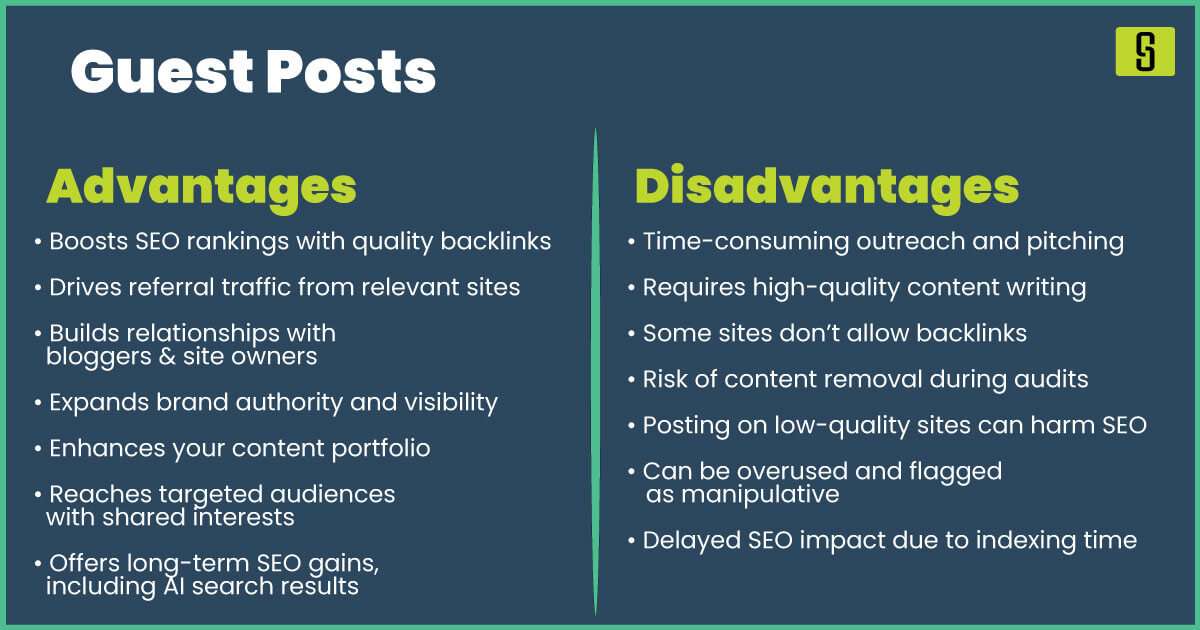
Guest posting is still an effective strategy, despite what Google says.
Think about it:
If it didn’t work, why would there still be an active marketplace around it?
Some might argue that manipulation is the driving force, but in my experience, as well as that of many other link builders, that’s not the whole story.
Guest posting continues to deliver results when done right.
That being said, here are the pros that make guest posting one of the most popular link building strategies today:
- Improves search engine rankings through quality backlinks.
- Increases referral traffic from relevant websites.
- Builds relationships with other site owners and bloggers.
- Expands brand visibility and authority in your niche.
- Improves the content portfolio and online presence.
- Targets a relevant audience with shared interests.
- Often leads to long-term SEO benefits and appearances in AI search results.
Disadvantages of Guest Posting
Still, guest posting isn’t without its challenges. Here are some of the drawbacks to keep in mind when choosing between niche edit links and guest posts:
- It can be time-consuming to find and pitch suitable sites.
- It requires high-quality content creation.
- Not all websites that accept guest posts allow backlinks.
- There is a risk of an article being removed later during a content audit.
- Poorly chosen sites can harm SEO if they are low-quality or spammy.
- Guest posts can be overused and flagged by search engines if done unethically.
- Search engine crawlers need time to check and index new content, and it may take time for it to appear in search results.
What Are Niche Edits?
Niche edits links (also known as curated or contextual links or link insertions) are typically added to already published content on a website.
Think blog articles related to your niche, listicles, resource pages, and any other page that would organically hold your backlink.
Link insertion strategy works a little differently compared to guest posting. Here’s how I approach it:
- When I find relevant and authoritative websites, I reach out to the site owners or editors with a friendly pitch, suggesting where my link could naturally fit.
- If they’re open to it, I might suggest minor edits to the content so that the backlink aligns with the article’s context and my target anchor text.
- Once approved, they update the article with my link.
- I double-check that the link is dofollow and placed within relevant, meaningful content.
- Finally, I monitor the performance of the backlinks and periodically check to see if the link has been removed.
Advantages of Niche Edits
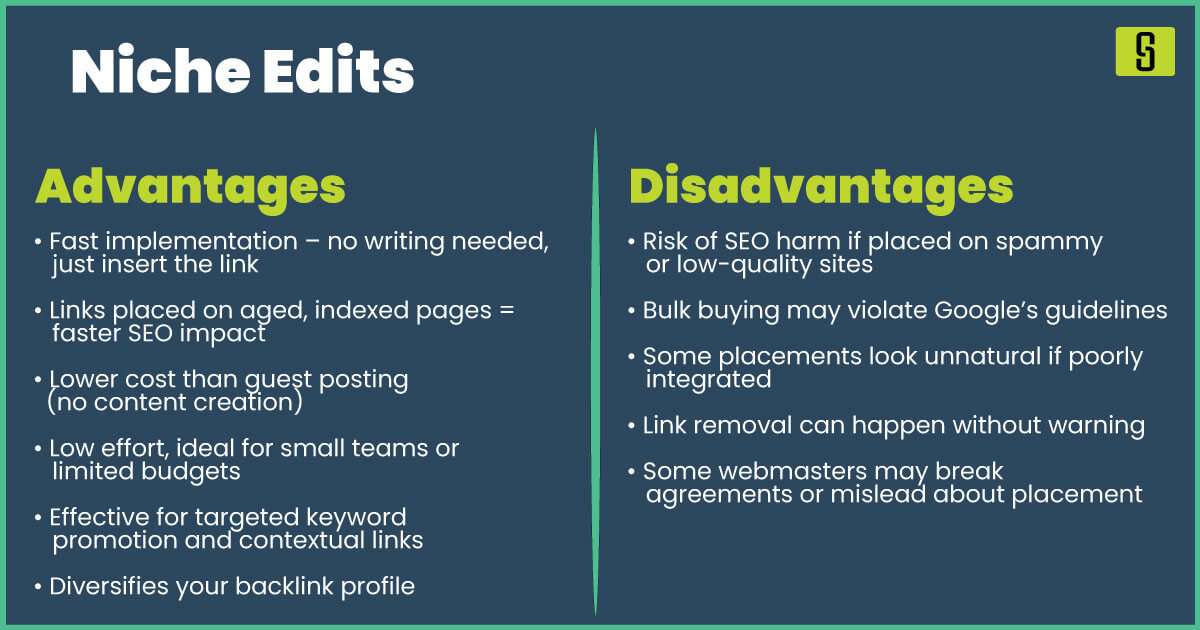
Do niche edits work in SEO?
Yes, they do, and here is why:
- Quick to implement by inserting links into existing content with no writing required.
- Placed in aged, indexed pages, which often leads to faster SEO results.
- More affordable than guest posts, with no content or editorial costs.
- Low effort and resource-friendly, ideal for smaller teams or tight budgets.
- Great for promoting specific pages or targeting particular keywords with contextual link placement.
- Helps diversify your backlink profile with contextual links.
Disadvantages of Niche Edits
However, niche edits can be a bit riskier than other tactics, and here’s why:
- If done on low-quality or spammy sites, it can harm your SEO.
- Buying niche edits in bulk can violate Google’s guidelines if not done naturally.
- Some edits may look unnatural if not well-integrated into the content.
- Links can be removed later without notice.
- Some webmasters may not be fully honest about link placement and violate agreement terms.
What helps me avoid these issues is working with trusted link providers and building long-term partnerships with reliable link builders I’ve come to know over the years.
Guest Posts vs Niche Edits: Side-by-Side Comparison
Over the years, I’ve used both guest posts and niche edits in different campaigns, and each has its strengths depending on the goals.
Based on what’s worked (and what hasn’t), here is a detailed guest posts vs niche edits comparison to help you choose the right approach for your link building strategy:
| Aspect | Guest Posts | Niche Edits |
|---|---|---|
| Content Creation and Control | Full control over content and backlink placement. | Little control; link added to existing content. |
| Speed and Scalability | Longer process; slower but sustainable growth. | Faster backlink acquisition; easier to scale. |
| Cost and Resources | Higher cost and effort due to content creation and outreach. | Lower cost due to less manual effort. |
| SEO Impact and Use Cases | Builds brand authority and topical depth over time. | Adds links to established pages for quick ranking boosts. |
| Risk Factors | Risk of penalties if done poorly or at scale on irrelevant sites. | Risk of link removal or penalties from low-quality placements. |
1. Guest posts give you control over content, while niche edits offer almost none
With guest posts, you have control over the content you create. You only need to follow the guidelines established by the host website’s webmasters. Other than that, you are allowed to tailor the message and naturally integrate backlinks. This is especially relevant since search engines analyze the surrounding text and context of a backlink to determine its relevance to the linked page.
In contrast, niche edits give you little to no influence over the existing content, as you are only asking for a link insertion into an already published piece. You can request an edit; however, from my experience, very few high-authority websites agree to it. You can imagine how restrictive it can be to find a context that fits your link naturally.
2. Niche edits are faster and easier to scale, while guest posts build lasting value
Niche edits typically allow for faster backlink acquisition since you don’t have to create new content. This also makes scaling easier because the process is more straightforward and less time-consuming.
Guest posts, on the other hand, require topic research, writing, pitching, and approval, which can take weeks or months. They, however, often generate more sustainable benefits, especially if your article ranks high in Google results. In my experience, while the time investment for guest posts is higher, they help build stronger authority.
3. Guest posts require more resources and cost, while niche edits are lighter on both
Guest posting usually involves higher costs. If you don’t have a content writer in-house, you might need to hire someone externally. And even if you do have someone, they need to dedicate extra time to guest post writing. Outreach efforts and negotiations with site owners also take time. Therefore, you need to consider these factors to avoid disrupting your internal processes.
Niche edits tend to cost less and require less manual effort. The main time consumer is the outreach and communication.
External guest post link building services tend to be slightly more expensive due to the prices associated with content creation.
4. Guest posts are better for long-term authority, while niche edits deliver faster SEO impact
Guest posts help build brand authority and topical depth by contributing original content to relevant websites. They support a diverse backlink profile and can attract referral traffic over time.
Niche edits, on the other hand, place backlinks in pages that already rank and get traffic. From what I’ve seen, they tend to have a faster SEO impact, especially when used to support existing content.
5. Both methods carry risk, but poor execution can quickly lead to penalties in both cases
Generally speaking, link building involves certain risks. Google’s guidelines on what constitutes spammy or manipulative practices are somewhat vague and easy to cross.
Overusing niche edits or placing them on low-quality sites can lead to penalties or reduced link value.
I’ve also seen links getting quietly removed after a few months, which makes it important to monitor them.
Guest posts have risks, too—especially when done at scale without caring about quality or relevance.
I avoid low-effort outreach, as it can harm both the rankings and the reputation of the website I’m working on.
How to Choose Between Niche Edits and Guest Posts
When deciding between niche edits and guest posts, it all comes down to:
- Your existing SEO strategy and goals
- Timeline
- Available resources
Both strategies aim to help search crawlers discover, understand, and rank your content. But essentially, they achieve this through different means—one by inserting links into existing authoritative pages, and the other by creating new, value-driven content from scratch.
When to Choose Guest Posts
In my experience, guest posts are best when you want to:
- Build long-term authority and trust in your niche through thought leadership
- Reach new audiences and develop relationships with other website owners
- Have control over content and messaging
- Invest in high-quality, original content that supports your brand
This strategy is ideal if you don’t mind slow growth and can dedicate time to content creation and outreach.
When to Choose Niche Edits
Niche edits are a good fit if you:
- Want fast SEO results without creating new content
- Work with a limited budget or a small team
- Need to improve rankings for specific pages or keywords quickly
- Prefer links placed on existing, well-established content
Niche edits are one of the most commonly used link building strategies today, and they work well as a tactical way to support broader SEO efforts and target specific keywords.
Combining Niche Edits and Guest Posting For Maximum Impact
In my experience, to maximize your SEO success, it’s best to combine niche edits and guest posting.
Each strategy brings something different to the table, and when used together, they help create a well-rounded backlink profile that supports both short-term gains and long-term growth.
How to Integrate Both Strategies Effectively
Start with niche edits to quickly rank specific pages, especially if you’re targeting commercial or money pages that already have some traction.
At the same time, consider investing in guest posting to create high-quality, evergreen content on authoritative websites. This not only strengthens your domain authority but also earns referral traffic.
I strongly recommend using your SEO performance data to guide your mix. If you’re seeing quick wins from niche edits, consider scaling them up. And if time or budget allows, use guest posting to balance your backlinks profile.
Pro tip:
It’s essential to maintain quality across both strategies. Don’t treat either as a shortcut. Instead of trying to cheat the algorithms, focus on relevance, context, and link placements that benefit your website in the long run.
Common Mistakes To Avoid With Both Strategies
It’s hard to say which strategy is better if mistakes keep holding you back.
Here are the common mistakes I learned to watch out for while practicing niche edits and guest posting:
- Paying attention only to Domain Rating (DR): This metric shows the strength of a website’s backlink profile. But it’s not set in stone—DR is a relative number and can be easily manipulated. Unfortunately, shady link vendors take advantage of this by selling “high DR backlinks” that, when you check them out, are clearly from fake websites.
- Ignoring poor content quality: You don’t want to be associated with a website that posts mediocre and often AI-scraped content. This can damage your brand and reduce the effectiveness of your backlinks.
- Overdoing outreach: It’s not a good practice to mass pitch without personalization. From my experience, this is a direct route to rejection and wasted effort.
- Neglecting guidelines: Failing to follow the host site’s rules, such as skipping their content guidelines or requesting major edits, often means losing the opportunity to get published or having your post and links removed later.
- Not monitoring links after publishing: It’s not as uncommon as you think. By failing to check if links remain active, you risk losing valuable backlinks.
- Lack of context: Placing links where they don’t fit naturally reduces their SEO impact.
- Not keeping your word: I’ve seen many link deals fall apart because one side doesn’t follow through, like when you agree to a free guest post exchange but then fail to deliver. Building trust and honoring these agreements is crucial to maintaining strong relationships and achieving long-term success.
Best Practices From Experts
I asked SEO experts for their takes on guest posts vs niche edits—specifically, which strategy they favor and the results they’ve seen in real campaigns. Here’s what they shared:
“One recent campaign for a travel niche client involved a mix of:
– guest posts on DR 40–70 sites
– 12 niche edits on DR 30–50 blogs with existing keyword rankings
The results after 90 days:
– Guest posts brought more keyword movement (~34% faster growth)
– Niche edits delivered quicker indexation and referral traffic
We used tools like Ahrefs, SurferSEO, and Postaga for prospecting and outreach. Internal metrics showed an average 15% boost in organic sessions and 40+ new keywords in the top 20.” — Muhammed Fawas, SEO Analyst, dExito Branding
“I’ve built links to my websites predominantly through guest posting and PR. I’ve avoided niche edits mainly because of the spammy, shady nature of the industry. I’ve found that too often with niche edits, the links are from link farms, low-quality sites, with absolutely zero relevance to the site. With guest posting, I feel so much more in control. I decide who I’m pitching to, where I want my words to feature, and what websites I would like to link to mine. I want to build authority, not a web of spam, and in my experience, the best way to do that is to roll up your sleeves and do the work. And, again, in my experience, my guest posts have yielded far more in terms of SEO effectiveness than cheap low DA niche edit links – instantly making them more resilient to the constant algo updates.” — Aly Johnson, Head of Content, Assertive
“We did an A/B test in 2023 with two almost similar SaaS clients:
– The guest post strategy saw 27% more keyword gains and referrals
– The niche edit route saw quicker short-term ranking, only to plateau post those link spam updates by Google
Host posts should be a matter of quality control: not just DR but audience match, traffic of late, and link velocity.” — Anatolii Ulitovskyi, Founder, UNmiss.com
So, Niche Edits or Guest Posting?
The answer to the guest posts vs niche edits dilemma depends on your SEO goals and current resources.
If you need quick SEO wins and have limited resources, I’d lean toward niche edits. They’re faster, cheaper, and perfect for boosting specific pages.
For long-term authority building and brand visibility, guest posts are worth the extra time and investment.
In my experience, combining both works best. Just remember—quality beats quantity every time, regardless of which method you choose.
FAQ
Are niche edits better than guest posts?
Neither is definitively better—it depends on your goals. Niche edits yield faster results for quick SEO benefits, while guest posts provide more sustainable outcomes. Use both depending on what you’re trying to achieve.
How do niche edits impact SEO speed compared to guest posts?
Niche edits typically show results faster because they’re placed on already-indexed, established pages. You can see ranking improvements within weeks. Guest posts take longer since search engines need time to crawl and index new content, but the results tend to be more sustainable.
What are the risks of Google penalties with each backlink method?
Both carry risks if done poorly. Niche edits can get penalized when placed on low-quality sites or done in bulk without context. Guest posts risk penalties when they’re clearly manipulative or published on irrelevant sites. Quality and relevance are key for both.
How does Google detect paid backlinks?
Google looks for patterns, like sudden link spikes, irrelevant placements, poor anchor text distribution, and links from known link farms. The solution is to make links look natural and contextually relevant, regardless of whether they’re paid.
Why might small businesses prefer niche edits over guest posts?
Simple: time and budget. Small businesses often can’t dedicate resources to content creation and lengthy outreach. Niche edits are faster, cheaper, and require less hands-on management—perfect when you need quick wins with a limited budget.