In a world where every brand is fighting for attention, the real challenge is finding a way to stand out without spending big budgets.
That’s where newsjacking comes in.
But what is newsjacking? And how can it help you break through the noise?
I’m Bilyana, and as a digital PR specialist with 3 years of hands-on experience, I’ve seen how this tactic can turn trending stories into real opportunities for visibility, backlinks, and authority.
In this article, I’ll show you:
- How newsjacking works
- Why it’s still effective
- And the practical steps you can use to make it part of your digital PR strategy
Let’s get started.
Highlights
- Newsjacking means inserting your brand into trending stories to gain visibility and coverage.
- The main benefits include media mentions, quality backlinks, thought leadership, and cost-effective exposure.
- To succeed, focus on stories relevant to your expertise, monitor the news daily, and act fast.
- You can newsjack through PR outreach, social media, blog posts, videos, visuals, and more.
- Always track performance (traffic, backlinks, engagement, leads) to improve future campaigns.
What Is Newsjacking?
Newsjacking is when a brand, business, or even an individual jumps on a breaking news story and uses it to get visibility, media coverage, and traffic.
It’s real-time marketing in action. When something big happens, the media is hungry for new angles. This is when you can step in with a clever take or a useful comment. Before you know it, your brand goes viral.
Sounds powerful, right?
That’s because it is.
This graph from David Meerman Scott’s book “Newsjacking: How to Inject Your Ideas into a Breaking News Story and Generate Tons of Media Coverage” perfectly describes what newsjacking is in PR:
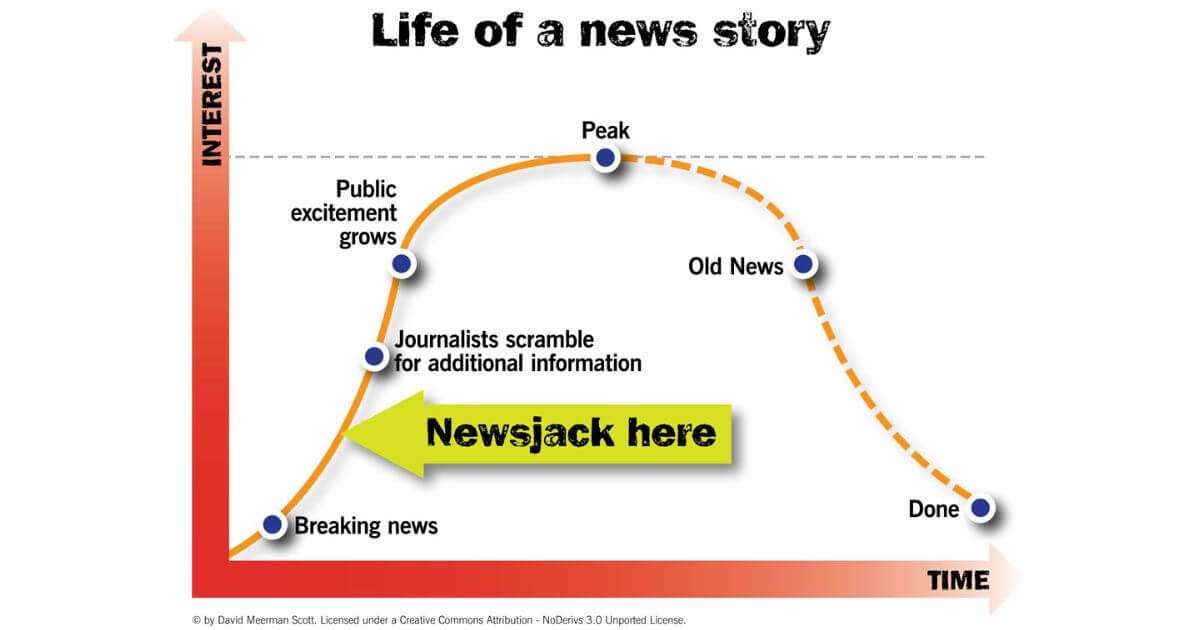
The whole point of newsjacking is speed. You’re essentially “hijacking” the news cycle while everyone’s attention is laser-focused on a trending story. Done right, it puts your brand in front of an audience that you normally wouldn’t reach.
Newsjacking vs Reactive PR—Are These Two The Same Thing?
The answer is: not exactly.
Newsjacking is a type of reactive PR, but the two aren’t identical:
- Reactive PR is the broader strategy of responding to external events, media inquiries, or breaking news stories.
- Newsjacking is a specific tactic within reactive PR where you creatively insert your brand into a trending story to earn coverage and visibility.
Reactive PR is a type of digital PR strategy. The latter typically falls into two main categories:
- Reactive PR: Responding to what’s already happening in the news or public conversation. This includes expert commentary, data drops, crisis response, or clarifications that help shape the narrative.
- Proactive PR: Creating your own stories that set the agenda. This could be launching original research, building a data-led campaign, or pitching a trend report before anyone else is talking about it.
Each of these strategies is powerful and effective. But, if you’re just starting out, newsjacking is often the easier way in. Journalists are already covering a hot story and actively looking for sources, which means your odds of landing coverage are much higher.
Does Newsjacking Still Work in 2025?
Yes, it absolutely does.
In fact, newsjacking is more relevant than ever. The news cycle is faster, journalists are under more pressure to publish quickly, and fresh expert voices are always in demand.
Let me give you a recent newsjacking example.
Here is an article by Editorial.Link published this year, where our founder, Nikola, shared his thoughts on one of the hottest topics in SEO right now—how to get featured in AI search engines.
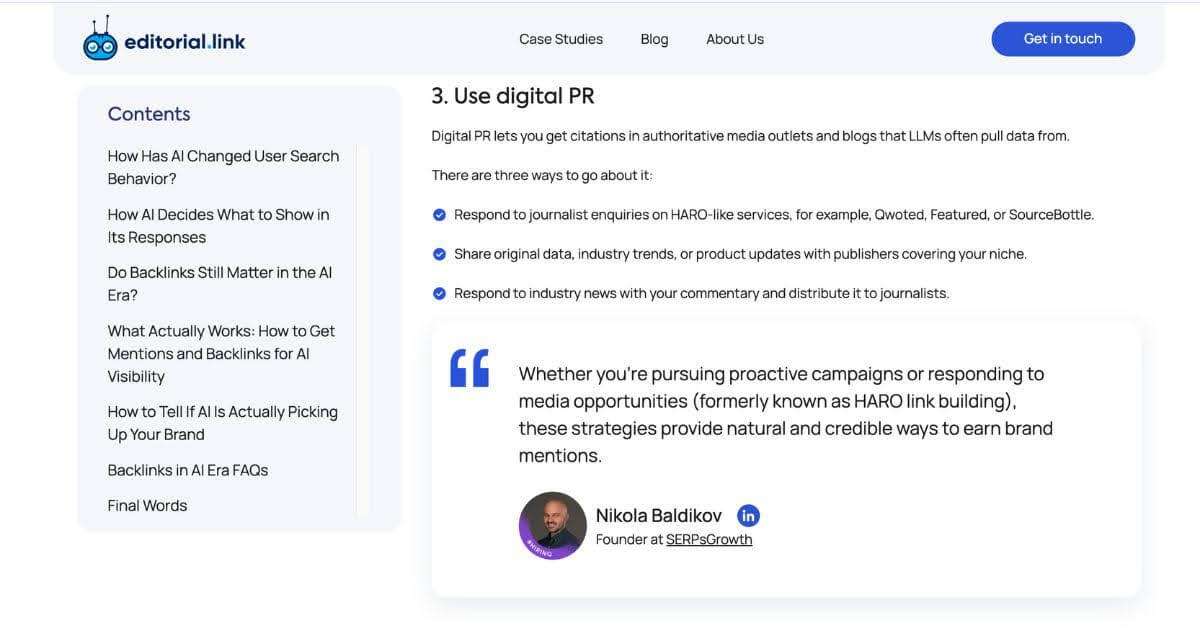
A trending story was already taking shape, and Nikola jumped in with insights that the editors could use.
As a result, he gained media coverage, the SERPsGrowth website got a backlink (from a DR 71 website), and our brand captured the attention of exactly the right audience.
What Are The Benefits of Newsjacking in Digital Marketing?
So, why should a brand care about newsjacking in the first place?
Because when you give it a try, the results can be surprisingly beneficial. Let’s take a look at them.
1. You Get Your Brand Mentioned in Top-Tier Media Outlets
Imagine landing a mention in Forbes or TechCrunch just because you added a quick expert comment on a trending story. That’s what newsjacking does. It gets your opinions in front of journalists who would never have found you otherwise.
2. Your Website Earns High-Quality Backlinks That Improve SEO
Every time a journalist links back to your site, it’s another signal to Google that it’s trustworthy.
What’s more, those links don’t just boost traffic short-term—they improve rankings for months after. Over time, you build a healthier backlink profile with links from diverse and authoritative domains.
3. You Establish Your Brand as a Thought Leader
And the more often you’re quoted in the media, the easier it becomes to get featured again because credibility builds on itself.
Just think about it:
When you react quickly to trending stories with smart commentary, journalists and readers start seeing you as the go-to expert in your field.
Over time, this consistency positions your brand as more than just “another company”—it turns you into a trusted authority.
4. Newsjacking Tends to Be More Cost-Effective and Timely Than Other PR Campaigns
Most PR campaigns require weeks of planning, creative assets, and big budgets.
Newsjacking is different. All you really need is speed, insight, and the right distribution channel.
Because you’re piggybacking on a story that’s already generating attention, you save both time and money while still earning coverage that rivals larger, more expensive campaigns.
How Can Brands Jump On Breaking News?
Newsjacking sounds exciting, but let’s get practical: How do you actually do it?
Here are the best practices that will help you to make the most out of it:
1. Identify The Areas of Your Expertise
Start with what you know best. Think about the topics where you can naturally add value.
If you’re a fintech company, jumping into a trending celebrity scandal isn’t going to do much for you. But sharing insights when the markets shake? That’s your lane.
And here’s the golden rule that will land media mentions:
Don’t force it.
Opportunistic newsjacking might get you attention, but it won’t build credibility. Instead, always aim to provide genuine value or insightful commentary.
2. Monitor News
The earlier you spot a story, the easier it is to jump into a news cycle before it moves on.
Here are some tips and tools for newsjacking you can use:
- Set up Google Alerts for your most relevant industry keywords and journalists.
- Check Google Trends daily to catch emerging topics.
- Use Twitter/X lists to follow journalists in your niche and see what they’re talking about in real time.
- Check news aggregators to catch emerging stories.
- If your budget allows, use media monitoring tools like Muck Rack for instant alerts on breaking stories.
3. Be Both Proactive and Reactive
Newsjacking works well when you expand your reach:
Proactive PR
Proactive PR is about creating opportunities before the news cycle peaks. It’s not just predicting stories; it’s preparing ways to expand them:
- Plan content around predictable events, such as policy announcements, seasonal events, and product launches.
- Commission quick surveys and release your own deep research on an ongoing conversation.
- Highlight the impact of a trend on a specific audience.
- Pitch journalists fresh angles they might not have considered yet.
Done right, proactive PR allows you to not just react but also drive the narrative. You’re showing up early with insights, yes, but you’re also pushing the story forward in ways that make your brand the go-to source.
Reactive PR
When unexpected news breaks, you can use journalist-request platforms to get your expert voice out quickly.
The most famous platforms are:
All of them are free to use, with optional subscription plans if you want extra features. Honestly, the free versions are more than enough to get started.
4. Create Compelling Content
The newsjacking strategy goes beyond pitching to journalists. You can also publish your own content about the trending news.
Here are newsjacking ideas you can try:
- Write a quick blog post that explains the news in plain language and why it matters for your audience.
- Turn the story into social media content. A short LinkedIn post, X (Twitter) thread, or Facebook or Instagram carousel with a clear “so what” can travel fast when people are searching for quick answers. You can even turn it into an ad campaign to gain traction.
- Add a data or visual angle. Use a chart, poll, or infographic to make your content more shareable. Even a simple “before and after” stat can help your post stand out.
- Record a short video. A 60-second explainer for TikTok, Instagram Reels, or YouTube Shorts summarizing the story and your take can reach people who don’t read blogs.
- Connect the news to your evergreen resources. At the end of your piece, link back to deeper guides or service pages. That way, the traffic you capture during the spike flows into your long-term content.
5. Monitor Performance and Adapt
The real learning starts after you hit publish. That’s why I always look closely at how a newsjacking campaign performs—not just if it got attention, but what kind of attention it drove.
It’s easy to set KPIs, but you need to know what stands behind them. Here are the questions I ask myself after every campaign:
- Did we see a spike in traffic after the campaign went live? If yes, where did that traffic come from: organic search, social, or referral links?
- Did we earn backlinks from relevant publications? Not just any links, but ones that improve our authority in the niche.
- Did the story perform on social? Shares, comments, and reposts are a clear sign that the angle resonated with people.
- Did the right audience engage? Traffic is great, but was it our target buyers, decision-makers, or industry peers?
- Did we get any direct outcomes? New leads, journalist follow-ups, or partnership opportunities are just as important as clicks.
Those signals tell you what worked, and, just as importantly, what didn’t.
And here’s the part I love about newsjacking: it’s a repeatable process.
Each time you do it, you get feedback. If a stat-driven post lands coverage but a witty tweet falls flat, you know where to double down next time.
Over time, the patterns become clear, and you’ll refine your timing, your angles, and your formats with each story you jump on.
What Industry Experts Say About Newsjacking
I questioned digital marketing experts, and here are some interesting takes that stood out.
Barbie Ann Jurolan, Head of SEO and Content at Which Real Estate Agent, believes newsjacking has shifted from being a “nice-to-have” to a core strategy for visibility. She argues that the faster pace of today’s news cycle means audiences are hungry for simple, timely explainers, and brands that provide them win attention and trust. Jurolan emphasizes connecting stories back to useful evergreen content to capture both short-term visibility and long-tail SEO gains:
“Newsjacking works because it’s audience-first. If you move quickly, explain the ‘so what’ in simple terms, and connect the moment back to helpful resources, you’ll lift rankings, engagement and links without gimmicks.” — Barbie Ann Jurolan, Head of SEO and Content, Which Real Estate Agent
Kathryn Goater, Co-founder and Co-CEO at Media-Wize, stresses the reputation side of newsjacking. For her, it’s not about backlinks but about positioning spokespeople as thought leaders. She warns that ambulance-chasing or competitor criticism can backfire, and notes that coverage in credible outlets increasingly boosts visibility not just in media but also in AI-driven search results:
“Newsjacking works if not ambulance chasing or criticising competitors otherwise it can backfire. It links organisations to topical breaking news when journalists are looking for agnostic, best practice advice… The aim should be to position the organisation and spokespeople as thought leaders and subject matter experts to boost brand, visibility and credibility.” — Kathryn Goater, Co-founder and Co-CEO, Media-Wize
Lillian Pierson, Fractional CMO, highlights newsjacking as a shortcut to relevance, particularly with younger audiences who consume information in short-form formats like videos and tweets. She links its effectiveness directly to SEO, explaining that fresh, timely content boosts rankings, traffic, and shares — and she’s seen firsthand how a quick response can earn high-quality backlinks:
“Newsjacking’s popularity has surged because it works… When a brand publishes content related to a trending news story, it has a higher chance of ranking for relevant keywords. Additionally, timely content is more likely to be shared across social media, which drives traffic back to the website and improves its domain authority.” — Lillian Pierson, Founder and Fractional CMO, Data-mania.com
Put simply, experts emphasize that newsjacking isn’t just about being the first to react. It’s about adding clarity, protecting your brand’s reputation, and using trending topics to boost both your SEO and long-term credibility.
Wrap Up
So, what is newsjacking in digital marketing?
At its core, it’s a powerful tool that lets brands show up at the right time, in the right place, with the right message.
When you pair speed with genuine insight, you don’t just chase trends. You build authority, attract backlinks, and get your brand mentioned in places that matter.
And because the news cycle never sleeps, opportunities are endless if you know how to spot them.
FAQ
How soon after a story breaks should I newsjack it?
As quickly as possible. The first 24–48 hours of a story are critical. That’s when journalists are looking for expert voices and fresh commentary. If you wait too long, the news cycle will move on, and your input won’t be relevant anymore.
What risks could harm my brand when I newsjack?
The biggest risk is looking opportunistic or tone-deaf. Jumping into sensitive stories without adding genuine value can backfire. It’s important to pick stories that align with your expertise and speak from a place of authority, not self-promotion.
How does newsjacking improve SEO and backlinks?
When your brand gets quoted in articles, those mentions often come with backlinks to your website. These links are high-quality, editorial links from trusted publications. Over time, this strengthens your backlink profile and helps your site rank higher in search.
How can I monitor trends to spot newsjacking chances?
Start simple: set up Google Alerts for industry keywords, follow journalists on Twitter/X, and check trending hashtags.
Is using newsjacking good to raise brand awareness for a small or solo business?
Yes, it can be. In fact, it can be one of the most cost-effective ways. You don’t need a big marketing budget to share expert commentary or react quickly to trends. If you consistently show up with smart insights, people will start recognizing your name.