When people hear “link building,” they often imagine shady tactics, spammy directories, or buying links under the table. But white hat link building is the complete opposite.
I’m Elena, and after five years in the field, I can say with confidence that trying to trick Google rarely works out the way you want. If you want rankings that last, you have to play by the rules—and that’s exactly what white hat linking is about.
In this article, I’ll break down:
- What white hat backlinking really means
- How it stacks up against black hat and grey hat tactics
- And the strategies I use every day to build links the right way
Let’s jump right in.
Highlights
- White hat link building is sustainable SEO because it earns links by adding value instead of manipulating the algorithms.
- Black hat tactics may bring quick results, but they carry high risks of penalties or even deindexing.
- Grey hat tactics can work short term, but one Google update can wipe out your progress.
- The most effective white hat tactics today are linkable assets, guest posting, broken link building, HARO, and digital PR.
What Is White Hat Link Building?
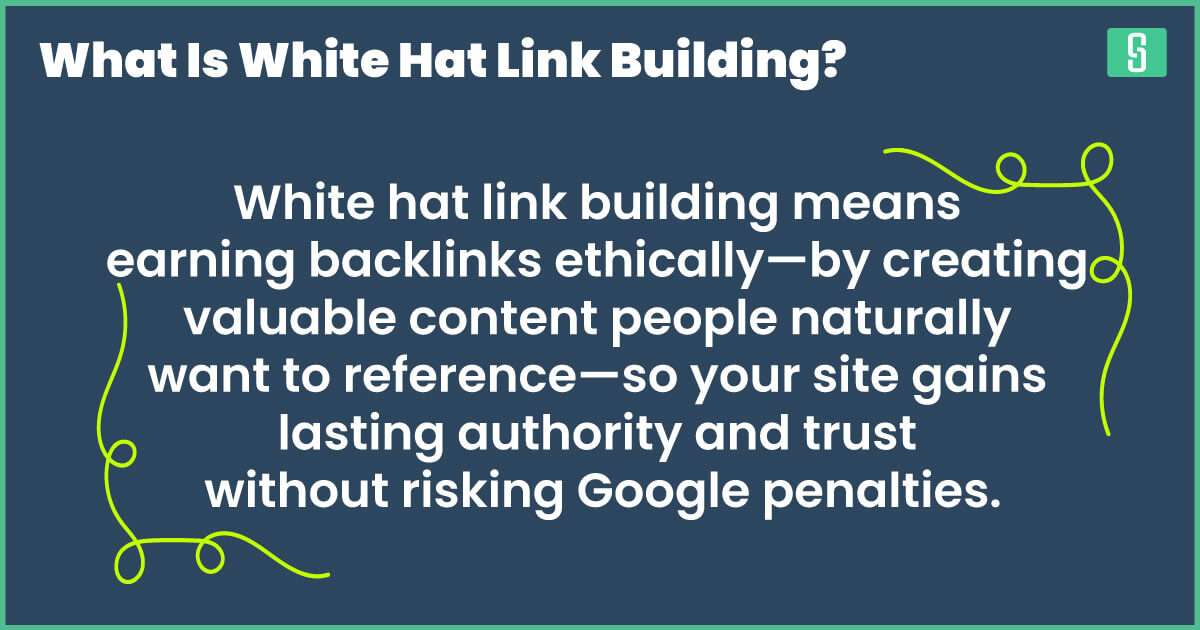
White hat link building is the practice of earning backlinks through strategies that are:
- Ethical
- Transparent
- Fully aligned with Google’s Webmaster Guidelines
Instead of buying links or engaging in manipulative tactics, SEO experts who employ white hat link building techniques invest their time in building meaningful content or useful resources that people want to link to.
But why does earning high-quality white hat links matter so much?
Because in SEO, shortcuts rarely last.
You see, black hat tactics can (and do) bring a quick bump in rankings, but they put your site at risk of penalties.
As soon as Google rolls out yet another Spam Update, those gains might vanish overnight. And in some cases, your entire domain can get hit.
White hat link building, on the other hand, is the sustainable path: you build authority, trust, and rankings that stand the test of time.
White Hat vs. Black Hat vs. Grey Hat Links
Google has been crystal clear: their spam policies discourage earning links unnaturally.
But what does it mean exactly?
To answer that, let’s break down the three main approaches to link building:
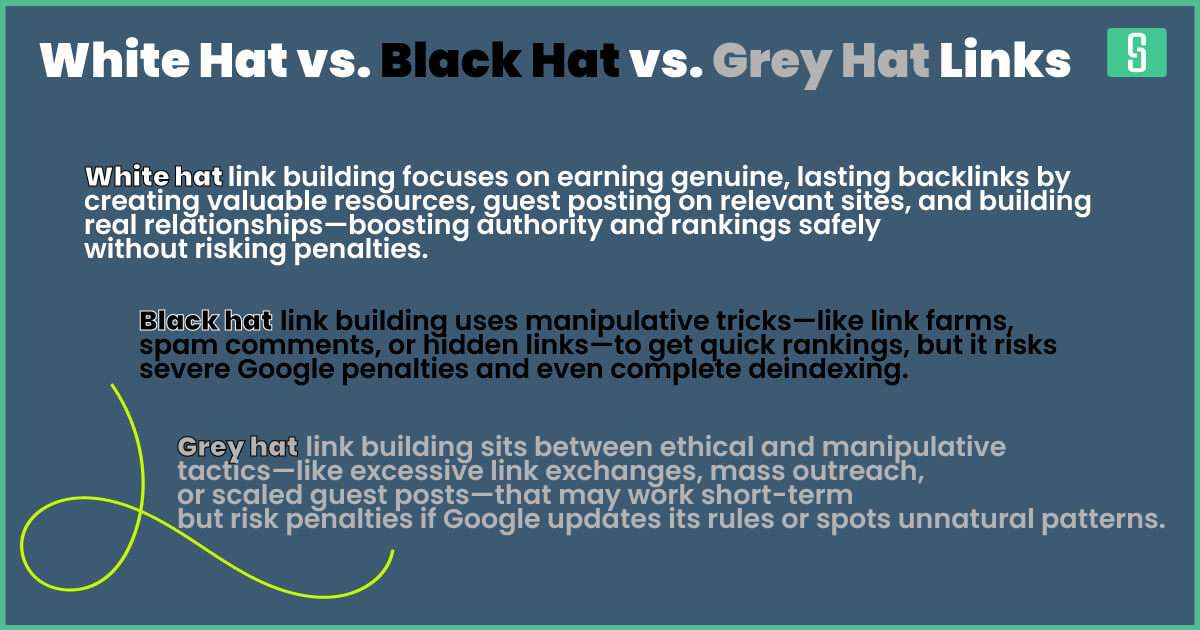
White Hat Tactics
So, what are white hat links?
Those are links that are obtained using sustainable methods. The goal is to avoid quick link grabs here and there and build real authority in your field so that people genuinely want to reference your work.
White hat backlink building can look like:
- Guest posting on blogs relevant to your industry.
- Creating helpful resources (like data studies or guides) that people would love to link to.
- Building connections that lead to cross-references and natural mentions.
Ultimately, white hat link building strategies are all about adding value to the web.
Sure, it takes longer than other tactics, but every link you earn this way is solid, future-proof, and actually boosts your search rankings instead of putting your whole website at risk.
Black Hat Tactics
This is the “dark side” of SEO link building. Instead of putting in the work to earn links naturally, black hat tactics focus on finding loopholes to exploit.
Think of it as:
- Link farms or Private Blog Networks (PBNs)
- Automated spam comments on blogs and forums.
- Sneaking links into plugins or themes.
- In extreme cases, even hacking other websites to drop backlinks.
Do they work?
Honestly, yes—at least for some time. Those strategies can push your website up the search rankings quickly, but the risks are too high.
If Google catches on (and they do more often than not), you can face manual actions, or so-called “penalties.” They range from losing your hard-earned rankings to having your site deindexed entirely.
Is buying links considered black hat?
Technically, yes. Buying links falls under black hat because it goes directly against Google’s guidelines.
But let’s be honest: it’s incredibly common in the SEO world.
Many websites do it. And when you obtain links from niche-relevant sites, it can be hard to detect manipulations.
That’s exactly why, if you want to buy links, I recommend finding a company that primarily focuses on high-quality, relevant placements. The ones that look like genuine white hat backlinks.
It takes more effort up front, but it gives you sustainable results without the constant risk hanging over your head.
Grey Hat Tactics
As you might have guessed, this is the messy middle ground. Search engine guidelines aren’t always crystal clear, and some rules are open to interpretation. That’s where grey hat tactics come in.
Grey hat covers strategies that don’t directly break the rules, but they push the limits of Google’s guidelines and can raise red flags if overused.
In fact, many of the link building methods used today fall into this category.
Some common examples include:
- Link exchanges that go beyond natural partnerships.
- Large-scale email outreach where the “value” of the link isn’t obvious.
- Guest posting done at scale purely for ranking gains.
They can deliver results in the short term, but the danger is that you’re still walking a fine line.
One algorithm update, or even just a shift in how Google evaluates link patterns, can wipe out those gains.
In other words, grey hat can feel safe for a while, but the closer you edge toward black hat territory, the harder it is to recover if things go wrong.
Core White Hat Link Building Strategies
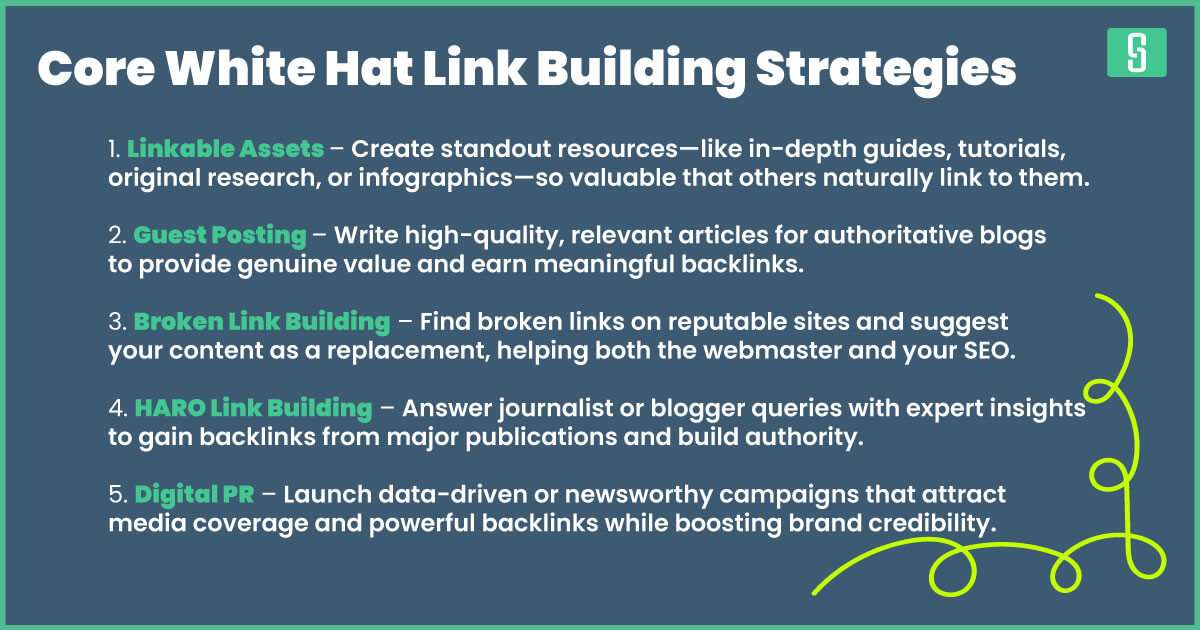
Now that we’ve covered the different methods of link building, let’s focus on the one that actually stands the test of time: white hat SEO link building.
These are the industry standards that I’ve leaned on for years because they deliver results without putting a site at risk.
1. Linkable Assets
At the heart of white hat link building is creating content so valuable that people want to link to it. These are your linkable assets. This tactic involves creating:
- In-depth guides that become the go-to resource in your niche.
- Step-by-step tutorials that solve a real problem.
- Original research or data studies that others can cite.
- Visual assets like infographics or charts that make complex info easy to digest.
If you want to know more about this white hat link building tactic, you can read our guide to linkable assets.
2. Guest Posting
Despite what you might read online, guest posting is still very much alive.
The reason some people dismiss it is because they’ve seen it done badly.
Instead of targeting industry-relevant blogs with real authority and engaged readers, many link builders go after any site that’s willing to publish their content, and the results are (predictably) weak.
When done right, though, guest posts are still powerful.
Real guest posting is about creating valuable, actionable content that genuinely helps the host site’s audience and naturally weaves in backlinks where they make sense.
That way, everyone wins: the site gets quality content, readers get useful insights, and you earn a link that actually matters for your website’s SEO.
3. Broken Link Building
This tactic is one of my personal favorites.
In broken link building, you look for broken links—links that point to pages that no longer exist or can’t be accessed—on authoritative sites in your niche. Then, you reach out to the webmaster and suggest your content as a replacement. They get to fix a dead link, and you gain a quality backlink.
With the right tools (Ahrefs, Screaming Frog, or even free checkers), it’s straightforward and not that hard to do either.
4. HARO (Help A Reporter Out) Link Building
HARO link building is a smart strategy that started with Help A Reporter Out, a platform that connected journalists with expert sources for their stories. By responding to journalist queries, you could land high-authority backlinks from major publications.
While HARO has changed over the years, there are alternatives like Qwoted, Featured, MentionMatch, and even direct journalist outreach on Twitter or LinkedIn.
The logic is simple:
You sign up, respond to journalist queries with insightful commentary, and if selected, you land a backlink from a reputable publication.
Over time, this can also establish you as a trusted voice in your field. It takes consistency, but the payoff—links from high-authority media outlets—is worth it.
5. Digital PR
Digital PR started out as a traditional public relations tactic.
But SEOs quickly realized something:
Every time a journalist mentioned a brand in their story, it opened the door to a high-quality backlink placement. That’s how digital PR grew into one of the most powerful link building strategies around.
By launching original studies, surveys, or data-led content, you create newsworthy hooks that journalists want to cover.
What’s more, digital PR isn’t just about link building. When done right, it earns you mentions in major publications and builds real brand authority. Think of it as blending marketing, PR, and SEO into one powerful strategy.
Bilyana, our digital PR master, has written a great article explaining what digital PR is and how you can implement it in your digital marketing strategy. I highly recommend checking it out.
Expert Opinions
And this isn’t just my take on it. To gain a broader perspective, I reached out to other link builders online and asked them to share their experiences with any white hat link building strategy. Here’s what some of the experts in the field had to say:
“White hat link building strategies remain highly effective today, but they require genuine value and relationship building rather than shortcuts. In my experience, guest posting and PR have consistently delivered the best results, especially when pitching relevant, timely content directly to established publications like The Guardian and Huffington Post.
I’ve found that approaches like niche edits often fall short because they rarely provide the same quality signals that search engines are increasingly prioritizing. The most successful link building now comes from creating content that publications actually want to feature, rather than trying to game the system with quantity-focused tactics. Publishers have become much more selective about the content they accept, making personal outreach and quality content more important than ever.” — Aly Johnson, Head of Content, Assertive
“White hat link building is still the only strategy that delivers sustainable results, but the tactics have shifted. Today, what matters isn’t just earning links, it’s earning the right links from niche-relevant, high-authority publishers. We helped a luxury home fashion eCommerce brand pivot from generic outreach to curated white hat placements, and within six months their organic traffic jumped by 150% while sales grew consistently. That success came not from chasing volume but from aligning outreach with editorial-quality content that real publishers wanted to feature.
The white hat tactics that work now are HARO-driven PR mentions, guest posts on industry-specific sites, and content partnerships where value flows both ways. What’s losing effectiveness are mass guest post exchanges and templated outreach campaigns. They may technically be “white hats,” but they no longer move the needle because publishers and Google have grown wise to them. White hat is alive, but it’s evolved into something slower, more strategic, and more ROI-driven.” — Alex Meyerhans, CEO, Get Me Links
Wrap Up
At the end of the day, link building always comes down to trust. Google wants to rank content that people genuinely find helpful, and white hat link building is the only reliable way to earn that trust.
Yes, it takes more time and effort than shortcuts. But the results are worth it: stronger authority, stable rankings, and a brand that keeps growing instead of worrying about the next penalty.
If you want to build links the right way, I would say white hat is the path forward.
FAQ
What white hat link building tactics are people using these days to boost DR without risking penalties?
The most common ones right now are guest posting on relevant blogs, creating linkable assets, and digital PR campaigns, including HARO journalist outreach. Broken link building is also still a strong option, especially in niches with lots of outdated resources.
Which white hat tactic drives the best ROI for small business blogs?
For small business blogs, I’ve seen the best ROI from creating linkable assets, usually in the form of helpful guides, checklists, or tutorials. You need content to rank your site anyway, so why not make it something people can also link to? A solid guide saves you time because it pulls double duty: it helps your audience, it works as a linkable asset for outreach, and you can even repurpose it into social media posts, email marketing, or lead magnets. One piece of content—multiple benefits.
Why does Google prefer editorially placed links over paid links?
Because editorial links are earned, not manipulated. Google’s ultimate goal is to show users the most relevant content. To figure out what deserves to rank, Google relies on algorithms that evaluate many signals, and inbound links are a big one. When a site owner or journalist chooses to link to your content, it’s a signal that your page has genuine value. Paid links, on the other hand, are meant to manipulate rankings. That’s why Google has always been clear: editorial links are the strongest and most trustworthy signals of authority.