EEAT isn’t a Google ranking factor itself, but it affects your SEO success.
While the concept may seem simple to some, I’ve noticed that many struggle to know where to begin. With ten years of experience as an SEO expert, I’m confident that applying EEAT principles correctly will drive organic growth for your online business.
I’ve created a practical EEAT checklist to help you better understand Google’s quality standards and how to apply the recommendations to rank higher.
Ready to feel the difference between ranking on page one and getting buried in SERPs?
Here, you’ll find exactly what you need to know.
Highlights
- EEAT is about showing that your website can be trusted—from content quality to brand perception and author reputation.
- Your reputation across the web matters just as much as what’s on your site.
- The checklist turns Google’s EEAT guidelines into clear steps you can apply to your SEO strategy.
What Is EEAT in SEO?
EEAT (Experience, Expertise, Authoritativeness, and Trustworthiness) represents a collection of signals that Google’s quality raters use to review search results.
Before December 2022, this concept was known as EAT. The extra “E” for Experience was introduced around the time of Google’s Helpful Content Update to better rate and assess the quality of webpages.
With this change, Google clarified that it prioritizes reliable and original content that comes from someone with personal knowledge of the topic, particularly those in the YMYL (Your Money or Your Life) category.
But what does it mean for SEO?
Google debunked EEAT being a ranking factor. However, since it is a part of search quality rater guidelines (and Google consistently emphasizes the importance of high-quality, human-centered content), it’s become clear that EEAT is significant for your site’s ranking potential.
My 13-Point EEAT Checklist
When I started researching this topic, I realized that while the concept is fairly straightforward and Google actually provides plenty of resources and guidelines on best practices to help you create helpful content, I still had to figure out how to apply all of this in our existing SEO strategy.
So, I started documenting my observations, and this is how the EEAT SEO checklist was created.
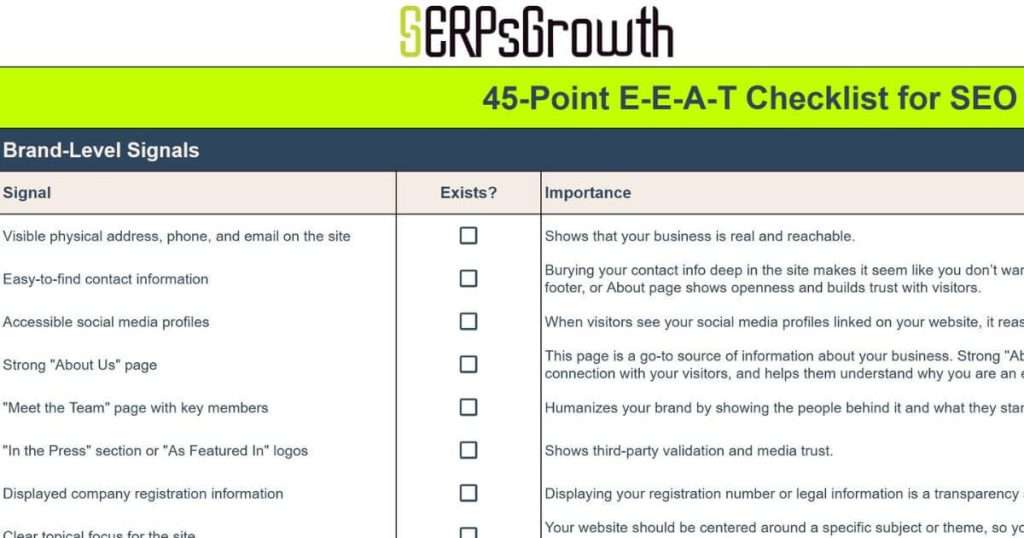
The checklist is divided into two parts: a guide that breaks down the main EEAT signals and a template with 45 points that you can download and directly assess your website’s EEAT score.
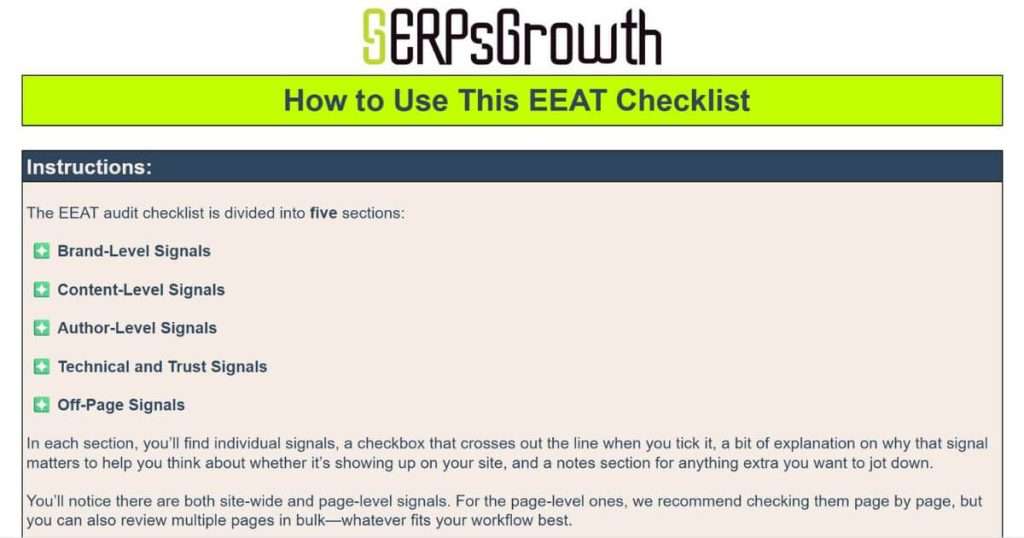
Brand-Level EEAT Signals
People usually look at more than one page of a site to decide if they can trust it. They’re also picking up on the overall feel and reputation of the brand behind it.
In other words, brand-level signals show your visitors that your website is credible and safe to browse and even purchase from.
Think about the impression you want your site to leave. How do you want people to see your brand? And most importantly, what can you do to show them they can trust it?
Here are some of my takes on how to strengthen brand-level signals:
1. Establish a Recognizable Brand Identity
Whenever people interact with your website, they should see reliable information and clearly understand what your business is about. Some of it include:
- Clear About Us page that shares your story, mission, values, and background.
- Team bios, founder profiles, or any other evidence showing that real people are behind your business.
2. Build Online Authority and Reputation
You can build trust through what others say about your brand. Therefore, I suggest the following:
- Aim for mentions and backlinks from credible, high-authority websites in your niche. These act as trust signals for both users and search engines.
- Collect and showcase positive reviews from independent platforms like Google Reviews, Trustpilot, Yelp, or any other industry-specific directories.
- Highlight any media features, awards, or partnerships that reinforce your brand’s credibility.
3. Showcase Real Experience
People are more likely to believe a company that can demonstrate that it’s capable of doing what it claims. To show your real experience, you can:
- Use case studies and client success stories to highlight how you’ve helped real people solve their problems.
- Feature user-generated content (UGC) like customer photos or reviews.
- Showcase your years of experience or important milestones in the industry.
Content-Level Signals
Think of content-level signals as clues to the quality and relevance of a webpage’s main content.
Search rater guidelines specify that the quality of a page’s content often comes down to the effort, talent or skill, originality, and expertise behind it.
So, EEAT-friendly content, when written and published by an expert in the field, offers something valuable beyond what is already ranking on Google.
4. Publish High-Quality, Helpful Content
Google regularly emphasizes that it aims to provide a diverse set of helpful, high-quality results to help people find what they are looking for. Therefore, some practical ways to demonstrate that would be:
- Focusing on satisfying user intent clearly and completely.
- Avoiding fluff or content written just to rank.
- Demonstrating the published or last updated date on the page.
- Linking to original sources to back up and verify claims and statements.
- Using original photos, videos, screenshots, and other media to show proof of first-hand experience.
5. Keep Content Fresh and Updated
Outdated information often gets skipped, which can hurt your rankings, so it’s worth revisiting and refreshing your content regularly.
- Audit content every 6 months to remove outdated, inaccurate, or irrelevant info.
- Add new statistics, recent trends, or updated examples to keep it current.
6. Use Structured Data and Rich Snippets
Help search engines better understand and display your content by using structured data.
- Add schema markup for articles, authors, FAQs, and reviews using Schema.org.
Author-Level Signals
Author-level signals are all about showing the credibility and expertise of the individual behind the content. The term refers to signals not just on your website, like bios and bylines, but also off-site, through professional profiles, published work, or expert mentions elsewhere online. This can be demonstrated in several ways:
7. Identify Content Creators
Make the information about the author clear and accessible. People want to know who advises them, especially on sensitive or complex topics.
- Add visible bylines on each article.
- Use clickable author names that lead to full author pages with links to other pieces they created on the website.
- Include professional headshots and contact info (like social media profiles) for added transparency.
- Include Reviewed by or Contributed by sections with names and credentials if other experts reviewed your content.
8. Establish Author Expertise
Back up your authors’ authority with real qualifications. Such an approach helps both users and algorithms trust the content more.
- Highlight degrees, certifications, or formal education in the author bio.
- Mention how many years they’ve worked in the field or specific projects they’ve led.
- Link to other articles, whitepapers, books, or public appearances they’ve contributed to.
- Transparently cite your sources and include references for any data or claims made.
Technical and Trust Signals
These behind-the-scenes elements show that your site is safe, user-friendly, and run by a real, trustworthy business. Some might not be noticeable to the naked eye, but they play a big role in building confidence with both users and search engines.
9. Security and Privacy
People want to feel safe when they land on your site, especially if they share personal information or make purchases.
- Make sure your entire site uses HTTPS.
- Include standard policies and notices you’d expect from a legitimate business, such as a privacy policy, terms and conditions, cookie policy, and copyright notice.
- If you run an ecommerce store, you want to include a return and delivery policy, and a clear complaints procedure.
- Use secure payment methods.
10. Transparency and Contact Info
Users should know who’s behind the site and how to get in touch with your business if they have to. Make sure to:
- Include a dedicated contact page that’s easy to find from your main navigation.
- Offer multiple ways to get in touch, like email, phone, or a contact form.
- If relevant, display a physical business address and company registration details to signal legitimacy.
11. Mobile Usability and Accessibility
A trustworthy site works well for everyone, no matter what device or disability they have.
- Use responsive design so your site looks and functions properly across phones, tablets, and desktops.
- Aim for WCAG compliance to ensure your content is accessible to users with disabilities (this includes things like alt text for images, keyboard navigation, and readable fonts).
For small businesses serving specific geographic areas, combining EEAT principles with local SEO strategies can significantly boost your visibility and trustworthiness in local search results.
Off-Page EEAT Signals
What happens off your website has a weight, too. Google looks beyond your domain to see how others view and reference your brand.
12. Backlink Profile
Think of backlinks as online votes of confidence. But not all votes count the same.
- Focus on earning backlinks from authoritative, relevant websites in your niche.
- Steer clear of spammy directories or link farms with low-quality links. They do more harm than good.
- Natural mentions and links from trusted sources help reinforce your authority and expertise.
13. Presence on Reputable Platforms
Your online presence shouldn’t stop at your website. The more reputable corners of the internet you show up in, the better.
- Claim or create Wikipedia pages, industry directory listings, or company profiles on well-known platforms.
- Spread your word through guest posts on trusted industry blogs.
- Build social proof by maintaining verified and active social media profiles on LinkedIn, Twitter/X, Facebook, Instagram, and YouTube.
While social signals contribute to your overall EEAT profile, understanding how SEO and social media marketing work together helps you allocate resources effectively and maximize your online visibility across channels.
Want the full list to use in your EEAT audit?
Wrap Up
As you can see, strong EEAT is significant for long-term SEO success.
Trust, expertise, and authority are what set high-quality content apart from the online noise, especially in competitive and sensitive niches. When you combine strong EEAT signals with a comprehensive approach to SEO as a marketing channel, you create a sustainable foundation for organic growth that compounds over time.
This EEAT checklist became an invaluable part of our content strategy, and I hope it will do the same for you. And, if you need a hand making sense of it all or putting it into action, our team is here to help.