SEO is the most effective marketing channel for driving sustainable, high-quality traffic and conversions.
Are you searching for a strategy that fuels long-term growth, attracts your ideal customers, and delivers measurable results?
SEO can do all that.
As an SEO expert with over a decade of experience, I can confidently say that leveraging the SEO marketing channel is one of the smartest moves you can make for your business today.
In this article, I break down:
- What makes SEO the backbone of modern digital marketing.
- How it outperforms other channels.
- Actionable insights from my own experience.
Let’s get started.
Highlights
- SEO is the most cost-effective and sustainable marketing channel.
- Google Analytics and Search Console are essential for measuring SEO success.
- Link building is crucial for driving authority and organic traffic.
- Combining SEO with content and social media multiplies results.
Why SEO Is a Powerful Marketing Channel
Is SEO a marketing channel in the first place?
Yes, SEO is a passive marketing channel and a fundamental pillar of digital marketing strategy. Unlike paid advertising or fleeting social media trends, SEO delivers compounding returns.
Let me show you why.
1. Cost-Effectiveness and ROI
SEO is often described as the most cost-effective marketing channel. It requires upfront investment in strategy, content, and optimization, but the ongoing costs are far lower than paid advertising. With the right SEO strategy, you can drive organic traffic for years without additional spend.
Google Analytics allows you to track every click, visit, and conversion, making it simple to measure the ROI of your SEO campaigns. In time, you’ll see how optimizing your site for search engines translates to tangible business growth.
2. Reach and Audience Targeting
SEO enables you to connect with your target audience at every stage of the customer journey. Whether visitors are seeking information, comparing products, or ready to buy, strong SEO ensures your content appears at the perfect moment in search results.
Through keyword research, you can understand the exact phrases your audience uses, tailoring your content to match their needs. This strategic alignment is impossible to replicate with outbound tactics.
3. Increased Visibility and Brand Authority
Appearing on the first page of Google search results is a signal of trustworthiness to your potential customers. SEO helps you build thought leadership by consistently delivering high-value, relevant content.
With tools like Google Search Console, you can identify search queries that drive traffic and optimize your content to capture even more visibility.
4. Long-Term, Passive Growth
SEO is often called a passive marketing channel, and for good reason. Once you’ve established authority and relevance, your content works for you 24/7, attracting visitors and leads even while you sleep. Compared to the stop-start nature of paid ads, SEO offers ongoing value.
How SEO Fits Into the Marketing Channel Mix
SEO is a core part of the modern marketing channel mix. It works alongside digital marketing tactics like paid advertising, social media, and email marketing to guide users through the customer journey.
Let’s break down how SEO stacks up against other primary marketing channels.
SEO vs. Paid Search (PPC)
Paid search, or PPC, brings instant visibility by placing your site at the top of Google search results for chosen keywords. However, you pay for each click, and your presence disappears once the budget runs out.
In contrast, SEO requires upfront effort but delivers ongoing organic traffic and results with no per-click cost. Over time, SEO is more cost-effective and builds authority, making it a sustainable marketing channel.
SEO vs. Social Media Marketing
Social media marketing helps brands connect, engage, and build awareness through platforms like Facebook and Instagram. While social media excels at real-time engagement and spreading brand messages, its reach is often short-lived.
SEO, on the other hand, targets high-intent users actively searching for solutions. Organic search delivers qualified leads who are ready to act, making SEO essential for long-term growth.
For a deeper dive into this comparison, check out our complete guide on SEO vs SMM.
SEO vs. Email Marketing
Email marketing is direct and personal, allowing you to build relationships with subscribers. Yet, to grow your email list, you need a steady flow of new visitors, which is where SEO shines.
Many subscribers first find your site through organic search before joining your list. In this way, SEO as a marketing channel feeds your email marketing efforts, while email nurtures those leads over time.
Learn more about the effect of combining SEO and email marketing.
Key Components of the SEO Marketing Channel
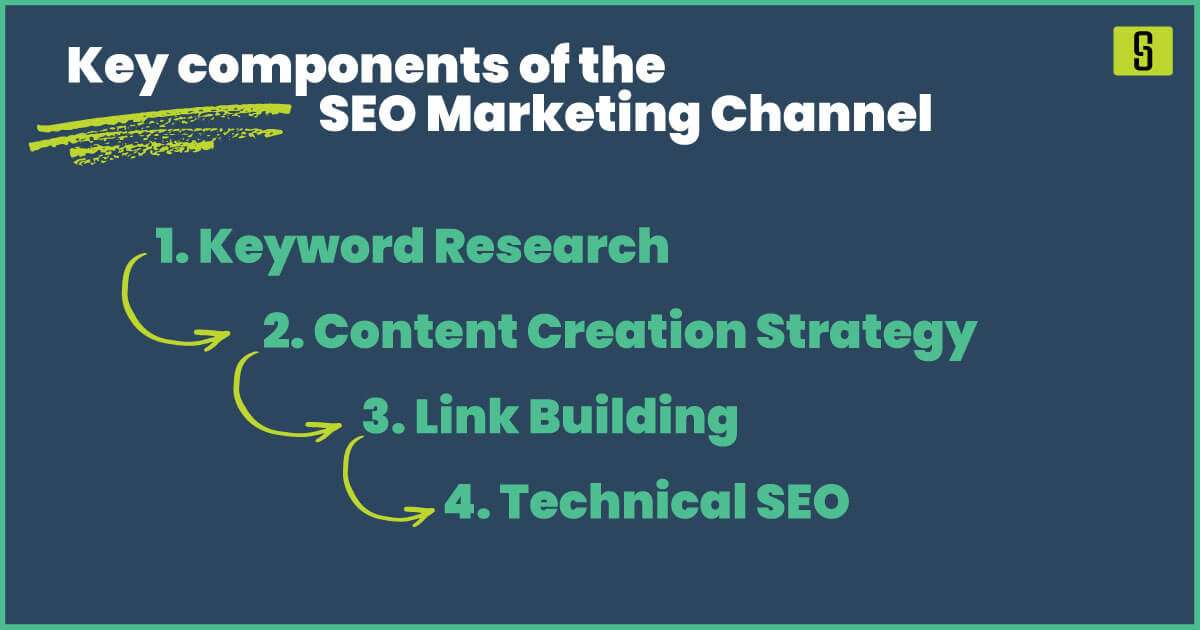
Let’s quickly break down the key building blocks of a winning SEO strategy:
1. Keyword Research
Effective search engine optimization always begins with understanding what your target audience is searching for and why.
Keyword research is the process of uncovering the specific queries, phrases, and questions potential customers use throughout their journey on Google and other search engines. This process informs every aspect of the SEO marketing channel strategy.
Below, I summarize what to focus on when doing strategic keyword research:
- Start with your niche: Identify core topics relevant to your business, products, or services. Think like your customers—what would they type into Google search to find you?
- Leverage tools: Use platforms like Google Keyword Planner, Semrush, Ahrefs, or Moz to discover high-intent queries. These tools reveal not just raw keywords but also valuable data on search volume, competition, and keyword difficulty.
- Spot long-tail opportunities: Don’t just target broad, ultra-competitive phrases. Long-tail keywords (longer, more specific search terms) often convert better and face less competition. For example, instead of only targeting “seo marketing,” you might focus on “seo as a marketing channel for ecommerce.”
- Assess relevance and intent: Always prioritize keywords that closely match your offerings. Look for “commercial intent” (ready to buy) or “informational intent” (seeking knowledge) depending on your goals.
- Analyze the competition: Check which keywords your competitors rank for. Tools like Semrush’s Domain Overview let you peek at their strengths and gaps.
My professional advice:
Keyword research is not a one-time task. Trends, language, and user intent change over time. Make it a habit to revisit your keyword lists, monitor new search trends (like voice search), and update your strategy. This agile approach keeps your seo marketing relevant and effective.
2. Content Creation Strategy
A winning content creation strategy is the heart of the SEO marketing channel. It’s how you attract, educate, and convert your audience while signaling to search engines that your website is an authority worth ranking.
Some content marketing strategy tips from me:
- Map content to the customer journey: Identify questions and pain points at every stage—from awareness (What is SEO as a marketing channel?) to consideration (How does SEO fit into multichannel marketing?) and decision (What are the best SEO strategies for my business?). Create blog posts, guides, and resources tailored to each step.
- Prioritize quality and value: Search engines reward sites that deliver genuine value. Answer user questions in-depth, provide actionable advice, and cite authoritative sources. Use formats like how-tos, case studies, and thought leadership articles.
- Incorporate secondary keywords: Weave in secondary keywords naturally within your content. This not only improves reach but also helps you target voice search and niche queries.
- Content types to consider:
- Comprehensive blog posts
- Visual guides and infographics
- Ebooks and whitepapers
- FAQ sections
- Video content (with transcripts for SEO)
- Refresh and update:
SEO is not set-and-forget. Regularly update older articles to reflect the latest best practices, algorithm changes, and user intent shifts. Refreshing statistics, examples, and internal links can revive a post’s performance. - Internal linking: Connect related articles using contextual internal links. This helps search engines crawl your site, prevents duplicate content, and guides readers to more valuable resources.
- Optimize for user experience and SEO: Use clear headings, short paragraphs, bullet points, and engaging visuals. This makes content easier to read and more likely to rank.
3. Link Building
If content is king, then link building is the kingmaker. Earning backlinks from authoritative, relevant sites signals to search engines that your content is trustworthy.
Google’s algorithm heavily weighs link authority. The more high-value sites that link to your pages, the higher you climb in the search results. Use tools like Ahrefs to track your link profile and identify opportunities.
Here is a brief overview of ways to build quality backlinks:
- Create share-worthy, original content that others want to reference.
- Reach out to industry thought leaders for guest posting opportunities.
- Participate in relevant online communities and forums.
- Utilize digital PR strategies to earn mentions in reputable publications.
- Monitor and reclaim broken or lost links to your site.
Remember:
It’s about quality, not quantity. A handful of links from top-tier sites trumps hundreds of low-quality links.
4. Technical SEO
Without a technically sound website, even the best content, keyword, and link building strategy can fall flat. Technical SEO is what ensures your site is crawlable, indexable, and optimized for search engines.
Here’s what to pay attention to:
- Fast load times: Site speed is a ranking factor and key to great user experience. Compress images, use caching, and minimize scripts. Tools like Google PageSpeed Insights and GTmetrix can pinpoint what’s slowing you down.
- Mobile-friendly design: With mobile-first indexing, your website must look and function perfectly on all devices. Use responsive design, readable fonts, and mobile-friendly navigation.
- Clean site architecture: Organize your site with a logical hierarchy. Use clear navigation, breadcrumbs, and silo structures. This helps both users and search engines find content efficiently.
- No duplicate content: Duplicate pages confuse search engines and dilute ranking signals. Use canonical tags, set up redirects where needed, and ensure each page has unique content and meta tags.
- Proper use of meta tags and schema: Write unique meta titles and descriptions for every page, incorporating your main and secondary keywords. Implement schema markup to enhance your listings with rich snippets (like reviews, FAQs, and prices) in Google search results.
- XML sitemaps and robots.txt: Submit XML sitemaps to Google Search Console and configure your robots.txt to guide search engine crawlers. Regularly audit for errors or blocked resources.
- Secure your site: HTTPS security is a trust factor for users and a ranking signal for Google.
- Monitor and fix technical issues: Use Google Search Console to detect and resolve crawl errors, broken links, and indexing issues. Regular technical audits are a must.
The payoff:
When your site is technically sound, you maximize your chances of ranking high and deliver a seamless experience for users and search engines. Google’s algorithms reward sites that load quickly, perform well on mobile, and provide a flawless journey.
Pros and Cons of SEO
The table below outlines the key advantages and disadvantages of SEO to help you evaluate its effectiveness as a marketing strategy:
| Pro/Con | Reason | Explanation |
|---|---|---|
| + Pro | Minimal Investment | SEO requires low financial investment while potentially delivering a high return over time. |
| + Pro | Organic Reach | Targets users who are actively searching for your product or service, reducing dependency on paid channels. |
| + Pro | More Visibility | Increases your website’s visibility in search engines, leading to more organic traffic and stronger brand awareness. |
| + Pro | Long-term Results | Once optimized, SEO efforts can provide lasting benefits without continuous reinvestment. |
| – Con | Time-consuming | Requires significant time and research; results often take months to materialize. |
| – Con | Competitive | High competition for popular keywords makes it challenging and resource-intensive to rank. |
| – Con | Algorithm Changes | Constant search engine updates require ongoing monitoring and adjustments to maintain rankings. |
Lessons Learned From a Decade in the SEO Field
Every SEO success I’ve had came from blending best practices with a relentless focus on delivering value to users and the business.
After 10+ years optimizing sites across industries, here’s what I know for sure and want to share with you:
- Consistency beats intensity: One-off efforts rarely move the needle. Regular, high-quality content and ongoing optimization always win.
- Never chase algorithms: Focus on user intent and user experience. Google’s updates reward businesses that genuinely help their audience.
- Collaboration is key: SEO works best when integrated with content, PR, and social media teams. Alignment multiplies impact.
- Embrace failure as feedback: Not every tactic will work. Use data from tools like Google Analytics to learn and iterate.
- Stay curious: The SEO field changes fast—voice search, AI, new ranking factors. Keep learning, testing, and evolving.
Wrap Up
The SEO marketing channel is the engine behind sustainable and scalable growth for any modern business.
With the right strategy, tools, and mindset, you can harness its power to drive targeted traffic, generate leads, and build lasting authority.
My advice:
Start today and keep going. Success is only one search away.
FAQ
Is SEO a marketing channel or just a tactic?
SEO is an essential marketing channel, not a tactic. It’s a primary way to attract, engage, and convert users through organic search engine traffic.
Why is SEO considered a passive marketing channel?
Because once your content ranks, it keeps driving visitors and conversions with minimal ongoing effort.
How does SEO fit into a multichannel marketing strategy?
SEO works alongside social media ads, email marketing, and paid campaigns to create a holistic approach. Each channel supports the others for maximum reach and impact.
How long does it take to see results from SEO?
Expect to see significant SEO results in 3–6 months, with compounding gains over time.
How do I measure SEO results?
Use Google Analytics and Search Console to track organic traffic, keyword rankings, and conversion rates. Set clear goals and adjust your seo strategies based on data.
What role does voice search play in SEO?
Voice search is growing rapidly. To stay competitive, optimize your content with natural, conversational language and focus on answering common questions your audience might ask out loud.
Should I use paid ads or focus solely on SEO?
A combination works best. Use paid ads for immediate results and SEO for long-term growth.