

Artificial intelligence has revolutionized how we approach search engine optimization, and I’ve been testing dozens of AI SEO tools to separate the winners from the time-wasters.
I’ve been working in SEO since 2015, back when AI wasn’t even part of the conversation. Fast forward to today, and almost every marketer uses it to work faster.
One thing is for sure:
AI isn’t perfect, but it’s here to stay. And instead of resisting it, we should learn how to use it wisely.
In this post, I share the best AI tools for SEO I rely on, how they’ve impacted my content performance, and some best practices to help you grow your site without risking Google penalties.
Curious to see which tools actually work?
Let’s dive in.
Best AI Tools for SEO in 2025 That I Recommend
The tools below stand out because they’ve proven effective for real-world SEO tasks:
- ChatGPT (Free Plan) – Best for versatile SEO assistance
- Gemini – Best for real-time SERP analysis and technical SEO
- Perplexity AI – Best for authoritative research and EEAT-focused content creation
- Semrush – Best for end-to-end AI SEO campaigns and brand visibility in AI search
- Search Atlas – Best for agencies and accessible AI-first SEO solutions
- SE Ranking – Best for affordable AI-powered content optimization and rank tracking
- Indexly – Best for fast indexing and LLM visibility tracking
- Frase – Best for SERP-driven content briefs and optimization
- Koala AI – Best for affordable SEO content generation (especially for beginners)
- Writesonic – Best for SEO-focused content creation with brand voice customization
Why AI Tools Are Transforming SEO
AI isn’t just a buzzword in SEO anymore. It’s becoming essential. With Google’s algorithms growing more sophisticated and content requirements becoming more demanding, manual SEO processes simply can’t keep up.
Here’s what makes AI tools for SEO so powerful:
- Pattern recognition: AI can analyze thousands of ranking pages to identify patterns that human eyes would miss. This means you can understand exactly what’s working in your niche right now.
- Time efficiency: Tasks that once took days (like comprehensive keyword research or content optimization) can now be completed in hours or even minutes. This has completely transformed my workflow.
- Content enhancement: AI doesn’t just help with technical SEO; it’s revolutionizing content creation. The tools I’ll share help ensure your content meets user intent while maintaining the EEAT standards Google demands.
- Competitive edge: Your competitors are likely already using these tools. Staying ahead means not just adopting AI for SEO, but knowing which specific tools deliver the best results for your unique situation.
My Testing Methodology
Before diving into my recommendations, let me explain how I evaluated these tools. Over the past 18 months, I’ve personally tested over 30 AI SEO tools across client websites and my own projects.
Here’s what I looked for:
- Actual impact on search rankings (not just promises)
- Time saved compared to manual processes
- Learning curve and ease of implementation
- Integration with existing SEO workflows
- Cost-effectiveness relative to results
- Quality of AI-generated content and recommendations
- Accuracy of data and analysis
I’ve organized my top picks into three categories:
- Free tools for those just starting out
- Comprehensive solutions for serious SEO professionals
- Specialized tools for specific SEO tasks
Best Free AI Tools for SEO
Let’s start with the good news:
You don’t need a massive budget to leverage AI for SEO.
These free tools have delivered results for me without costing a penny.
1. ChatGPT (Free Plan)
When used correctly, ChatGPT is one of the most versatile SEO assistants available.
I’ve used ChatGPT to:
- Generate content outlines based on top-ranking pages
- Create meta descriptions that maintain keyword relevance while enticing clicks
- Brainstorm semantically related keywords to enhance content depth
- Analyze competitor content to identify gaps and opportunities
- Draft FAQ sections that address actual user questions
The key is knowing how to prompt effectively.
For example, instead of asking “give me SEO content about dog training,” try something more explanatory like “analyze the top 5 ranking pages for ’positive reinforcement dog training’ and create a comprehensive outline that covers all their topics plus identifies content gaps.”
My results?
I used ChatGPT to restructure a client’s underperforming blog post, and within three weeks, it jumped from page 3 to position 4 on page 1.
Pros
- Users can access the tool without any financial commitment
- The platform is easy to navigate
- Suitable for a variety of tasks,
- OpenAI frequently updates the model
Cons
- Some advanced functionalities are restricted
- The quality of responses may vary, with less reliability in generating highly specific or complex content
- There may be restrictions on the number of queries or usage per day
- The free version may not offer tailored responses based on user preferences or history.
2. Gemini
Since Gemini is developed by Google, it provides insights that align more closely with Google’s approach to search.
What makes Gemini particularly valuable for SEO:
- Real-time web access for current SERP analysis
- Ability to analyze images of your website for SEO recommendations
- Integration with Google’s ecosystem (especially helpful for Google Business Profile optimization)
- Sometimes provides different perspectives than ChatGPT, giving you more comprehensive insights
I’ve found Gemini particularly helpful for technical SEO tasks. When I was troubleshooting a client’s structured data implementation, Gemini identified an error that other tools missed, which we fixed to regain our rich snippets.
Pros
- Real-time web access for up-to-date SERP analysis
- Ability to analyze images on your website
- Integration with Google’s ecosystem
- Offers unique perspectives that may differ from other AI tools
Cons
- As a newer tool, it may not have as extensive a user base or community support compared to established platforms
- Some users may find its insights less comprehensive than those provided by specialized SEO tools
3. Perplexity AI
Perplexity AI is my secret weapon for research-intensive SEO tasks. Unlike traditional search engines or other AI tools, Perplexity provides cited sources for its information, which is invaluable for creating authoritative content.
Here’s how I leverage Perplexity for SEO:
- Researching industry statistics and trends with proper citations
- Analyzing what sources Google considers authoritative for specific topics
- Finding content angles that haven’t been overdone
- Identifying potential link-building opportunities from authoritative sources
The real value of Perplexity is how it helps with EEAT (Experience, Expertise, Authoritativeness, Trustworthiness).
For a finance client, I used Perplexity to identify the most credible sources in their niche, which we then referenced in our content.
The result?
A 23% increase in organic traffic to their money-related pages.
By the way, I’ve written an entire article dedicated to EEAT with a checklist of all ranking signals.
Pros
- Provides cited sources, enhancing the credibility of the content
- Helps identify authoritative sources, improving EEAT
- Offers unique insights that can uncover content opportunities
- Facilitates thorough research, making it easier to stay updated with industry trends
Cons
- May require more time to sift through cited sources compared to traditional tools
- Limited to the information available in its database, which may not cover every niche
- Some users may find the interface less intuitive than other AI tools
Comprehensive AI SEO Solutions
If you’re serious about leveraging AI for SEO at scale, these comprehensive tools offer end-to-end solutions that can transform your entire approach.
4. Semrush
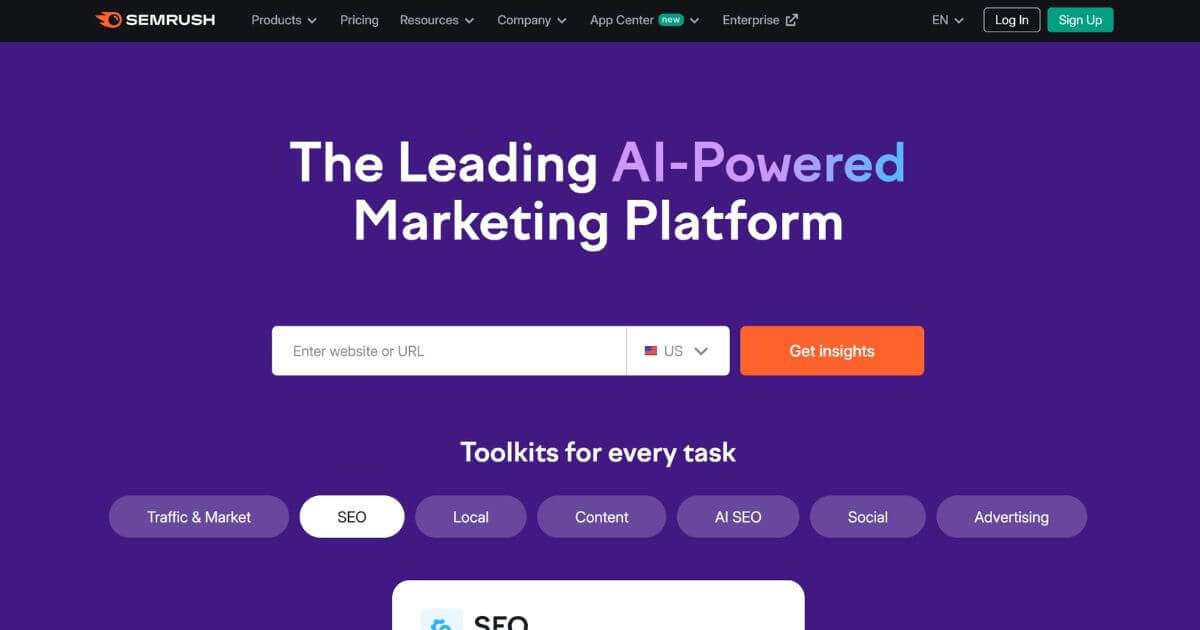
Semrush has evolved from a traditional SEO tool into an AI powerhouse. Their AI Toolkit and Content Marketing Platform have completely changed how I approach SEO campaigns.
What makes Semrush’s AI capabilities stand out:
- AI Writing Assistant that helps optimize content while you write
- Content Marketplace with AI-powered brief creation
- AI-driven keyword clustering that automatically groups related terms
- Brand monitoring across AI platforms like ChatGPT and Perplexity
- AI SEO recommendations based on your specific website data
The most impressive feature is how Semrush now tracks your brand’s visibility in AI search results. This is crucial as more users turn to AI assistants for information.
I implemented Semrush’s AI content optimization for a SaaS client, and within two months, their organic traffic increased by 41%. The AI-driven keyword clusters helped us identify content opportunities we’d completely missed with manual research.
Pros
- Comprehensive AI tools integrated with traditional SEO features
- AI-powered content briefs save hours of research
- Monitors brand visibility in AI search results
- Regular updates to keep pace with AI advancements
Cons
- Higher price point (starts at $139.95/month)
- Learning curve for utilizing all AI features
- Some AI features require additional payment
5. Search Atlas
As a newer player in the SEO tool space, Search Atlas has quickly become one of my favorites due to its AI-first approach and competitive pricing compared to established platforms.
Search Atlas’s standout AI features include:
- OTTO SEO—an automated AI assistant that provides actionable recommendations
- AI Content Writer that creates SEO-optimized content based on top-ranking pages
- Site Auditor with AI-powered fix recommendations
- White label reporting with AI-generated insights
What I particularly appreciate about Search Atlas is how it makes advanced SEO accessible to those without deep technical knowledge. The AI explanations help clients understand complex SEO concepts.
For a local business client, we used Search Atlas’s AI content tools to create location-specific pages that outranked much larger competitors. The AI automatically incorporated local signals that would have taken hours to research manually. Thanks to it, we handled this local SEO task with ease.
Pros
- More affordable than other enterprise tools (starts at $99/month)
- Excellent white labeling for agencies
- AI assistant provides actionable recommendations
- Intuitive interface with minimal learning curve
Cons
- Newer platform with some features still in development
- Limited historical data compared to established tools
- Some users report excessive email notifications
6. SE Ranking
SE Ranking has made significant investments in AI capabilities, transforming it from a traditional rank tracking tool into a comprehensive AI SEO platform.
The AI features that have impressed me most:
- AI Writer powered by GPT-4O technology
- AI-powered keyword research with intent analysis
- LLM visibility tracking to monitor your presence in AI search results
- Content Editor with AI optimization suggestions
- Automated reporting with AI-generated insights
SE Ranking’s AI Writer deserves special mention. Unlike generic AI writing tools, it’s specifically designed for SEO content, analyzing top-ranking pages to ensure your content matches search intent while maintaining readability.
I used SE Ranking’s AI tools to revamp an ecommerce client’s product descriptions, and their category pages saw a 31% increase in organic traffic within six weeks. The AI-generated content maintained brand voice while incorporating all the necessary keywords.
Pros
- Excellent balance of AI features and traditional SEO tools
- AI Writer produces highly optimized content
- Monitors visibility in AI search results
- More affordable than some competitors (starts at $65/month)
Cons
- Some advanced AI features require higher-tier plans
- Limited customization options for AI-generated content
- AI content sometimes needs significant editing
Specialized AI SEO Tools
Sometimes you need tools designed for specific SEO tasks rather than all-in-one solutions. These specialized AI tools excel in their particular niches.
7. Indexly
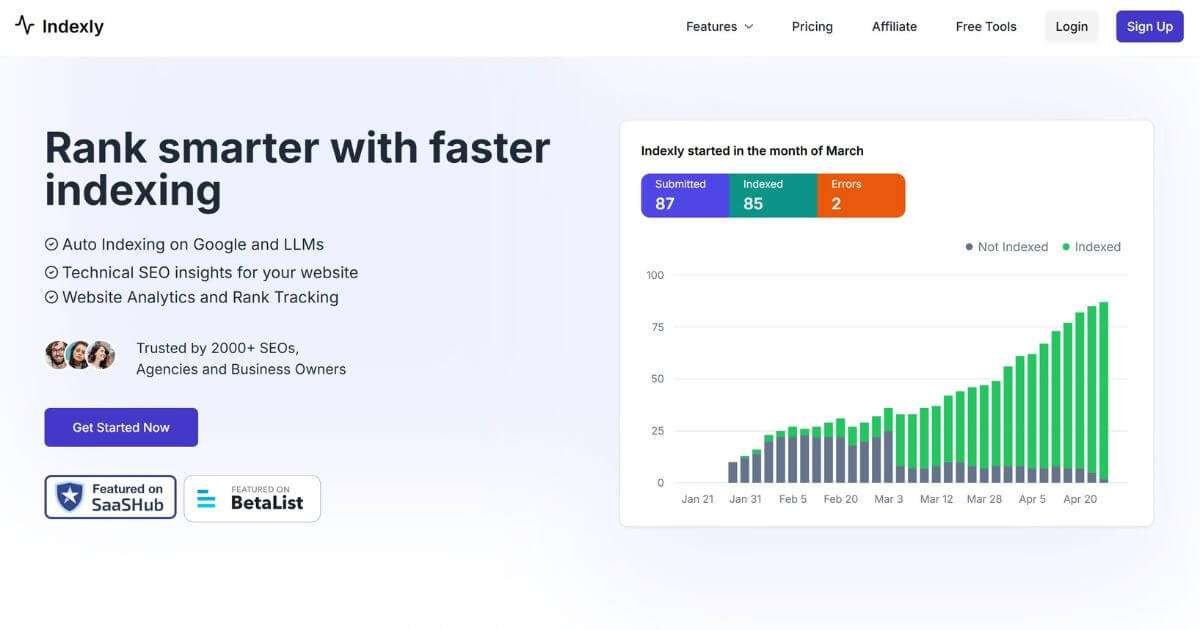
If you’ve ever struggled with getting Google to index your content quickly, Indexly is your solution. This specialized tool uses AI to optimize the indexing process and track your visibility in large language models (LLMs).
Key features that make Indexly stand out:
- Instant indexing that gets pages into Google’s index within hours
- Bulk index submission for large websites
- LLM Indexability tracking to see if your content appears in AI search results
- Automated monitoring of indexing issues
- Page inspection to identify indexing blockers
The LLM visibility tracking is particularly valuable as AI search becomes more prevalent. It shows whether your content is discoverable by ChatGPT, Perplexity, and other AI platforms.
For a small local news website client, we reduced indexing time from days to hours using Indexly, which was crucial for their time-sensitive content. The difference in traffic was substantial—breaking news articles started receiving traffic quickly after publication.
Pros
- Dramatically speeds up indexing process
- Unique LLM visibility tracking
- Affordable pricing (starts at $14/month)
- Simple, focused interface
Cons
- Limited to indexing functionality
- No content creation features
- Higher plans needed for multiple websites
8. Frase
Frase specializes in AI-driven content optimization and has become my go-to tool for creating content that truly matches search intent.
What makes Frase unique:
- AI-powered SERP analysis that identifies what top-ranking content includes
- Content briefs generated automatically based on competitor analysis
- AI writing assistant that helps create optimized content
- Real-time content scoring as you write
- Question research tool that identifies what users are asking
The most impressive aspect of Frase is how it analyzes the top-ranking pages for your target keyword and identifies exactly what topics, headings, and questions you should include to compete effectively.
I used Frase to optimize a client’s cornerstone content, and within two months, their page jumped from position 9 to position 2 for their primary keyword. The AI identified several subtopics we had completely missed in our original content.
Pros
- Unmatched SERP analysis for content optimization
- Excellent content brief generation
- Intuitive interface with real-time feedback
- More affordable than enterprise tools (starts at $45/month)
Cons
- Limited to content optimization (no technical SEO features)
- AI writing sometimes needs significant editing
- No rank tracking or backlink analysis
9. Koala AI
For budget-conscious website owners who need quality SEO content, Koala AI offers an impressive balance of affordability and effectiveness.
Standout features include:
- Customizable tone of voice settings
- Ability to specify exact word count
- Custom outline creation before generating content
- Target keyword optimization
- Support for 100+ languages
What I appreciate most about Koala AI is its simplicity. You don’t need to be an SEO or GEO expert to create optimized content—the tool guides you through the process with clear options and suggestions.
For my own blog, I used Koala AI to create supporting content around my main topics. One article generated with Koala (with my expert additions) now ranks in the top 10 for its target keyword, bringing in consistent traffic at a fraction of the cost of hiring a writer.
Pros
- Extremely affordable (starts at $9/month)
- User-friendly interface
- Generous free plan (5,000 words/month)
- Excellent multilingual support
Cons
- Limited advanced SEO features
- No SERP analysis capabilities
- Content sometimes needs significant editing
10. Writesonic
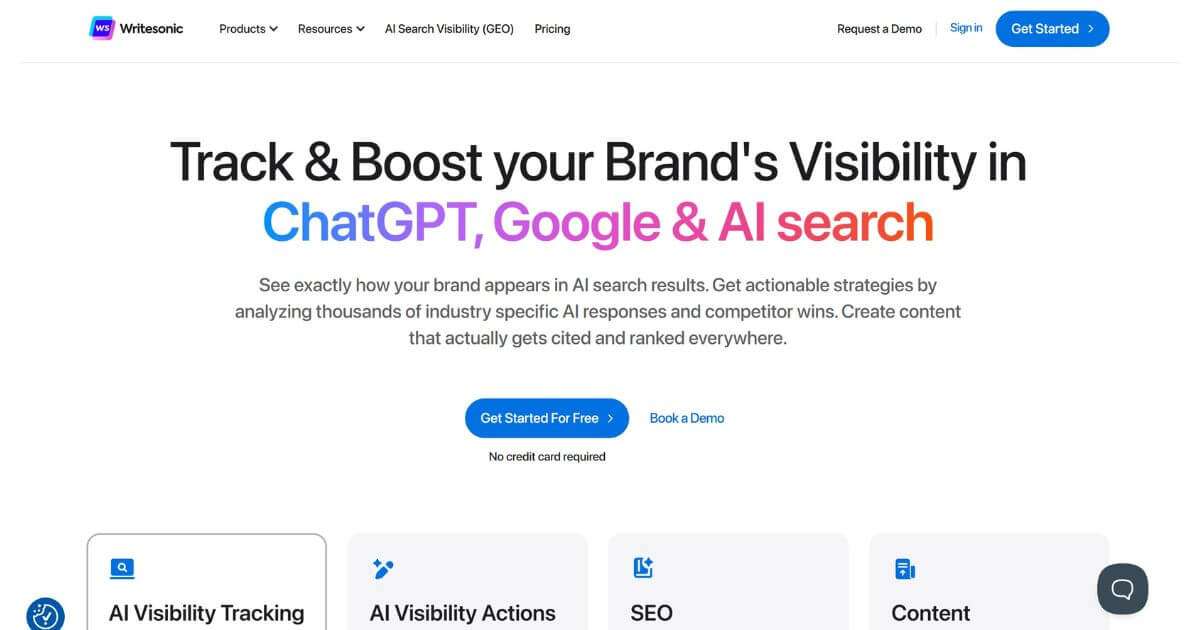
Writesonic has evolved into a powerful AI SEO tool with features specifically designed for search optimization and content marketing.
Key features that make it valuable for SEO:
- SEO Checker and Optimizer for content improvement
- Humanizer to make AI content more natural
- Custom brand voice modeling
- AI Blog Topic and Ideas Generator
- Integration with Google Search Console for performance tracking
The SEO Checker is particularly useful—it analyzes your content against top-ranking pages and provides specific recommendations for improvement, from keyword usage to content structure.
I used Writesonic to create and optimize product descriptions for an ecommerce client, resulting in a 27% increase in organic traffic to their product pages within three months. The AI-generated descriptions maintained brand voice while incorporating all necessary keywords.
Pros
- Excellent content generation with SEO focus
- Brand voice customization
- Integration with SEO tools like Ahrefs and Semrush
- Comprehensive content repurposing features
Cons
- Higher pricing than some alternatives (starts at $49/month)
- Limited technical SEO features
- Some features require higher-tier plans
Pro Tips: Maximize Your Results With AI Tools for SEO
After testing multiple AI tools for SEO optimization, I’ve discovered some strategies that significantly amplify results.
Here are my top pro tips:
Combine Complementary Tools
No single AI tool does everything perfectly. I’ve found the most success using combinations like:
- Indexly + Frase: Create optimized content with Frase, then ensure fast indexing with Indexly.
- ChatGPT + Semrush: Use ChatGPT for creative content ideas, then optimize with Semrush’s AI Writer.
- Perplexity + Koala AI: Research with Perplexity, then create content with Koala AI.
Human Review is Non-Negotiable
Even the best AI tools for SEO require human oversight. I always follow this workflow:
- Generate initial content or recommendations with AI
- Review for accuracy, brand voice, and logical flow
- Add personal experiences, case studies, and unique insights
- Run through AI optimization tools again
- Final human review before publishing
Improve EEAT
Google’s EEAT guidelines (Experience, Expertise, Authoritativeness, Trustworthiness) are more important than ever. Use AI tools to:
- Identify authoritative sources to cite in your content
- Find gaps in expertise coverage compared to top-ranking pages
- Generate expert-level explanations of complex topics
- Create comprehensive content that demonstrates depth of knowledge
Track AI Search Visibility
As more users turn to AI assistants for information, your visibility in these platforms becomes crucial. Tools like Semrush’s AI Toolkit, Indexly, and SE Ranking now offer features to track and improve your presence in AI search results.
I’ve seen clients get significant traffic from being prominently featured in AI responses, making this an emerging SEO priority.
Wrap Up
The AI revolution in SEO is just beginning. As these tools continue to evolve, they’ll become even more integral to successful search strategies.
Here’s what I believe is coming next:
- More sophisticated AI content creation that’s increasingly indistinguishable from human writing.
- Predictive SEO that anticipates algorithm changes before they happen.
- Hyper-personalized content optimization based on user behavior patterns.
- Deeper integration between traditional SEO metrics and AI search visibility.
The best AI tools for SEO I’ve shared today represent the current state of the art, but the landscape is changing rapidly. What remains constant is the need for human strategy, creativity, and oversight to get the most from these powerful AI assistants.
Remember, the goal isn’t to replace human expertise with AI, but to amplify what we can accomplish by focusing our time and energy on the strategic elements that machines can’t replicate.
FAQ
Are AI-generated articles good for SEO?
AI-generated articles can be effective for SEO when properly edited by humans. Google’s guidelines don’t prohibit AI content, but they do emphasize quality, helpfulness, and EEAT factors.
The best approach is to use AI as a starting point, then add unique insights, personal experiences, and expert knowledge. Pure AI content without human oversight typically lacks the depth and authenticity needed to rank well long-term.
Can AI SEO optimization tools replace human SEO specialists?
No, AI SEO platforms cannot fully replace human SEO specialists. While these tools excel at data analysis, content generation, and pattern recognition, they lack strategic thinking, creative problem-solving, and contextual understanding.
The most effective approach is collaborative: human SEO specialists leveraging AI tools to automate repetitive tasks, uncover insights, and scale their efforts. This combination allows specialists to focus on strategy, interpretation, and the nuanced aspects of SEO that AI cannot yet master.
How do I measure the ROI of AI SEO software?
To measure the ROI of AI SEO software, track these key metrics:
– Time saved: Compare the hours required for tasks before and after implementing AI tools
– Content output: Measure increases in content production volume and quality
– Ranking improvements: Track position changes for target keywords
– Organic traffic growth: Monitor increases in search traffic
– Conversion rate: Assess whether AI-optimized content converts better
I recommend establishing a baseline before implementing AI tools, then tracking changes over 3–6 months to accurately assess their impact.


