

Using ChatGPT for SEO goes beyond saving time on tasks. We are tapping into AI models that are changing search in ways that weren’t possible before.
After more than a decade in SEO and digital marketing, I’ve seen plenty of “game-changers” come and go. But this isn’t another shiny tool—it’s a complete system shift.
The GPT models can now write faster, and they are becoming smarter, with reasoning and creative firepower that completely rewrites the old SEO playbook.
We’re not talking about cranking out mediocre blog posts anymore. We are entering the era of AI-driven SEO strategies built on precision and efficiency, and backed by data.
The rules have changed, the goalposts have moved, and the future of SEO belongs to those who can harness this machine.
Highlights
- GPT-5 offers advanced contextual understanding for nuanced SEO tasks.
- Use ChatGPT for end-to-end content strategy, from ideation to promotion.
- Human oversight is crucial for maintaining EEAT and content quality.
- Automate complex technical SEO tasks like schema markup and redirect rules.
- Master link building by generating prospects, outreach emails, and linkable assets.
Understanding the Technology: The Leap to GPT-5
Before we dive into the practical applications, it’s crucial to understand what we’re working with.
GPT-5, or Generative Pre-trained Transformer 5, is the latest and most powerful language model from OpenAI. At its core, it’s a sophisticated prediction engine. It functions by calculating the most probable next word in a sequence, based on the immense patterns it learned from a massive dataset of text and code.
The key difference that sets GPT-5 apart from its predecessors is its vastly improved ability to understand context, nuance, and intent.
While earlier models were impressive, they could sometimes produce generic, factually questionable, or slightly off-topic content. GPT-5, however, can grasp complex, multi-step instructions, maintain a consistent and specific tone of voice, and generate text that is often indistinguishable from human writing.
Its reasoning capabilities allow it to act not just as a writer but as a strategist, making it an incredibly powerful ally for any search engine optimization professional.
The Big Question: Is ChatGPT Good or Bad for SEO?
Let’s address the elephant in the room:
Is ChatGPT bad for SEO?
My answer is no, but with a major caveat. It’s not the tool itself that’s good or bad; it’s how you use it. The debate is nuanced and centers on intent and quality.
Google’s stance, clarified through its Helpful Content Updates, is that it rewards high-quality content that is helpful to people, regardless of how it’s produced. The focus remains squarely on EEAT (Experience, Expertise, Authoritativeness, and Trustworthiness). By the way, I’ve written an article about EEAT with a checklist inside.
If you use ChatGPT to mindlessly churn out hundreds of low-quality, unedited, and unhelpful articles, your rankings will inevitably suffer. This approach is simply the modern version of old-school content spam.
The right way to use ChatGPT for SEO is as a collaborator. It’s your brainstorming partner, your tireless research assistant, your first-draft generator, and your automation buddy.
Your role as the SEO expert is elevated. You become the strategist, the editor-in-chief, the fact-checker, and the human voice who provides the final layer of polish, unique insight, and real-world experience.
So, is ChatGPT good for SEO, then?
Yes, when it empowers you to be better, faster, and more strategic at your job.
Core ChatGPT SEO Application: Content Strategy and Creation
Content is at the core of SEO, and this is where ChatGPT truly shines, from the initial idea to the final draft.
Here’s a detailed breakdown of how to use ChatGPT for SEO content:
1. Ideation and Advanced Topic Clustering
Staring at a blank page is a thing of the past. You can use ChatGPT to generate plenty of content ideas and structure them strategically.
Prompt Example:
Act as a senior content strategist for a B2B SaaS company specializing in cybersecurity. Our target audience is non-technical small business owners. Generate five topic clusters. For each cluster, provide a pillar page title (e.g., The Ultimate Guide to Small Business Cybersecurity) and five supporting blog post titles that answer specific user questions (e.g., How to Create a Strong Password Policy for Your Team).
This is the chat excerpt:
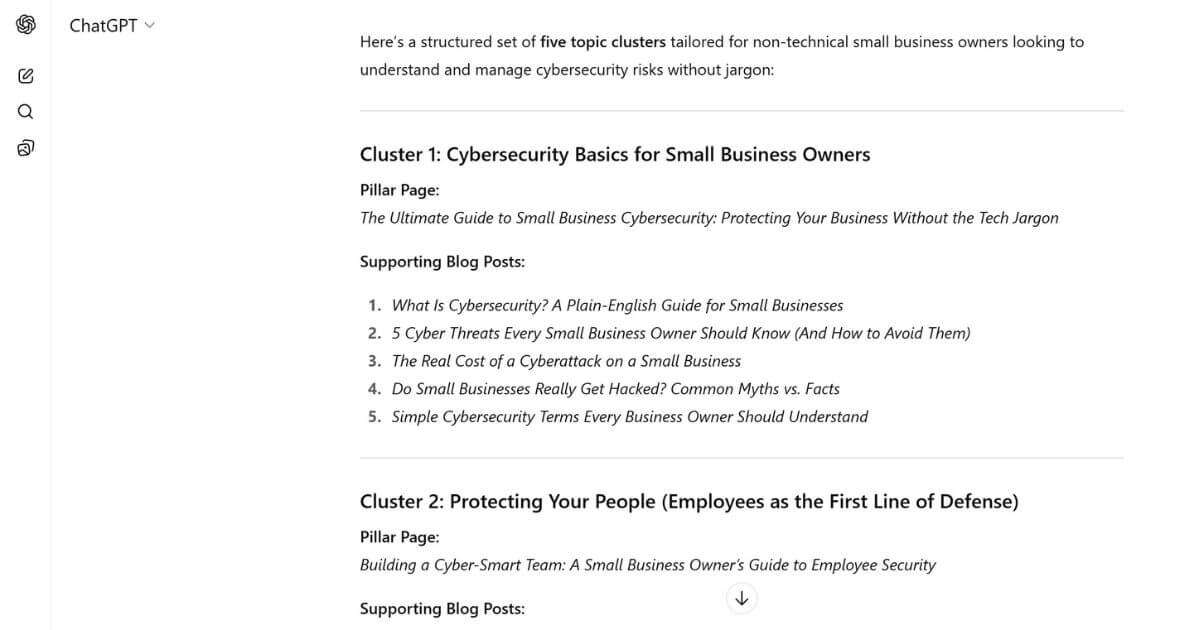
Here’s a link to the full chat.
2. Structuring Comprehensive Content With Outlines
A good outline is the blueprint for a successful, well-structured article that satisfies user intent. And ChatGPT handles this task effortlessly.
Prompt Example:
Create a detailed blog post outline for the title “10 Ways to Protect Your Business from Phishing Scams.” Include an introduction that defines phishing in simple terms. For each of the 10 ways, include a brief explanation and a scannable, actionable tip. Add a concluding section and a 3-question FAQ section.
Here’s an excerpt from the chat:
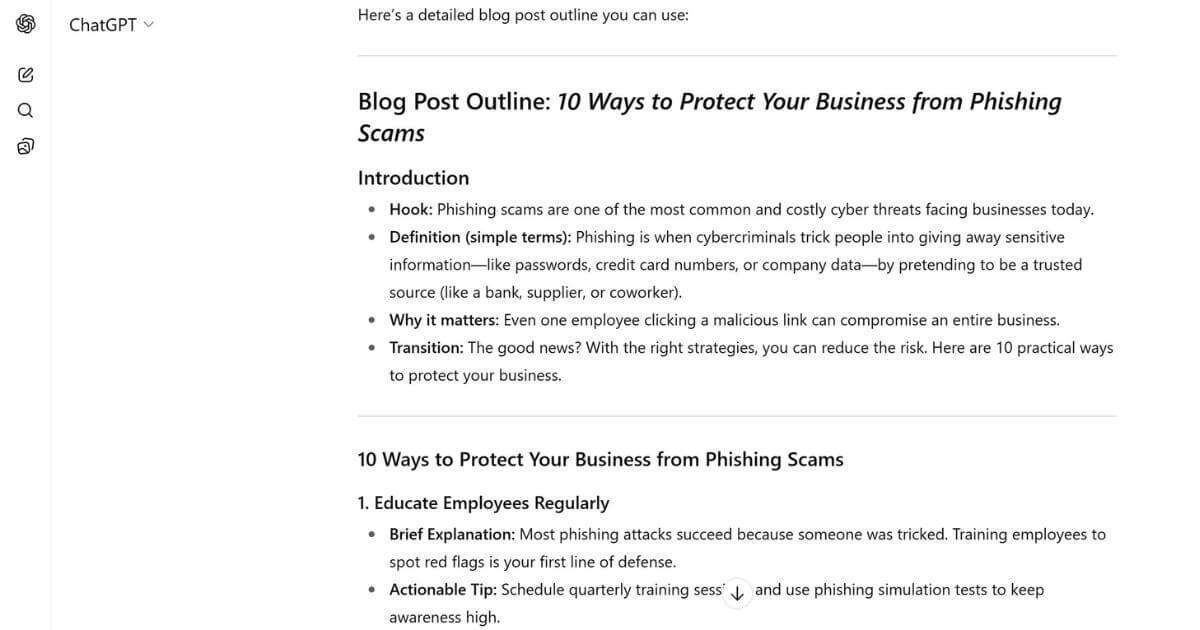
And this is the link to the chat.
3. Drafting High-Quality, Nuanced Content
This is one of the most powerful ChatGPT SEO use cases where you can save the most time. Provide your detailed outline and specific instructions to guide the AI, and ask it to write the content.
Prompt Example:
Using the outline provided, write a 1500-word article. Write in a helpful, confident, and slightly urgent tone, avoiding technical jargon. I am an SEO expert with 10 years of experience. Ensure the article flows logically and uses transitional phrases. Include bucket brigades to keep the reader engaged.
This is just a simple prompt without mentioning the use of specific main and secondary keywords throughout the text. But you can add them as well.
Here’s a screenshot of the output ChatGPT produced based on the generated outline from the previous point:
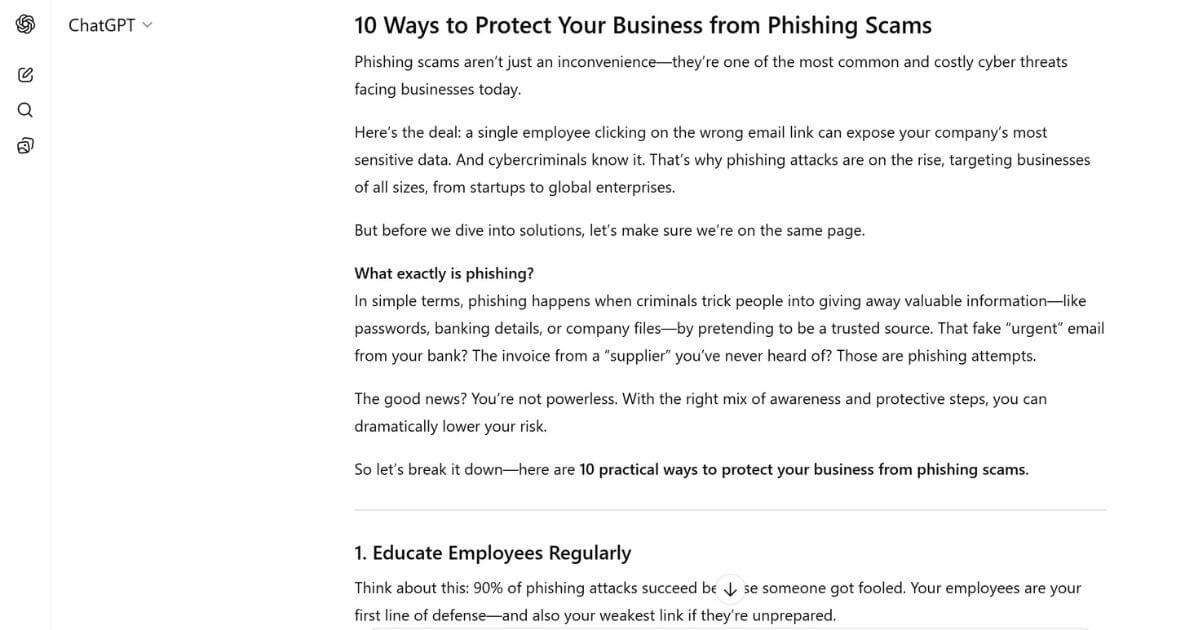
Of course, you need to read through the article and make some edits. But, you already have the content written, and you just need to spend time on editing. In my experience, this makes content creation 3 to 4 times faster.
Mastering Keyword Research With ChatGPT
While dedicated keyword research tools are still essential for volume and difficulty metrics, ChatGPT can add a powerful new dimension to your process.
Here’s how to use ChatGPT for SEO keyword research:
1. Semantic Keyword Clustering and Intent Analysis
Organizing a long list of keywords from tools like Ahrefs or Semrush is time-consuming. ChatGPT can group them based on user intent in seconds.
Prompt Example:
Cluster the following keywords into semantically relevant groups. Label each group with a primary user intent (Informational, Commercial, Transactional, or Navigational). For each group, suggest a content format that would best serve that intent (e.g., Blog Post, Comparison Page, Product Page). Keywords: [paste a list of 30–100 keywords here].
This is the output based on cybersecurity keywords:
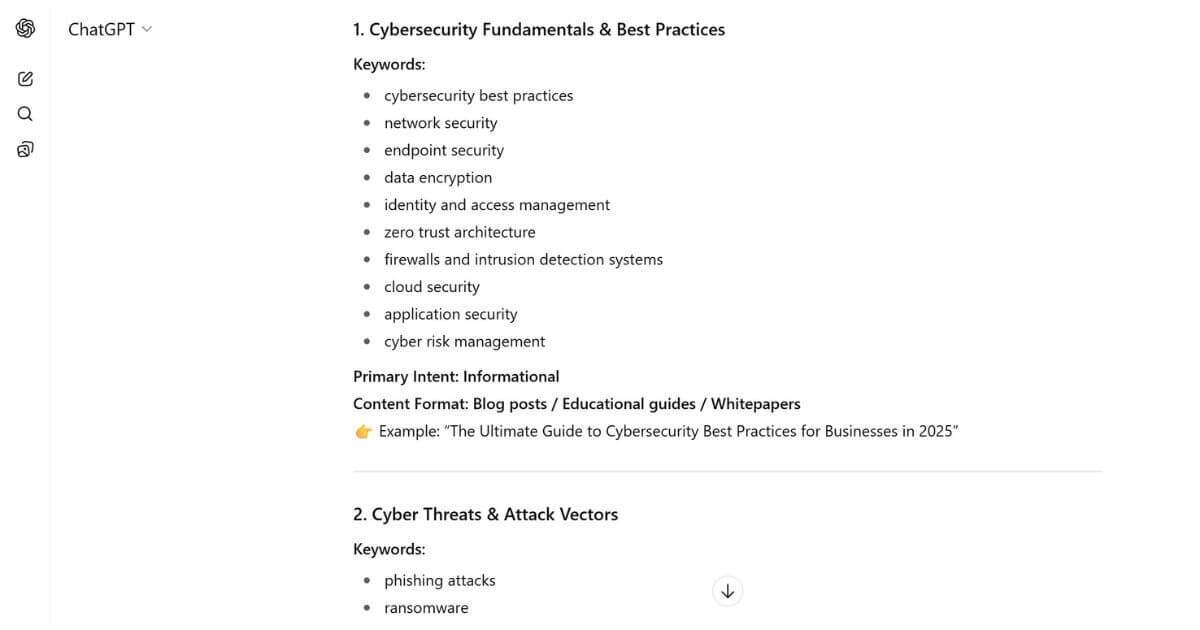
And here you’ll find the full answer.
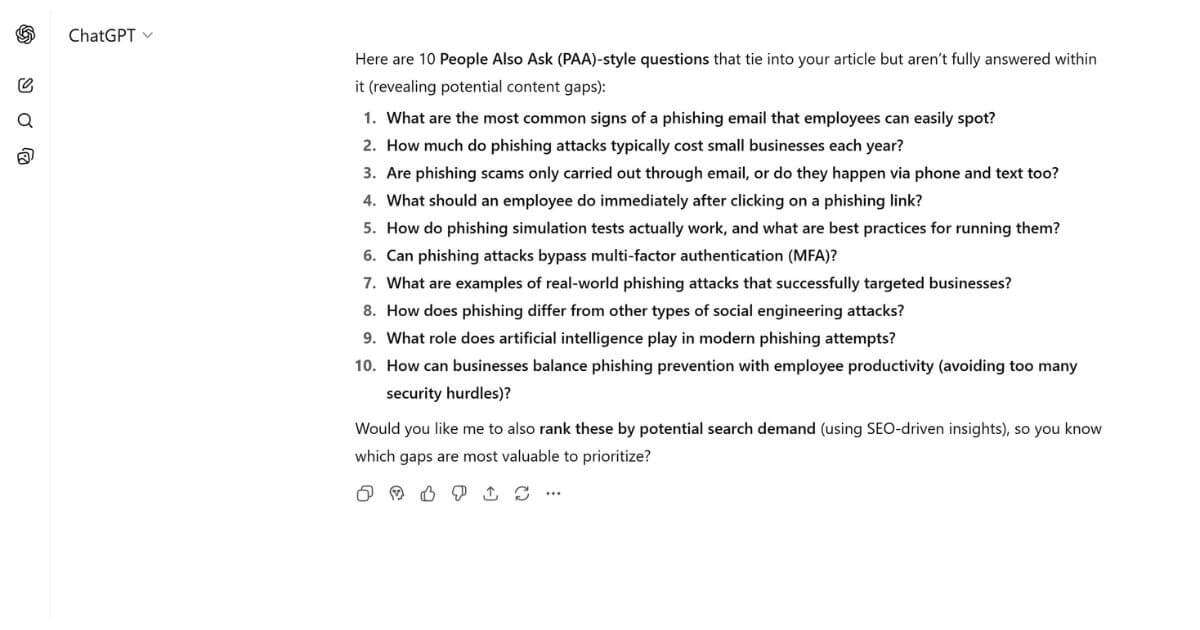
2. Identifying “People Also Ask” Opportunities
Another effective way to use ChatGPT for SEO keyword research is to ask it to find the unanswered questions and identify gaps in your existing content.
Prompt Example:
Analyze the following article text: [paste the text of one of your blog posts]. Now, act as a user and generate 10 People Also Ask style questions that are not fully answered in the text. This will help me find content gaps to fill.
Here’s the output, again with the cybersecurity example:
Technical SEO and On-Page Optimization With ChatGPT
ChatGPT for SEO optimization extends far beyond keywords and content. It can also help automate many tedious and error-prone technical tasks.
1. Writing Meta Tags and Schema Markup at Scale
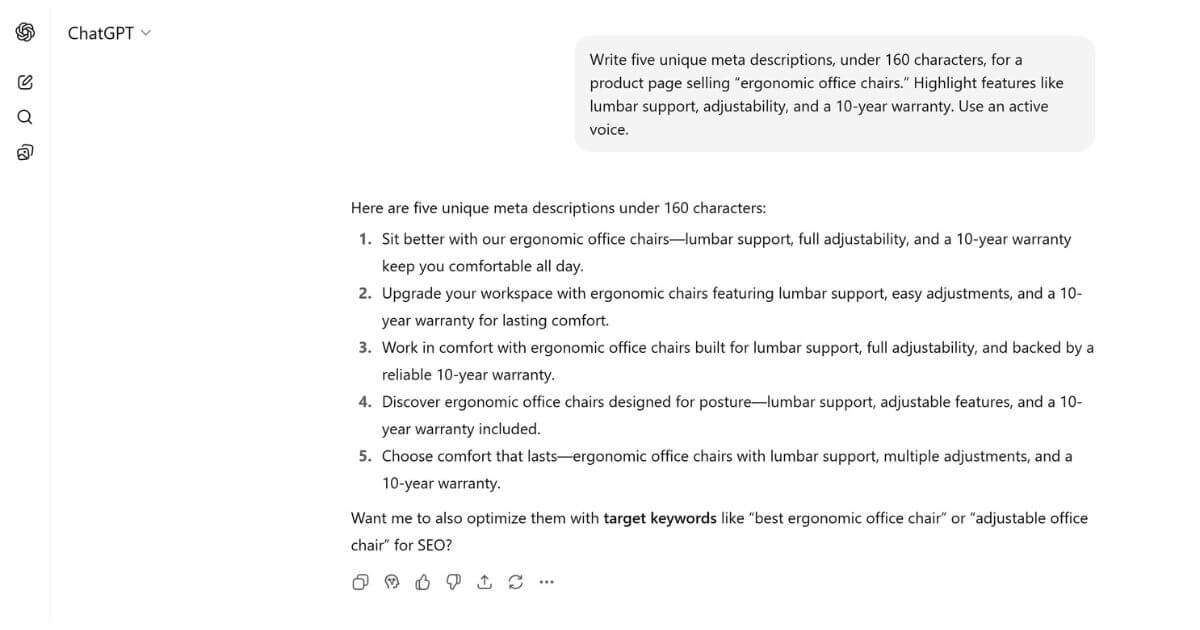
Writing unique meta tags and structured data for hundreds of pages is a classic SEO chore. But with simple ChatGPT prompts, you can achieve fast results.
Here’s an example with meta descriptions generated by ChatGPT:
Meta Description Prompt:
Write five unique meta descriptions, under 160 characters, for a product page selling “ergonomic office chairs.” Highlight features like lumbar support, adjustability, and a 10-year warranty. Use an active voice.
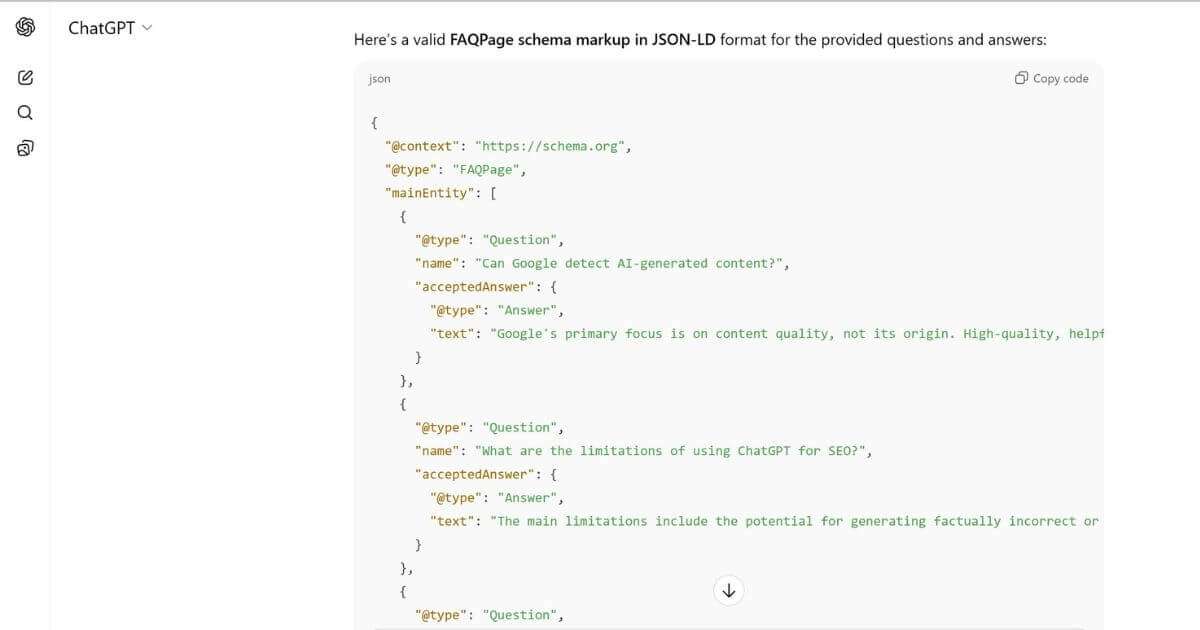
And below another example of a valid schema markup code that ChatGPT produced.
Schema Markup Prompt:
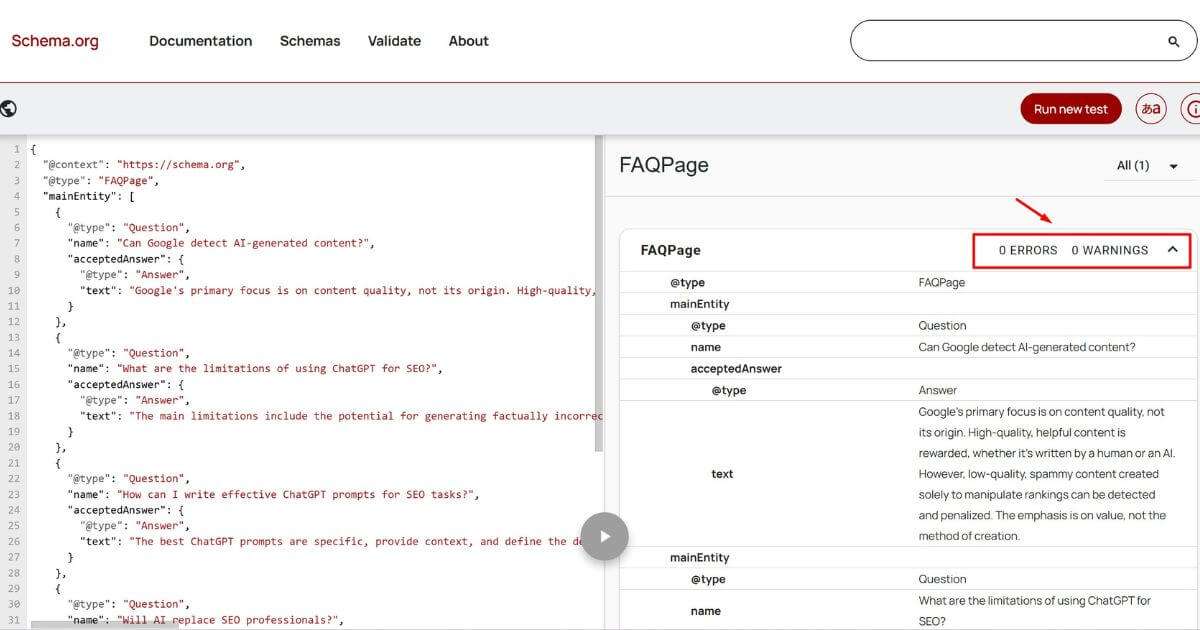
Generate FAQPage schema markup in JSON-LD format for the following questions and answers: [paste your Q&As here]. Ensure the code is valid.
I run this code through the Schema Validator, and it’s error-free.
2. Generating Complex Technical Directives
As someone who has basic knowledge in coding and has to deal with SEO issues of clients’ websites, ChatGPT has been a great helper.
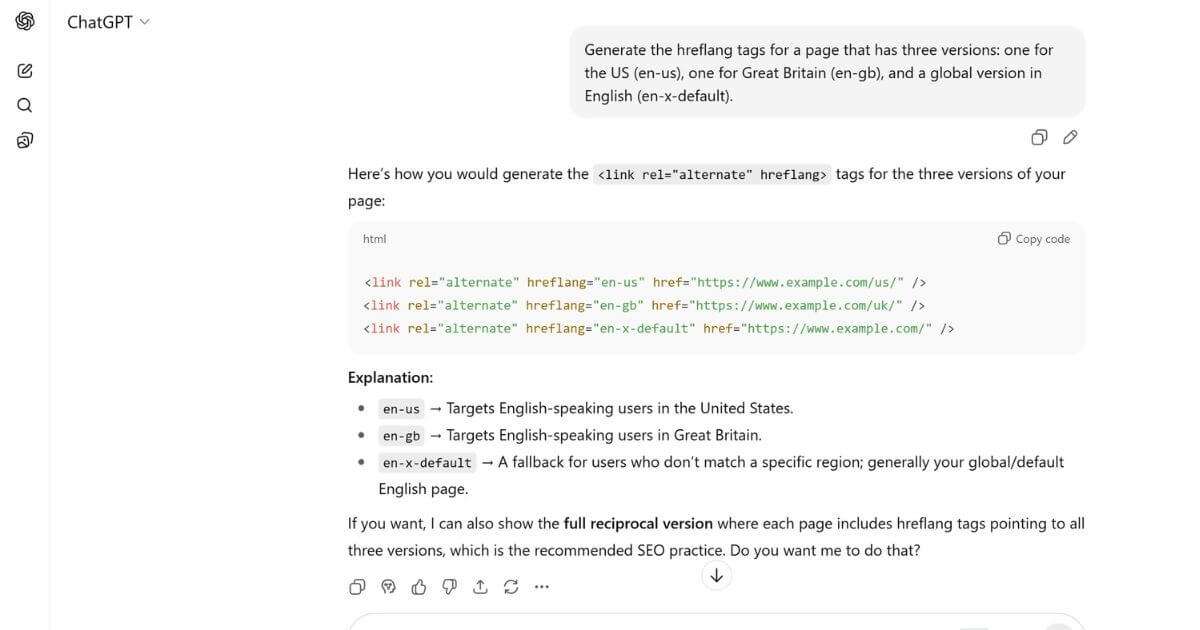
For example, if you need to create redirect rules or international targeting tags, ChatGPT can write the code for you.
Let’s see how this works.
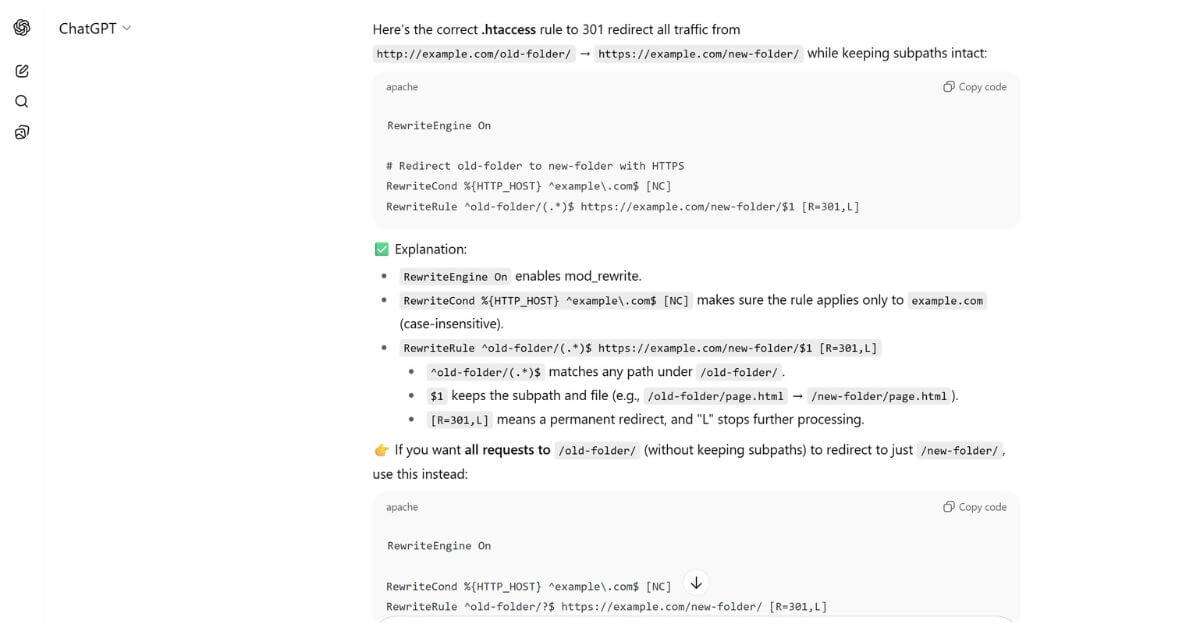
.htaccess Prompt:
Generate a 301 redirect rule for an .htaccess file to redirect all traffic from http://example.com/old-folder/ to https://example.com/new-folder/.
The output ChatGPT produced has two variations and an explanation for newbies like me.
Hreflang Prompt:
Generate the hreflang tags for a page that has three versions: one for the US (en-us), one for Great Britain (en-gb), and a global version in English (en-x-default).
Link Building Assistance With ChatGPT
To be honest, at first, I was skeptical about using AI for something as human-centric as link building.
But I decided to test it on a campaign for a client in the hyper-competitive SaaS niche. They offer a type of project management tool, and we had just published a new data report on the State of Remote Work Productivity, full of original survey data.
Instead of just blasting it out, I used ChatGPT to brainstorm 10 distinct outreach personas. It identified targets I hadn’t considered, like HR tech journalists, “Future of Work” bloggers, and editors at business leadership publications.
Then, I had it craft a unique email pitch for each persona. For the HR journalist, the pitch highlighted data on employee burnout. For the tech blogger, it focused on the role of the software stack in productivity.
The AI-generated drafts were about 80% of the way there. I spent an hour refining them, adding a personal touch and referencing a recent article each journalist had written.
The result?
We secured high-authority backlinks from three major tech publications and a leading business journal within two weeks—a process that would have previously taken my team a month of manual work. ChatGPT turned out to be a great digital PR link building assistant.
1. Crafting Personalized Outreach Emails
Instead of blasting out generic, cookie-cutter messages, you can create a solid foundation with a few well-crafted email templates and have the AI customize them at scale. This lets you connect with dozens or hundreds of prospects while each message still feels personal and relevant.
Guest Post Pitch Prompt:
Write a persuasive but concise guest post pitch to the editor of a marketing blog. My proposed title is “5 Ways AI Is Changing SEO.” Mention that I have over 10 years of experience and have written for [mention a notable publication]. Keep the email under 150 words.
Here’s the output generated by ChatGPT:
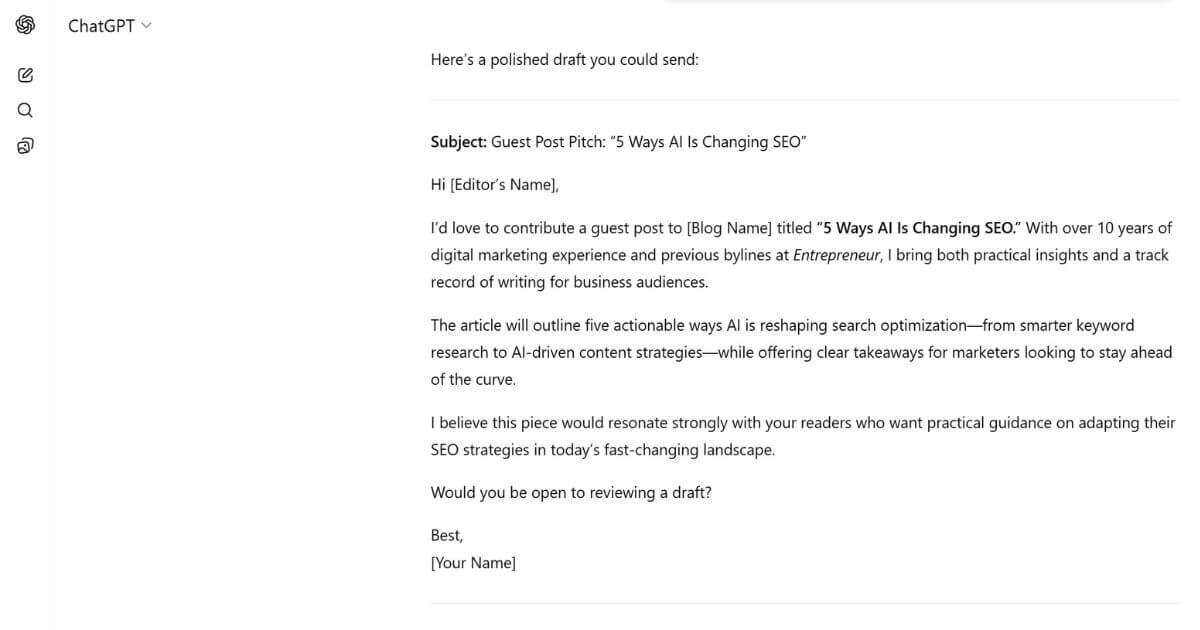
Personally, I would tweak the subject line and the content a bit, but having a quickly generated version to work with is better than starting from scratch.
2. Generating Ideas for Linkable Assets
A linkable asset is a piece of content so valuable that other sites want to link to it. This could be an in-depth guide, original research, or a unique tool that solves a real problem for your audience. When created strategically, these assets not only attract backlinks but also build authority and long-term organic traffic.
Prompt Example:
Brainstorm five ideas for a linkable asset for a company that sells solar panels. The ideas should be data-driven or highly practical. Examples: an interactive calculator for solar savings, a data study on energy prices by state, or a comprehensive guide to installing DIY panels.
Here’s what ChatGPT suggested:
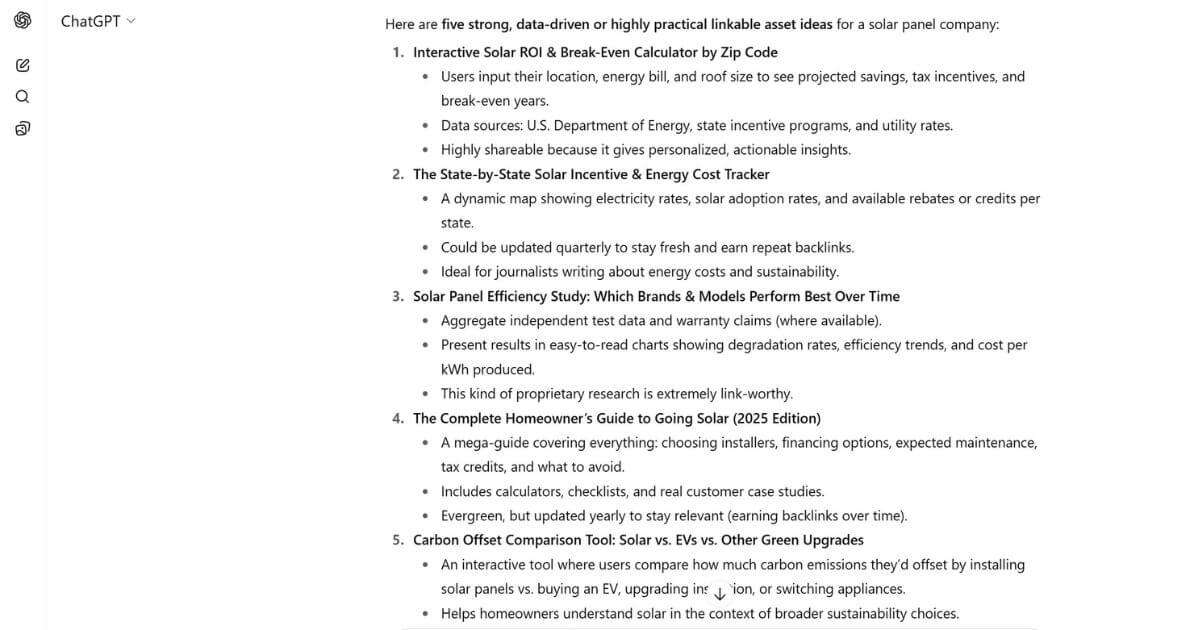
I think that these ideas are pretty good and can be turned into linkable assets.
Image Generation and Visual SEO
With the integration of models like DALL-E into ChatGPT, creating unique visuals for your content has never been easier.
1. Creating Unique Blog and Social Media Images
Stock photos are usually too generic and don’t align with your brand vision. Custom images grab attention, and ChatGPT can now create them.
Let’s test some image prompts now.
Prompt Example:
Generate a vibrant, photorealistic image for a blog post titled “The Future of Urban Gardening.” Show a futuristic rooftop garden in a bustling city with lush greenery, no people.
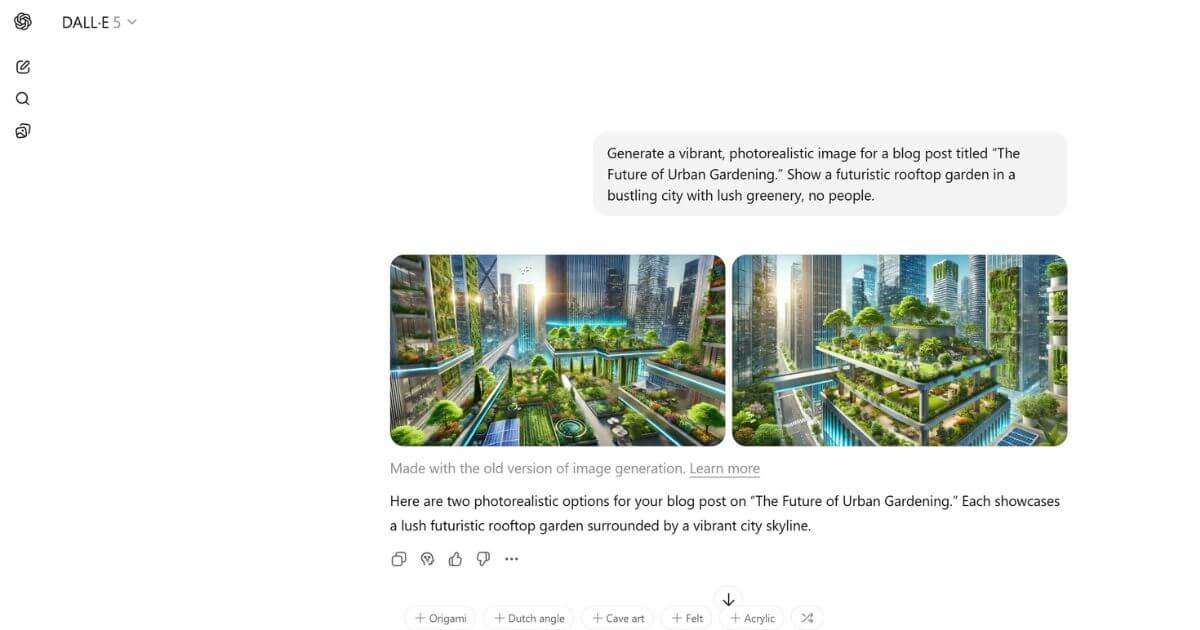
At this point, I’d say this option doesn’t work so well with complex prompts.
Simpler image generation prompts work better. Here’s an example:
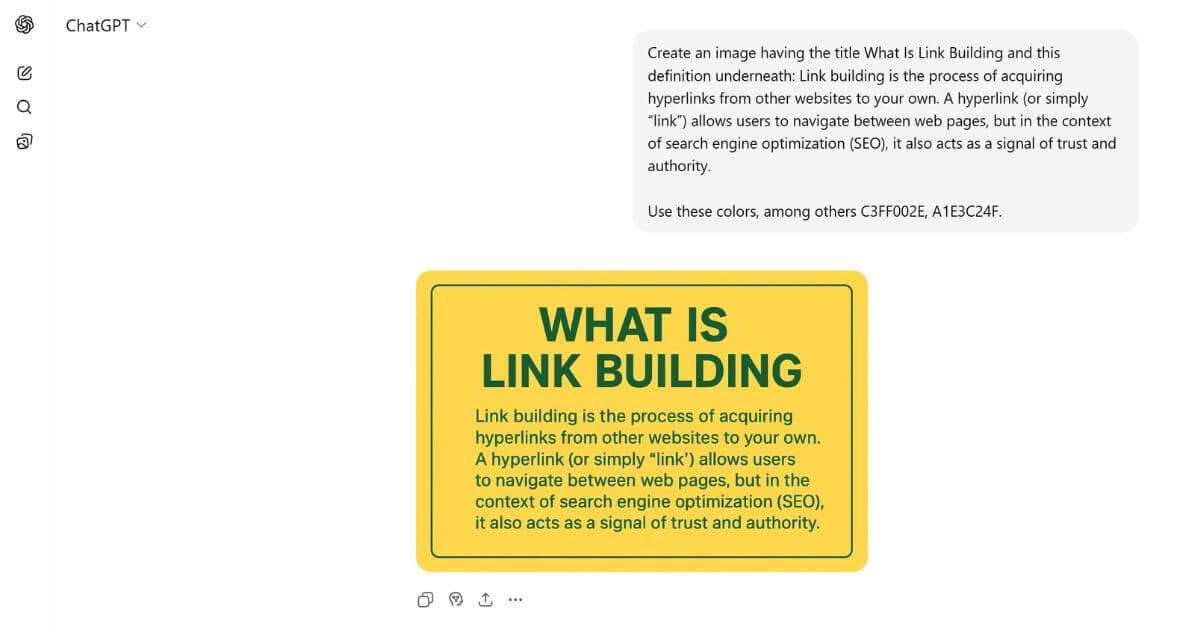
2. Writing Optimized Alt Text and Captions
Alt text is a short description of an image used for accessibility and image SEO. ChatGPT can write short, descriptive, and keyword-rich alt text in seconds.
Prompt Example:
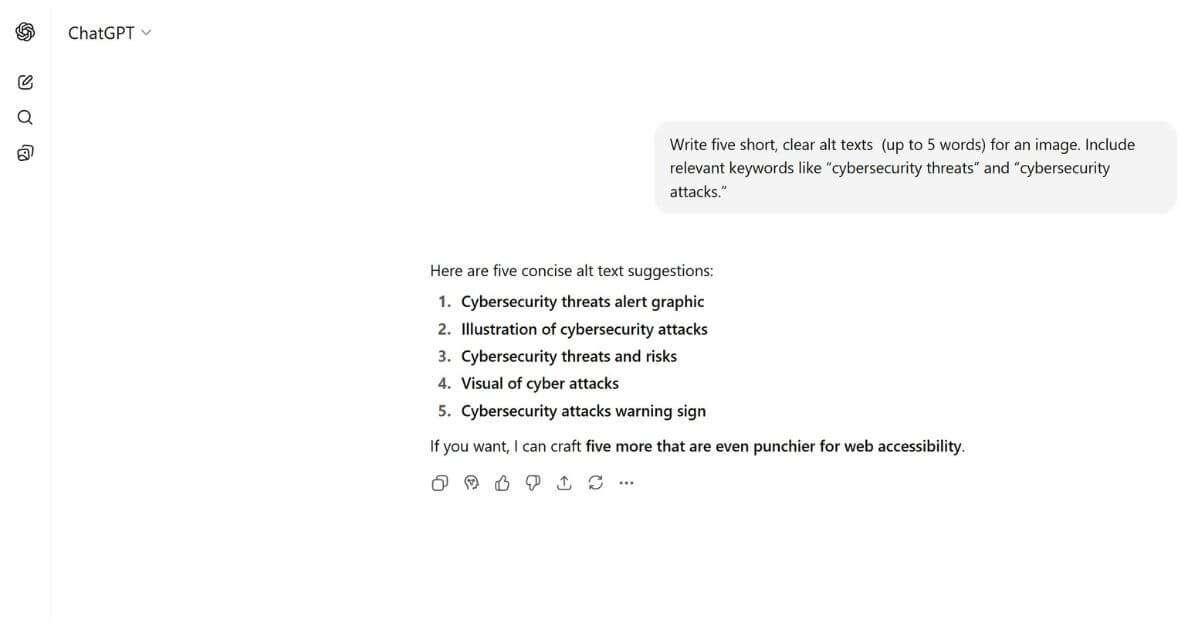
Write five short, clear alt texts (up to 5 words) for an image. Include relevant keywords like “cybersecurity threats” and “cybersecurity attacks.”
Here’s the result:
Other Unique and Interesting ChatGPT Use Cases
The applications of ChatGPT AI in SEO are limited only by your creativity. Here are a few more advanced strategies:
- Local SEO domination: Generate dozens of unique Google Business Profile posts about your services, promotions, or events. Create location-specific service page content by swapping out city names and local landmarks.
- eCommerce product descriptions at scale: Feed ChatGPT a spreadsheet of product specs and have it generate unique, benefit-driven product descriptions for hundreds of SKUs, avoiding duplicate content issues.
- Content repurposing engine: Paste the text of a long-form blog post and ask ChatGPT to repurpose it into a script for a 5-minute YouTube video, a 10-tweet thread, and five engaging LinkedIn posts.
- Simple code generation: Need a simple Python script to scrape the titles from a list of URLs? Or a JavaScript snippet to calculate something on a landing page? ChatGPT can often write the code for you, saving you development time.
The Future of SEO: Generative Engine Optimization (GEO)
As search engines like Google continue to integrate generative AI into their core results (with features like the Search Generative Experience), a new discipline is emerging: Generative Engine Optimization (GEO). This is the practice of optimizing your content to be the primary source for AI-generated answers.
Here’s what GEO focuses on:
- Clarity and factual accuracy: AI models need content that is clear, concise, and factually correct. Citing sources and providing data becomes paramount.
- Structured content: Using clear headings (H2s, H3s), lists, and robust schema markup helps AI models parse and extract information accurately.
- Authoritative voice: Demonstrating expertise through in-depth content and a confident tone can signal to the AI that your content is a reliable source.
By following modern SEO best practices and especially the hints in Google’s helpful content document, you are already on your way to optimizing for GEO.
Wrap Up
Here’s the obvious truth:
ChatGPT has changed how SEO professionals handle their daily work. It helps across different areas of optimization work.
But the best results of using ChatGPT for SEO happen when you treat AI as a partner, not a replacement for human judgment. The technology takes care of repetitive, time-consuming tasks so SEOs can focus on strategy, creative solutions, and getting real results for clients.
Search engine optimization is becoming more of a team effort between human creativity and machine power. This pairing creates smoother workflows without losing the strategic thinking that produces real improvements in search performance.
FAQ
Can Google detect AI-generated content?
Google’s primary focus is on content quality, not its origin. High-quality, helpful content is rewarded, whether it’s written by a human or an AI. However, low-quality, spammy content created solely to manipulate rankings can be detected and penalized. The emphasis is on value, not the method of creation.
What are the limitations of using ChatGPT for SEO?
The main limitations include the potential for generating factually incorrect or outdated information (always fact-check), a lack of true creativity and personal experience (your unique insights are still vital), and an inability to understand real-time trends or data without access to the live internet.
How can I write effective ChatGPT prompts for SEO tasks?
The best ChatGPT prompts are specific, provide context, and define the desired role, format, and tone. For example, instead of “write about SEO,” use “Act as an SEO expert and write a 500-word introduction to a blog post about the importance of link building for a beginner audience, using a helpful and encouraging tone.”
Will AI replace SEO experts?
No. AI will replace repetitive tasks, not strategic thinking. SEO professionals who learn to leverage AI tools like ChatGPT will become more efficient, data-driven, and valuable. The need for strategy, critical thinking, client communication, and creativity will remain essential human skills.
What’s the best way to fact-check information from ChatGPT?
Always cross-reference information with authoritative sources, especially for statistics, dates, or technical details. Use trusted industry websites, academic papers, and official documentation to verify any claims made by the ChatGPT AI. Never take its output as an absolute fact without verification.


