The secret to how to get press coverage for your small business lies in getting journalists to see your story as the one worth telling.
I’m Bilyana, and for the past 3 years, I’ve helped small businesses turn everyday wins into headlines in local and niche media.
In this guide, I’ll walk you through:
- How to find a newsworthy angle that grabs media attention.
- How to write pitches journalists respond to.
- How to turn a single email into a media momentum.
Follow these steps, and you’ll know exactly how to earn coverage that builds trust, attracts customers, and keeps delivering results long after it goes live.
Highlights
- Positive press coverage comes from a strategic, well-researched approach, not random outreach.
- A newsworthy angle is the foundation of any successful media pitch.
- A well-structured press release makes it easier for journalists to cover your story.
- Target media outlets your ideal customers read or follow.
- Building genuine, long-term relationships with journalists increases your chances of coverage.
- Use both proactive (creating stories) and reactive (responding to opportunities) PR strategies.
What Is Media Coverage?
Media coverage is when a newspaper, magazine, blog, podcast, TV program, or social media account talks about your business and shares it with their audience.
In the digital space, it often takes the form of:
- A full article about your story
- A brief mention in a piece
- A journalist quoting you as an expert
Unlike advertising, you don’t pay for this kind of attention. You earn it by offering something interesting, relevant, or useful enough for others to share. And because it comes from a third party, audiences often see it as an unbiased perspective rather than a sales message.
Benefits of Media Coverage
For small businesses, media coverage can be a turning point. It can create opportunities that last long after the original mention.
Media coverage benefits small businesses by:
- Building trust with potential customers.
- Reaching people you wouldn’t reach otherwise.
- Expanding awareness beyond your existing audience.
- Leading to collaborations, partnerships, and new sales channels.
- Improving your visibility in search results through PR backlinks.
- Continuing to work for you over time; one mention can keep bringing attention months or even years later.
And the best part?
You don’t need a big PR budget to get started.
Types of Media Coverage Approaches
There are two ways for a small business to approach PR. It all comes down to choosing the right one for your press coverage goals.
Proactive PR (Digital PR Campaigns)
With Proactive PR, you create newsworthy content with the specific goal of earning media coverage. It’s also great for SEO, since it can earn you a ton of valuable backlinks. That’s one of the main benefits of digital PR.
Examples include publishing original data studies, running creative stunts, launching interactive tools, or releasing industry reports.
In short:
You’re not waiting for news to happen—you’re making it.
If your goal is long-term brand visibility, proactive PR is the way to go.
Reactive PR (HARO Link Building)
Reactive PR involves responding to media opportunities as they appear.
What it means:
You need to keep an eye on journalist queries in platforms like Qwoted, Featured, and Help a B2B Writer, and offer your commentary when appropriate. If you can provide them quickly, you can land coverage in hours, not weeks.
If you’re after quick wins and chances to share your expert take, reactive PR can get you results faster.
In the next section, we’ll dive into practical strategies small businesses can use to attract this kind of media attention, even on a limited budget.
How to Get Press Coverage For Your Small Business
A lot of people think getting the press to talk about your brand is just a matter of luck. And sometimes it is.
But here’s the thing: your chances skyrocket once you have a clear plan and strategy in place.
So, how do you make that happen?
By making your story impossible to ignore.
Here’s the step-by-step approach I’ve used to get press coverage for my digital PR efforts that you can use too.
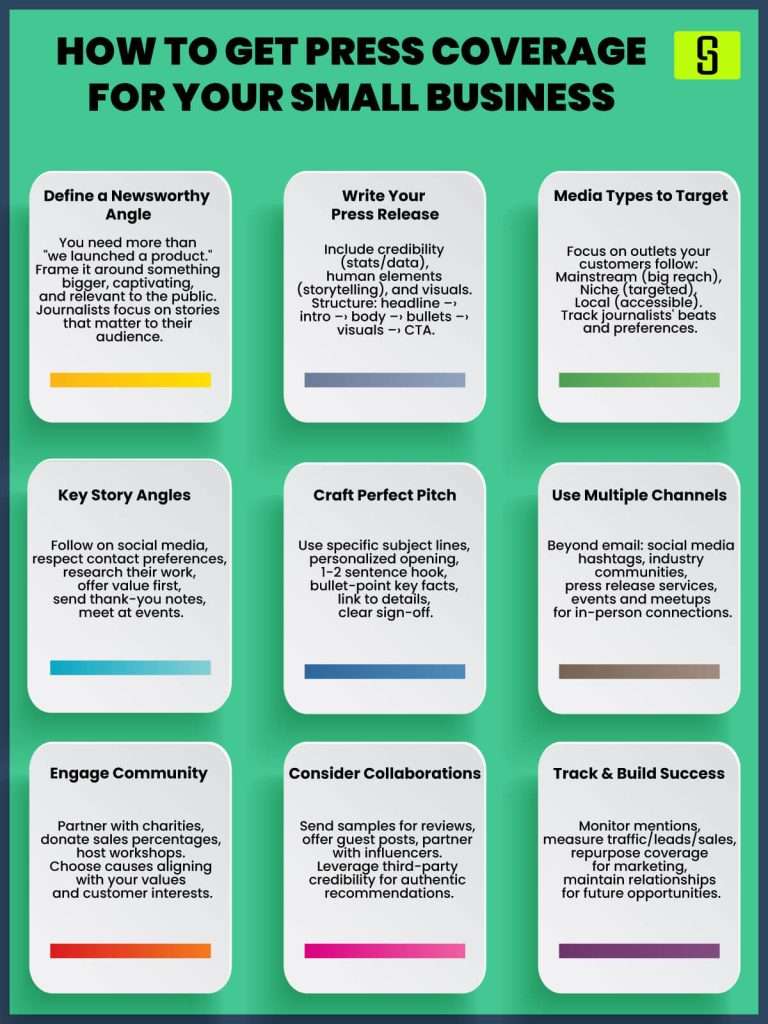
1. Define a Newsworthy Angle For Your Story
If you want to get featured on news sites, you will need more than “we launched a product.”
Announcing a product launch isn’t bad, but it works much better if you frame it around something bigger, something captivating, and more relevant to the public.
If there’s one thing I’ve learned about getting media attention, it’s that journalists focus on stories that matter to their audience.
So, ask yourself:
- Does my story tie to a bigger trend?
- Does it highlight or solve a problem?
- Is there a human-centered angle to it?
- Is there local interest?
These questions will help you identify reasons why reporters should care about covering your small business’s story.
2. Write Your Press Release
Once you have your angle, it’s time to turn it into a press release.
This will be the main piece you share with the media, so it needs to be packaged in a way that makes a journalist’s job easy.
Ideally, they should be able to copy and paste sections straight into their article with little to no editing.
For me, a press release that gets featured in the media usually includes:
- Credibility: statistics, industry data, or case studies.
- Human element: storytelling, honest opinions, and an authentic narrative.
- Visuals: photos, videos, or infographics that are ready to use.
Here’s the structure I use to bring all of that together in one press release:
- Start with a headline that sums up the story in one clear line.
- Follow with an introductory paragraph that’s short, fact-filled, and designed to spark interest.
- Write the body of the press release to unravel your story. This is where you weave in your human element, so it doesn’t read like an ad.
- Include bullet points that highlight quick facts for easy scanning.
- Add visuals such as images, videos, or charts that bring the story to life.
- Finish with a call to action that tells people exactly what to do next.
- Add a “Notes to editors” section with a short company background and contact details.
The goal is simple: make it effortless for journalists (and readers) to scan, understand, and reuse your story without having to dig for the main points.
3. Identify Your Target Media and Audience
Not all press is equal. You’ll get better results if you focus on the outlets your ideal customers read or follow.
Think about the different types of media you can approach:
- Mainstream media has a big reach, but it is very competitive for small businesses to break into.
- Niche publications cater to a smaller audience, often more relevant, but highly targeted.
- Local outlets are more accessible and often open to covering small businesses.
Pro tip:
I keep a simple spreadsheet of journalists and editors who cover industries I usually work with.
For each one, I note the topics they write about, their tone, and a few examples of recent work. So, when it’s time to pitch, I already know who’s likely to be interested and how they like to be approached.
4. Build Relationships With Journalists
I’ll be honest—building connections with reporters is one of the hardest parts of digital PR.
But here’s the good news:
Journalists rely on PR specialists to bring them meaningful and engaging stories.
And when you understand what they need and respect how they work, you can become one of their go-to sources.
Here are some dos and don’ts I’ve found work best for getting media attention:
Dos:
- Follow them on social media (primarily LinkedIn and X) to see what they cover and share.
- Respect their preferred contact method (96% of journalists prefer email pitches).
- Research their recent work so you understand their beat and audience.
- Offer value first: share useful data, quotes, or unique story ideas.
- Send a thank-you note when they feature you.
- Meet in person at industry events (when possible).
Don’ts:
- Don’t spam them with multiple follow-ups (one is enough).
- Don’t pitch irrelevant stories that don’t fit their topics.
- Don’t start the conversation with a request for media coverage email.
- Don’t send attachments, especially heavy ones.
- Don’t treat the relationship as purely transactional.
- Don’t ignore their published work until you need something.
Strong journalist relationships aren’t built overnight. But when you invest in them, you stop being just another pitch email in their inbox—you become a trusted source.
5. Write Your Pitch
A great pitch makes life easy for the journalist. You should make it easy for them to recognize why the story matters and have everything they need to work with it.
Here’s the structure I use:
- Subject line: Short and specific; like a headline, not clickbait.
- Opening line: Personalize it. Mention why you think they might be interested in covering this story. Was it their recent story that made you feel that way? Or do you think it matches their style? Remember: it MUST be about them, not about you.
- The hook: 1–2 sentences on why this story matters now. Tie it to trends, events, or a timely angle.
- Main points: A bullet list with key facts: who, what, when, where, and why it’s relevant. Keep it tight.
- Link to more details: Add a single sentence like: For more details, you can find the full story here: [Your Link]
- Assets: Link to photos, videos, or infographics—only if necessary.
- Sign-off: Short, friendly, with a clear next step (e.g, “Happy to arrange an interview or provide additional info”). Don’t forget to include your contact information.
Here is a simple pitch template you can use:
Subject line: New report: [X in Y people] say [key finding/impact]
I came across your recent piece on [topic the journalist covers] and thought these new findings could be a strong fit for your coverage.
A new [nationwide/regional/industry] survey highlights how [main issue] is shaping [everyday decisions/industry trends], pointing to shifts that may define [timeframe/future].
The report was conducted by [Organization/Research Firm Name]. It is based on a survey of [Number of respondents + demographic/location] about [topic surveyed]. The data was collected in [Month–Month, Year], and the full report was released on [Release Date].
Key findings:
– [X%] of respondents say [finding #1]
– [X%] report [finding #2]
– [X in Y] delayed [finding #3]
– [Group A] are [Z times more likely than Group B] to [finding #4]
These results illustrate how [audience/consumers/households/industry] are adapting to [challenge/trend], with clear implications for [markets/industry/policy].
You can view the full press release and report here: [Insert Link]
Happy to provide more details, connect you with [Lead Analyst/Executive Name], or share additional data for your story.
Best,
[Your Name]
[Your Title / Organization]
[Your Email]
[Your Phone Number]
6. Use Multiple Channels to Reach Out
While email is still the most common way to pitch, it’s not the only place journalists find stories.
A big part of digital PR is putting your news where they’re already hanging out and looking for ideas.
Here’s how you can get press attention otherwise:
- Social media: Follow relevant hashtags, X lists, and LinkedIn groups where journalists in your niche ask for sources.
- Industry communities: Some reporters browse sector-specific Reddit groups for insights and story ideas.
- Press release distribution services: While not a replacement for targeted outreach, platforms like PR Newswire or Business Wire can help your story surface in searches.
- Events and meetups: Trade shows, conferences, and local business events are still great places to mention your news to media contacts in person.
When you are active in spaces journalists already use, you’re halfway to figuring out how to get a reporter to cover your story.
7. Engage With Your Community and Support Causes
One of the easiest ways for a small business to get local press coverage is by showing up for the community. Reporters gladly cover stories about companies that make a real impact.
Think about:
- Partnering with a local charity or school on an event.
- Donating a percentage of sales to a cause you believe in.
- Hosting workshops or free training for the community.
Expert advice:
It’s important to choose causes that align with your values and your customers’ interests. Then, when you craft your story around the “why” behind your involvement, it looks natural and meaningful.
8. Consider Collaborations and Reviews
Partnering with other publishers can get you in front of audiences you wouldn’t reach on your own.
Here are a few ideas for you to try:
- Send product samples to journalists, bloggers, or YouTubers for honest reviews.
- Offer to participate in interviews or contribute guest posts to relevant publications.
- Team up with influencers or local personalities for joint campaigns.
When someone with credibility talks about your business, it works like a personal recommendation at scale. Plus, reviews and collaborations often lead to fresh content you can share across your own channels.
9. Track Your Results and Build on Success
Getting media coverage is great, but knowing what it’s doing for your business is even better. Otherwise, you won’t be able to see what’s working, double down on it, and turn one feature into many more.
- Monitor press mentions and track referral traffic, leads, or sales that result from them.
- Use your best coverage in marketing materials, sales decks, and on your website.
- Keep in touch with the journalists who featured you. They’re more likely to cover you again if you stay on their radar.
The real value comes from building on your wins. Each successful story can be the stepping stone to your next one.
Wrap Up
After three years in digital PR, I’ve learned that positive press isn’t about size or noise. It’s about fresh ideas and genuine relationships with the media.
Learning how to get press coverage for your small business means doing the groundwork: finding an angle that matters, packaging it so journalists can use it, and sharing it with the right people at the right time.
Stay persistent, stay creative, and keep telling your story. The more you show up, the more likely you are to stay on a journalist’s radar.
FAQ
How do I establish contacts with the press to get free coverage on my business?
Start by identifying journalists who already cover topics related to your business. Read their recent work so you understand their style and audience. If your story genuinely fits what they write about, reach out with a short, relevant introduction explaining the connection. Keep it professional, concise, and respectful of their time.
What are the most effective ways to find journalists interested in my niche?
Search for articles on your topic using Google News and see who wrote them. Media databases like MuckRack and LinkedIn can also come in handy when looking for the right contacts. Moreover, platforms like HARO and Qwoted also connect you with reporters looking for sources in specific industries.
How can I craft a compelling story to attract media attention for my business?
Focus on a clear, newsworthy angle that ties your business to a broader trend or problem. Include credible data, strong quotes, and a human element where possible. Write it in a way that could work as an article, not a sales pitch.
What common mistakes should I avoid when pitching to the press?
Avoid sending generic mass emails, pitching stories irrelevant to a journalist’s topics, overhyping without evidence, attaching large files instead of linking to them, and following up excessively.
How early should I send press releases before an event or launch?
Generally, send them 1–2 weeks in advance for local and trade publications, and 3–4 weeks for national media. This gives journalists time to plan, but not so much time that the story feels stale.
How can I leverage social media to supplement press coverage efforts?
Share your media coverage on your social channels, tag the publication and journalist, and encourage engagement. Use relevant hashtags and join conversations where your story fits. You can also use social platforms to connect directly with journalists and respond to their public requests for sources.