

A lead generation funnel is a systematic process that guides potential customers from initial awareness of your brand to taking a desired action, such as making a purchase or signing up for a service.
For the past decade, I’ve been working in digital marketing and SEO, and I’ve seen one truth play out time and again: traffic is a vanity metric if it doesn’t convert.
You can drive visitors to your site, but without a robust system to capture and nurture them, your efforts are ineffective. This guide is your roadmap to doing just that—getting the right traffic and nurturing it.
Ready to stop guessing and start converting?
Let’s dive right in.
Highlights
- A lead generation funnel turns strangers into paying customers through a multi-step process.
- SEO and link building are critical for driving organic traffic to the top of your funnel.
- The funnel has three main stages: top (TOFU), middle (MOFU), and bottom (BOFU).
- High-value content, like a lead magnet, is essential for capturing a visitor’s contact information.
- Consistent optimization and testing are necessary for improving your conversion rates over time.
What Is a Lead Generation Funnel?
A lead generation funnel is a marketing and sales methodology designed to capture leads. It’s a visual representation of the customer journey, from the very first time a person hears about your business to the moment they become a paying customer.
The funnel shape is intentional:
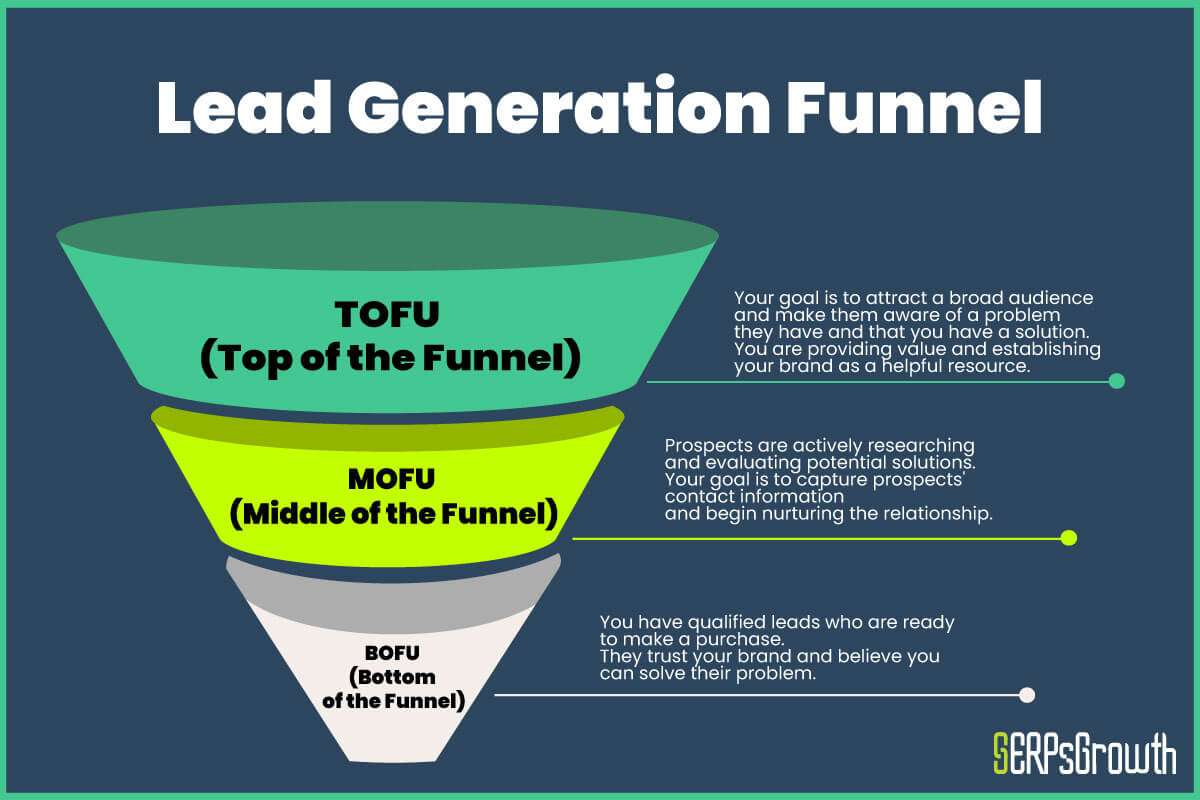
You start with a wide audience at the top, and as you move down, the audience becomes smaller but more qualified and closer to making a purchasing decision.
The core purpose of a leads funnel strategy is to create a predictable and repeatable process for attracting, engaging, and converting prospects. It removes the guesswork from your marketing and sales efforts.
So, instead of randomly throwing marketing tactics at the wall and hoping something sticks, the funnel provides a clear path. Each stage has a specific goal, and you use targeted content and strategies to move prospects smoothly from one stage to the next.
Lead Generation Funnel Stages
Now, let’s break down the funnel journey from a stranger to a customer.
Top of the Funnel (TOFU): Awareness and Attraction
At the top, your goal is to attract a broad audience and make them aware of a problem they have and that you have a solution.
The content here must be educational, informative, and free of hard selling because you are building trust and authority.
The primary marketing tactics for this stage include:
- Blog posts: Writing in-depth articles that address your audience’s common questions and pain points.
- Social media: Sharing valuable content and engaging with your community on platforms where they spend their time.
- SEO: Optimizing all your content to be discovered through search engines.
- Infographics and videos: Creating easily digestible and shareable content that explains complex topics simply.
At this point, you are not asking for an email address. You are simply providing value and establishing your brand as a helpful resource.
Middle of the Funnel (MOFU): Consideration and Nurturing
Once a prospect is aware of their problem and your brand, they move into the middle of the funnel. Here, they are actively researching and evaluating potential solutions.
Your goal is to capture their contact information and begin nurturing the relationship. This is where the lead magnet comes into play.
You offer a piece of high-value, gated content in exchange for their email address. Examples of a great lead magnet include:
- Ebooks or whitepapers
- Checklists or templates
- Webinars or video courses
- Case studies
After you capture the lead, the nurturing process begins. This often involves a series of automated email campaigns designed to build more trust, showcase your expertise, and gently guide them toward the final decision-making stage.
Bottom of the Funnel (BOFU): Decision and Conversion
At the bottom of the funnel, you have qualified leads who areready to make a purchase. They trust your brand and believe you can solve their problem.
The content and offers at this stage must be highly targeted and action-oriented, making it easy for them to convert.
This is where you present your core offer. Effective BOFU strategies include:
- Product demos: Offering a personalized walkthrough of your software or service.
- Free trials: Allowing prospects to experience your product firsthand for a limited time.
- Consultations or strategy sessions: Providing a one-on-one meeting to discuss their specific needs.
- Testimonials and reviews: Showcasing social proof to solidify their confidence in your solution.
The transition from a lead to a customer at this stage fills your sales pipeline and directly impacts your revenue.
How to Build a Lead Generation Funnel That Converts
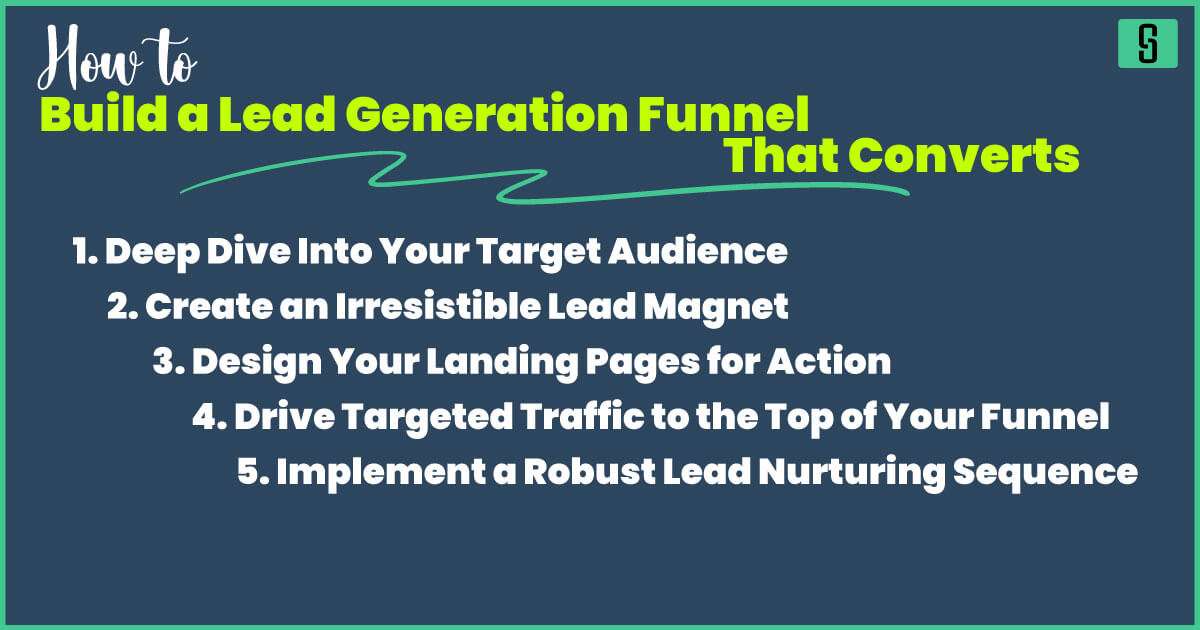
Now that you understand the theory, let’s get practical.
Building a successful lead gen funnel involves several key steps:
1. Deep Dive Into Your Target Audience
Everything starts with knowing your customer. You cannot create compelling content or a smooth customer journey without a deep understanding of who you’re talking to.
Go beyond basic demographics and explore:
What are their biggest challenges and pain points?
What are their business goals?
What motivates them?
Create detailed buyer personas to guide every decision you make in the funnel-building process.
2. Create an Irresistible Lead Magnet
Your lead magnet is the single most important element in the middle of your funnel. It must be so valuable that your ideal customer is more than willing to trade their email address for it.
It must offer a quick, specific solution to a pressing problem. So, don’t just create an ebook for the sake of it. Create a resource that will make a tangible impact.
3. Design Your Landing Pages for Action
Each offer, from your lead magnet to your product demo, needs a dedicated landing page. This page must have one goal only: to get the visitor to take a single, specific action.
Remove all distractions and focus on these elements:
- a compelling headline
- copy that clearly articulates the value of the offer
- a call-to-action (CTA) button that’s impossible to miss
4. Drive Targeted Traffic to the Top of Your Funnel
Use the TOFU strategies we discussed earlier (SEO, content marketing, and social media) to drive traffic to your blog posts and other top-of-funnel content.
The key here is to be strategic. Focus your efforts on the channels where your target audience is most active. Promote your content to generate leads and start filling your sales pipeline.
5. Implement a Robust Lead Nurturing Sequence
Once you capture a lead, the work isn’t over. In fact, it’s just beginning.
Use email marketing automation to deliver a sequence of messages that builds the relationship. Share more valuable content, tell stories, present case studies, and address common objections.
This lead nurturing process keeps your brand top-of-mind and builds the trust necessary to ask for the sale.
The Role of SEO and Link Building in Your Funnel
You can have the most sophisticated lead gen funnel in the world, but it’s useless if no one enters it.
This is where search engine optimization (SEO) plays a starring role. SEO is the engine that drives organic traffic—the lifeblood of top-of-funnel lead generation.
When your target audience searches for solutions to their problems, you need your website, blog posts, and landing pages to appear at the top of the search results.
The best part:
You’re not interrupting their day with an ad; you’re providing a solution right when they need it.
But it gets even better:
When you create truly valuable content (think ultimate guides, original research, or free tools), other authoritative sites will link back to it. These backlinks are like votes of confidence in the eyes of search engines, pushing your pages higher in the rankings.
More importantly, each link is a new pathway for qualified leads to discover your brand and enter your lead generation marketing funnel.
My Personal Playbook: A Lead Generation Funnel Example That Worked
A few years ago, I worked with a SaaS client. Their problem was common: they had decent website traffic but a very low conversion rate for their free trial. Their existing funnel was just a Sign Up button on their homepage.
Here’s how I built their funnel:
- Instead of asking for the sale immediately, we created a TOFU piece of content: a comprehensive guide. I used SEO to rank this guide for dozens of long-tail keywords.
- Then, we created a MOFU lead magnet: a downloadable checklist. We offered this checklist within the blog post, on a dedicated landing page, and through exit-intent pop-ups. This simple checklist was a huge hit, and their email list grew by 200% in two months.
- Finally, we built a 5-day email nurturing sequence. It provided more tips, shared a case study, and on the final day, it presented a special offer for a personalized demo and an extended free trial. This new lead funnel increased their qualified leads by over 120% and their trial-to-customer conversion rate went up by 20%.
This is a perfect lead funnel example of how a strategic approach works.
Wrap Up
A well-executed lead generation funnel is the most reliable way to generate a steady stream of qualified leads and customers for your business.
It transforms your marketing from a series of random acts into a predictable, scalable system for growth.
By implementing integrated marketing strategies for brands, companies can send a cohesive message that resonates across all platforms. This holistic approach not only strengthens brand identity but also enhances customer engagement, leading to increased loyalty. Ultimately, these strategies allow brands to effectively measure their impact and adjust tactics for optimal performance.
By understanding your customer funnel, creating valuable content for each stage, and driving traffic with powerful strategies like SEO and link building, you create a true asset for your business.
Remember, the journey requires a commitment to understanding your customer and consistently optimizing your approach.
FAQ
How long does it take to see results from a lead generation funnel?
Results can vary based on your industry, offer, and traffic sources. With a strong SEO foundation, you might start seeing initial leads within the first 1–3 months, but a fully optimized funnel that delivers consistent, high-quality leads often takes 6–12 months to build and refine.
What are the most important metrics to track for a lead funnel?
You should track metrics for each stage. Key metrics include: Traffic (by channel), Landing Page Conversion Rate, Cost Per Lead (CPL), Lead-to-Customer Conversion Rate, and Customer Lifetime Value (CLV).
Can a lead generation funnel work for any type of business?
Yes. While the specific tactics might change, the principles of attracting, engaging, and converting prospects apply to B2B, B2C, SaaS, ecommerce, and service-based businesses. The key is to tailor the content and offers to your specific target audience.
What’s the difference between a sales funnel and a lead generation funnel?
A lead generation funnel focuses specifically on the top and middle stages—attracting visitors and converting them into leads. A sales funnel covers the entire journey, including the final steps of converting those leads into paying customers (sales pipeline management).


