

SEO for B2B is a powerful driver of high-quality leads, brand credibility, and long-term growth for business-to-business (B2B) companies.
If you’re not investing in a bold and data-driven SEO for B2B strategy, you’re leaving money on the table and letting your competitors eat your lunch.
In this guide, I’ll break down why mastering B2B search engine optimization is non-negotiable, how to build a winning plan, and what it takes to outperform in the most competitive verticals.
Ready to gain knowledge from a seasoned expert?
Then, stick around to discover working tactics plus real-world lessons from a decade in the B2B SEO game.
Highlights
- B2B SEO helps attract leads, build trust, and increase sales.
- Data-driven keyword research and buyer persona mapping are mission-critical.
- Content must solve pain points for complex B2B decision makers at every funnel stage.
- Link building and technical SEO separate top B2B players from the rest.
Why SEO for B2B Is the Growth Engine You Can’t Ignore
Why is SEO important for B2B?
The answer is simple: decision makers search before they buy.
Unlike B2C (business-to-customer), the B2B buying cycle is longer, the stakes are higher, and the path to purchase is filled with research, comparison, and internal debate.
So, if you’re not visible when people search, you’re invisible when it matters most.
B2B SEO isn’t just about ranking for vanity keywords. It’s about owning the conversation at every step of the decision-making process and reaching influencers, researchers, and C-suite buyers. You also need to create content that addresses every pain point with surgical precision.
The High Stakes of Business-to-Business SEO
Complex sales funnels, niche audiences, and long sales cycles make business-to-business SEO a unique beast.
Here, you’re not just targeting a single buyer but entire buying committees. That means your content strategy, keyword research, and technical SEO must be up to par.
Plus, the B2B buying funnel is intricate and involves multiple stages, such as:
- Initial research by junior staff or analysts.
- Internal presentations and budget approvals.
- Technical evaluations by IT or subject matter experts.
- Final sign-off from directors or the C-suite.
That’s why you must create content that speaks to every persona and answers the questions at each funnel stage.
And since the search journey is rarely linear, your strategy can’t be, either.
How to Build a Bulletproof B2B SEO Strategy
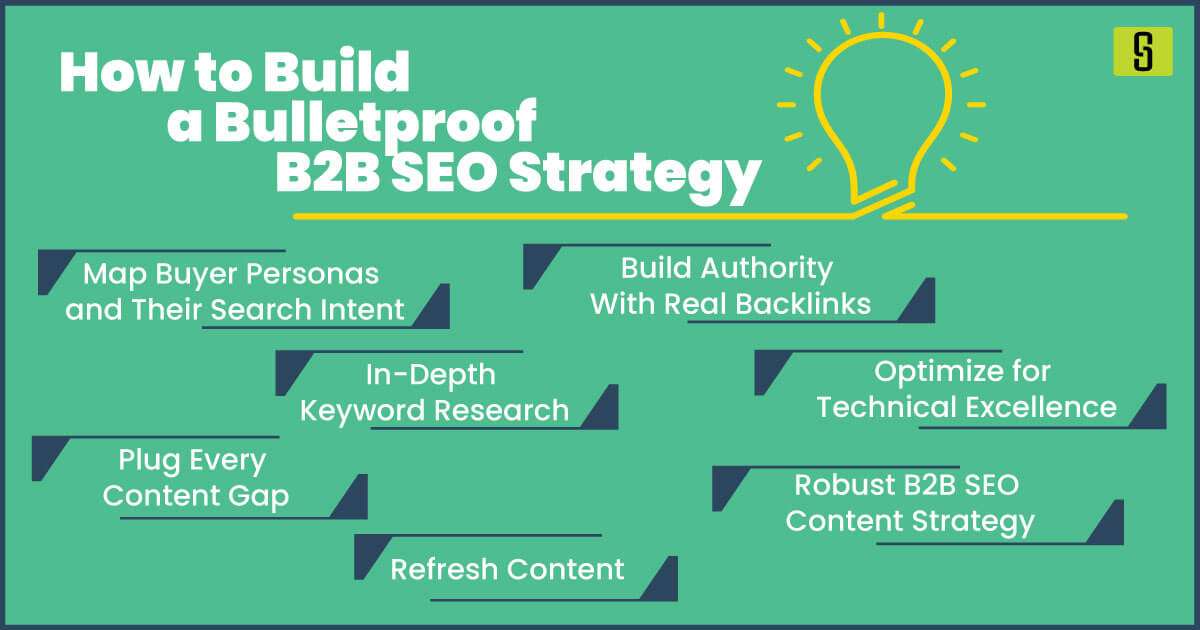
A strong B2B SEO strategy starts with understanding your buyers inside out. The days of generic blog content and random keyword stuffing are over.
Here’s how I build B2B SEO campaigns that deliver real results:
1. Map Buyer Personas and Their Search Intent
Buyer personas are at the core of successful B2B SEO. Each persona, whether a procurement officer, IT manager, or CEO, has different priorities and uses unique search terms at each stage of the buying cycle.
To gain insights into buyer personas, I suggest doing the following:
- Interview real customers and sales teams.
- Identify decision makers, influencers, and users.
- Map content to each stage of the sales funnel.
Action Step:
Create detailed buyer personas. Assign keywords, pain points, and decision triggers to each. Use CRM data and sales conversations to inform your personas.
2. In-Depth Keyword Research
In my experience, the real traffic and conversions come from long-tail, intent-rich queries. So, don’t just target the obvious head terms.
Focus on B2B SEO keywords that match your audience’s search habits, pain points, and buying cycle. Use intent-driven queries, such as:
- “best [solution] for [industry]”
- “how to solve [pain point] in [sector]”
- “Top rated B2B SaaS platforms”
- “How to improve search engine optimization for manufacturing companies”
- “B2B SEO strategies for international expansion”
Leverage SEO tools for B2B like Ahrefs, Semrush, and Google Search Console for keyword data.
Action Step:
Identify the keywords and content topics your top three competitors rank for that you don’t. Fill these gaps with optimized, audience-centric content.
3. Plug Every Content Gap
Content gap analysis is your secret weapon. Audit your competitors’ top-ranking pages. Find unanswered questions and underserved topics, then create content that’s 10x better.
Remember that you’re not just competing with direct competitors. You’re up against publishers, industry blogs, and even forums.
Here’s what to do:
- Use Ahrefs’s Content Gap tool to find missing topics.
- Create in-depth blog content, whitepapers, and comparison landing pages.
- Address every question and pain point your audience has.
Action Step:
For each target keyword, read the top five ranking pages. Identify what they’re missing and then add it to your content. This is how you win featured snippets and People Also Ask boxes.
4. Build Authority With Real Backlinks
Manual outreach, digital PR, and niche edits get results. Skip the low-value links, and go for B2B SEO service providers who can land you real placements in industry publications.
B2B link building is about quality, not quantity. So, you must target links from:
- Industry associations
- Influential B2B blogs
- Digital trade publications
- Relevant SaaS directories
Action Step:
Pitch guest posts or data-driven insights to leading industry sites. Offer unique research, case studies, or expert commentary.
5. Optimize for Technical Excellence
A slow, clunky site with broken links and poor structure will sabotage even the best content. Conduct quarterly technical audits using Screaming Frog or Sitebulb.
Here’s what you must achieve:
- Lightning-fast page speed (under 2.5 seconds).
- Flawless mobile experience.
- Schema markup for rich SERP features.
- Crawlable, indexable site architecture.
Action Step:
Fix crawl errors, compress images, and ensure every landing page is indexed and optimized.
6. Robust B2B SEO Content Strategy
A successful B2B SEO content strategy focuses on the real problems your buyers face. You need to move beyond generic advice and create landing pages, blog content, and resources that:
- Speak directly to your target audience’s pain points.
- Guide users from awareness to decision with relevant search engine content.
- Build trust by showcasing case studies, testimonials, and data-driven insights.
Best practices dictate that every piece of content should serve a clear purpose in the funnel, from top-of-funnel thought leadership to bottom-of-funnel solution comparisons.
- Top of funnel: Educational blog posts, industry trend reports, “how-to” guides.
- Middle of funnel: Product comparisons, case studies, ROI calculators.
- Bottom of funnel: Demo requests, pricing pages, customer success stories.
Action Step:
Audit your existing content. Are you missing key funnel stages? Fill gaps with content tailored to each persona and decision stage.
7. Refresh Content
Updating old blog content with new data, examples, and stats revives rankings and keeps your audience engaged. Decision makers who’ll read your content want the freshest possible data. Regular updates also signal to search engines that your site is active and authoritative.
Action Step:
Identify blog posts that have lost rankings. Update them with new insights, visuals, and stronger calls-to-action.
B2B SEO Best Practices: What Works in 2025
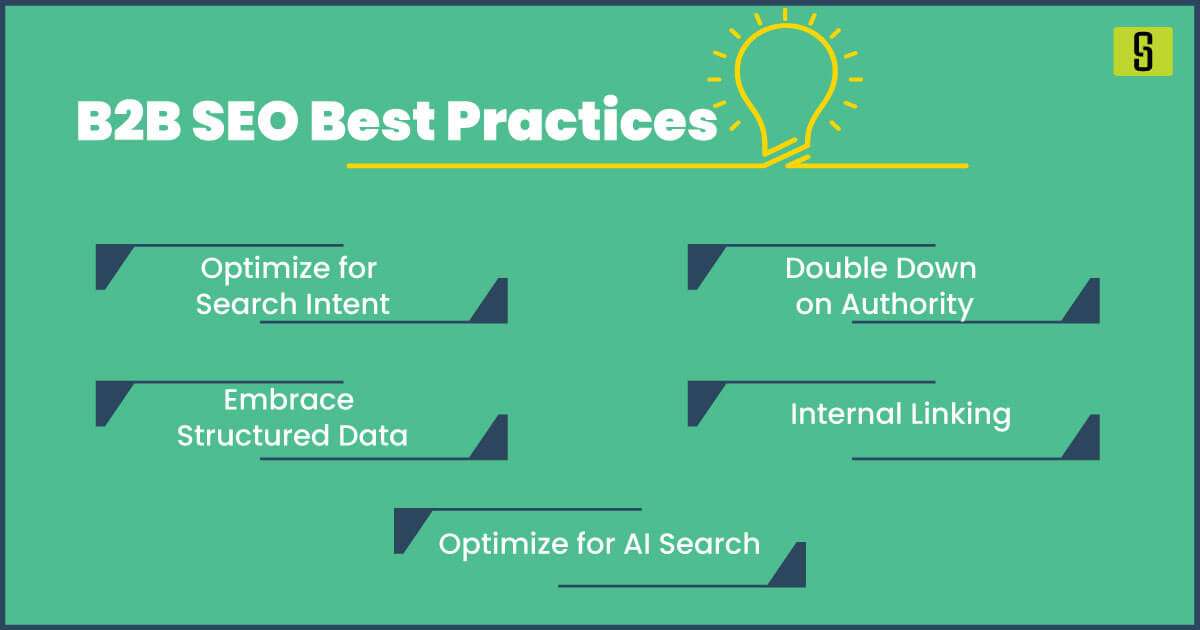
Here’s my list of the best B2B SEO practices in 2025 that every marketer should follow to stay relevant:
1. Optimize for Search Intent
Always align your content with the true intent behind every searched keyword. Understand what your target audience is really looking for—whether it’s information, a solution, or a comparison—and deliver answers that fit each stage of the buyer’s journey.
2. Double Down on Authority
Build trust through thought leadership, publishing original research, and showcasing industry awards or recognitions. Authoritative content and credible signals not only impress buyers but also send strong trust signals to search engines.
3. Embrace Structured Data
Use schema markup to help search engines better understand your pages. Structured data can earn you rich snippets, FAQs, and other SERP features that increase visibility and click-through rates.
4. Internal Linking
Strategically link related pages within your site to guide users and search engine bots to your most important and valuable content. Internal linking also helps distribute page authority and keeps visitors engaged longer on your site.
5. Optimize for AI Search
Optimize your content for AI-powered search engines and assistants by focusing on clear, concise answers and conversational language. As AI search tools become more sophisticated, prioritize content that directly and accurately addresses common questions and complex queries decision makers are likely to ask.
The Hard Truths About B2B SEO Tactics That Most Agencies Won’t Tell You
I want to share what I’ve learned after a decade of practicing B2B SEO.
First of all, superficial content won’t cut it. For high-value keywords and competitive niches, your content must be:
- Deeply researched
- Authored by subject matter experts
- Supported by data, visuals, and case studies
To achieve such depth and specificity, you must partner with in-house experts or industry consultants when creating complex content. Their real-world insights will resonate with decision makers and win trust.
Second, automated link building doesn’t work in B2B. You must build relationships with journalists, bloggers, and influencers in your industry. When you provide real value and expertise, they’ll reward you with high-quality backlinks.
I suggest hosting webinars or virtual events. Invite industry leaders, then publish recap posts and roundups. These attract natural links and shares.
These are a few more takeaways I’ve gathered over the course of my B2B SEO journey:
- SEO for B2B websites isn’t just about traffic; it’s about attracting qualified leads.
- Content must answer complex technical questions and compliance concerns.
- The best B2B search engine optimization campaigns integrate PPC, retargeting, and email nurturing.
- Localized landing pages and multilingual keyword research are non-negotiable for international B2B SEO.
My Wildest SEO for B2B Experiment: Content Personalization at Scale
Running a campaign for a SaaS client, I built 50+ hyper-personalized landing pages—each mapped to a unique vertical and buyer persona.
The result?
- 200% increase in decision maker engagement.
- 5x jump in organic conversion rates.
- Outranked every competitor for the most valuable transactional keywords.
Personalizing content for specific industries, company sizes, and job roles isn’t easy, but it pays off. You must use dynamic content blocks, industry-specific case studies, and tailored calls-to-action to succeed at this.
B2B SEO Tools I Use and Recommend
These are my go-to tools for delivering results to B2B clients:
- Ahrefs: for backlink auditing, content gap analysis, keyword research, and technical audits.
- Screaming Frog: for technical site audits.
- Google Search Console: for performance tracking and index management.
- Google Analytics: to track website traffic.
Wrap Up
SEO for B2B is the linchpin of modern digital marketing for business-to-business growth.
Those still treating SEO like a side project are already falling behind. Winning in B2B means owning your niche on the SERPs, anticipating buyer intent before your competitors even blink, and optimizing with laser precision.
It’s also worth understanding SEO vs SMM to determine where to allocate your marketing budget most effectively.
FAQ
How does B2B SEO differ from B2C SEO?
B2B SEO targets business buyers with longer sales cycles and more complex decision making. The focus is on highly specific keywords, in-depth content, and multi-persona targeting. B2C SEO targets individual consumers and focuses on quick conversions through emotionally-driven, product-focused content.
How do long sales cycles influence keyword targeting?
Long sales cycles require targeting keywords for every stage: educational terms for early research, solution-focused terms for consideration, and specific queries for final decisions. This ensures your content supports B2B prospects throughout their extended decision-making process.
How can B2B companies measure the true ROI of their SEO efforts?
B2B companies can measure SEO ROI by tracking organic leads, conversions, and revenue generated from search traffic. Tools like Google Analytics link keyword rankings and content performance directly to sales outcomes.
What are the top B2B SEO tactics in 2025?
In 2025, the top SEO tactics for B2B are content personalization, AI-assisted optimization, and structured data.


