Link building is one of the pillars of SEO—but it’s also the part most teams struggle with.
Think about it: you’re already buried in keyword research, content planning, technical audits, and the never-ending list of “urgent” tasks. By the time you get to link building, the energy (and hours) are gone.
That’s why so many marketers decide to outsource backlink building.
I’m Nikola, and after more than a decade in SEO, I’ve seen how the right approach to outsourcing can transform campaigns for agencies, in-house teams, and independent consultants.
In this guide, I’ll walk you through when it actually makes sense to bring in outside help—and how to do it in a way that’s smooth, cost-effective, and drives real results.
Highlights
- Know your backlink needs, goals, and budget before hiring a provider.
- Prepare your website first: strong technical SEO and high-quality content make your site link-worthy.
- Vet providers carefully: look for specialization, proof of results, and transparent communication.
- Set expectations early by clearly defining KPIs, deliverables, and reporting standards to prevent misalignment.
- Stay involved—collaboration on strategy and content leads to stronger, long-term results.
- Always verify reports: check link quality, anchor texts, and the impact on rankings over time.
How to Outsource Backlink Building: Step-by-Step Guide
If you’re considering outsourcing link building, the best way to maximize its effectiveness is to follow a clear and well-defined process.
Over the years, I’ve seen what works and what doesn’t, so here’s the approach I recommend to anyone who wants to acquire backlinks from service professionals the right way.
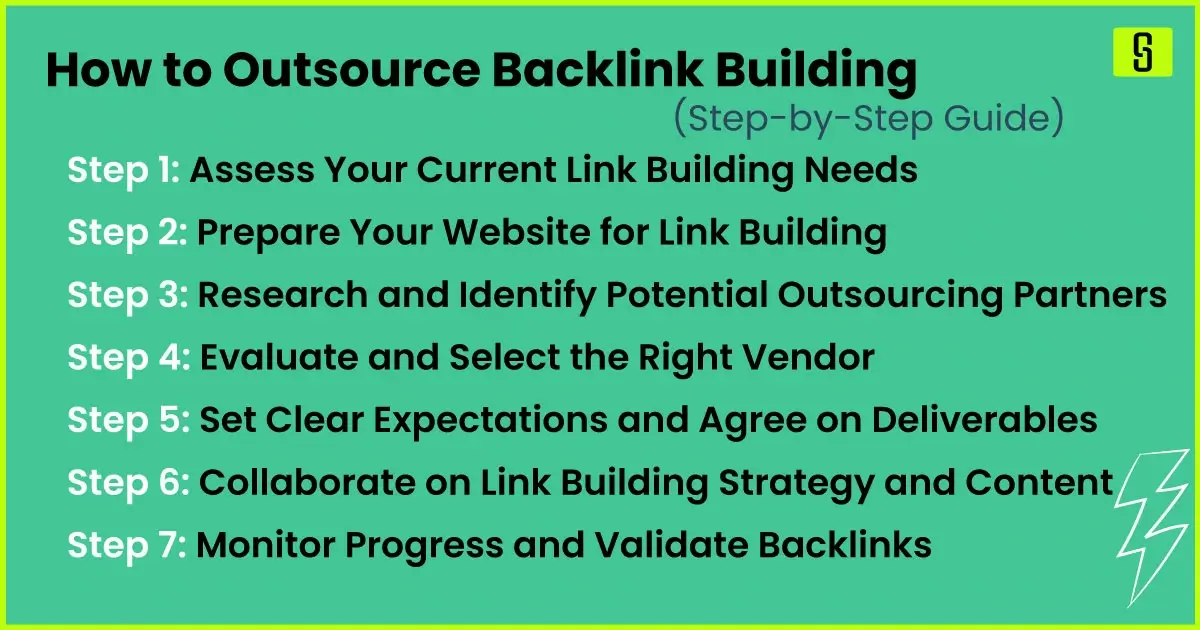
Step 1: Assess Your Current Link Building Needs
One common thing I’ve noticed when working with clients is that many aren’t fully clear on what they actually need from link building.
Before you hand the work over to someone else, you need to understand where you stand and what you want to achieve.
Agencies
For agencies, the challenge is usually scale.
With multiple clients on your plate, it’s not realistic to give every campaign the same attention.
If you’re an agency and want to outsource backlink building, my advice for you is to start by answering two simple questions:
- Which clients need link building the most?
- What kind of results do you expect—steady monthly links, industry-specific placements, or a one-off push for a new campaign?
In-house SEO teams
In-house SEO teams often face the opposite problem: too many competing priorities and a limited budget.
As someone who used to lead an in-house team, I know that when you’re responsible for every aspect of SEO, most of the team’s time is absorbed by other priorities. And, in the chase for quick results, off-site strategies like link building are often left behind.
Since in-house teams need more targeted results, it’s best to know which parts of the business website would benefit most from outsourced backlinks.
Do you want to improve visibility for money-making keywords?
Or perhaps, your strategy is focused on improving the topical authority of your website?
All of these aspects should be discussed with your backlink providers.
Solo consultants
For solo consultants, the bottleneck is time.
It can be hard to manage multiple clients at once without burning out. That’s why it’s important to decide which tasks you’ll keep (usually strategy and quality checks) and what you’ll hand off (link prospecting, outreach, placements).
Insider recommendation:
Write all of this into a short one-page brief.
Whether you’re an agency, a team, or a consultant, a simple document outlining your situation, goals, and budget will make provider conversations faster and more productive.
Step 2: Prepare Your Website for Link Building
From my experience, one of the biggest reasons link placement requests get rejected isn’t the outreach itself, but the quality of the website.
The most powerful backlinks come from high-quality websites. And high-quality sites don’t want to link to something that looks outdated, thin, or untrustworthy because it hurts their own credibility.
At the end of the day, your website’s quality speaks louder than any email pitch, and if it doesn’t hold up, top publishers simply won’t link to it.
So, what can you do to improve it?
1. Make sure your technical SEO is solid
Cleaning up these problems ensures that every backlink you earn actually improves your rankings instead of being diluted or ignored.
Here are the issues I recommend fixing first:
- Indexing: Check that your important pages are crawlable and indexable. If Google can’t see them, links won’t matter.
- Broken pages (404s): If backlinks point to a dead page, all that potential authority goes to waste.
- Duplicate content: When multiple pages compete for the same keywords, search engines get confused, and links don’t have their full impact.
- Redirect chains: A link that passes through two or three redirects loses strength along the way.
- Internal links: When one page on your website earns a backlink, part of that SEO value gets passed to the other pages it links to. Strong internal linking ensures that link equity doesn’t get stuck on one page but spreads to the sections of your site that matter most (like product pages or cornerstone guides).
If you run a SaaS website, you’ll find this Technical SEO for SaaS guide especially useful—it’s designed to help you get your site in top shape.
2. Have quality content in place
Links only work if they point to something worth visiting. That could be:
- Blog posts that solve a real problem or explain a topic better than anyone else.
- Guides that go in-depth and act as reference material for your niche.
- Studies and original data that others can cite to back up their own arguments.
- Product or service pages that are not just sales copy but actually show value with clear descriptions, social proof, and helpful details.
Ask yourself: “If I were another site, would I want to link to this page?”
If the answer is “no,” create or improve content before you start outsourcing.
Pro tip:
Some agencies offer content services alongside link building. If you don’t have the resources to produce strong linkable assets in-house, this can be a good option for you. Just make sure the content they create fits your brand.
Step 3: Research and Identify Potential Outsourcing Partners
I’d say that this is the most important step in link building outsourcing.
The truth is, link building providers can vary greatly in quality and approach.
Some go for more refined link acquisition tactics, while others sell cheap placements in bulk on spam websites.
And the difference matters because the wrong partner can not only waste your budget but also damage your site’s reputation and even put it at risk of penalties.
When evaluating providers, ensure they follow white hat link building practices rather than risky tactics that could result in penalties.
Here are the main things I recommend looking for when choosing your link building provider:
1. Look for agencies or freelancers who specialize in link building
Generalist agencies might offer it as an add-on, but you’ll usually get better results from teams that live and breathe links.
Plus, generalists often outsource their link building services, too.
2. Check their track record
When you’re trusting someone with your link building, you want proof they can actually deliver good results. Here’s how you can test their reliability:
- Ask past clients to tell you about their experience: Were deadlines met? Were the links high quality? Did they see real results?
- Request case studies: A good provider should be able to show how they ran a campaign, what links they built, and what impact it had on traffic or rankings. This gives you a window into how they work.
- Check for examples of links they’ve placed for other clients: Check that these links come from real websites with traffic and not spammy sites created just to sell links. It’s not hard to spot them—they often have bad design, AI-generated articles, and no clear focus.
Step 4: Evaluate and Select the Right Vendor
Once you’ve shortlisted a few potential providers, it’s time to dig deeper and see who’s actually a good fit:
- Start by requesting a proposal: A serious vendor should be able to outline their strategy, explain how they build links, and give you a clear breakdown of costs.
- Ask about their link sourcing methods: They also shouldn’t have issues telling you that. Do they rely on genuine outreach, guest posting, and digital PR, or do they cut corners with directories and link farms? The way they answer this question will tell you a lot about their process.
- Pay close attention to transparency and communication: If responses take days, or their explanations feel vague, consider it a preview of what working with them will be like.
Insider tip:
Don’t choose based on price alone. Expensive doesn’t automatically mean the best. Choose the vendor that explains their work clearly and makes you feel confident about the process.
Step 5: Set Clear Expectations and Agree on Deliverables
One of the biggest risks when outsourcing link building is misaligned expectations. If you don’t define success early, you could end up paying for links that look fine in a report but don’t actually support your SEO goals.
You must be specific. Decide what “success” means to you.
Here’s what that looks like in practice:
One of our clients came to us with the goal of building authority in the technology niche and improving their rankings for highly competitive keywords.
From the start, they knew that they wanted to get featured in notable publications, so we agreed on clear deliverables:
- links from DR 60+ sites with real traffic
- placements in relevant industry news sites, online magazines, and blogs
The strategy that worked the best for them in this situation was reactive PR and niche edits placements.
As you can see, when you set the standards early, both sides know what they are working toward, and reporting becomes straightforward.
Step 6: Collaborate on Link Building Strategy and Content
Outsourcing doesn’t mean disappearing from the process. In fact, all of our best campaigns happened because our clients were involved in the process.
We need to know your priorities, so I always ask my clients to:
- Point out their priority pages and target keywords early on: Sometimes it’s product pages, other times it’s blog posts or a new content hub. When clients give us that clarity, we can focus outreach where it matters most.
- Provide us with brand guidelines if we write content: Many links are secured through guest posts, expert commentary, or niche edits, and in most cases, my team handles the writing. I can say with certainty that the content performs best when clients give us clear brand guidelines, so every placement feels natural and consistent with their brand.
- Give feedback: It’s important to remember that we all work toward the same goal, and collaboration is what turns outsourcing into long-term growth.
Step 7: Monitor Progress and Validate Backlinks
When link building outsourcing agencies send you the final report, it’s always a good idea to verify the results on your own. It’s not hard to do either:
- Check that all of the links in the report are live and have correct anchor texts.
- Review the quality of the website with tools like Ahrefs and Semrush. They allow you to bulk check domains for DR and traffic.
- Monitor the search engine rankings over time. Keep an eye on whether these new links are actually helping your rankings and organic visibility.
My advice:
Make it a habit to validate every report. It doesn’t take long, but it ensures your outsourcing investment is driving real results.
Common Link Building Mistakes to Look Out For (According to Experts)
Even with the best intentions, many companies trip up when outsourcing backlink building. Here are the pitfalls I see most often—and what industry experts have to say about them.
1. Chasing Quantity Over Quality
A big link count might look impressive on paper, but low-quality or irrelevant links won’t improve your rankings, and can even hurt them. What really matters is relevance, authority, and natural placement.
“The main error I notice occurs when businesses hire link building agencies that focus on delivering large numbers of links instead of relevant ones. A client showed us their 200 backlink purchase with pride but revealed that half of them originated from unrelated forums and outdated directories. The links failed to produce any measurable results. The value of quality content surpasses quantity because Google continues to improve its ability to detect link quality.” — Vincent Carrié, CEO, Purple Media
2. Accepting Zero Transparency
If a link building agency won’t tell you where your links come from, you’re flying blind. Without transparency, you risk paying for links from weak, irrelevant sites that bring no SEO value.
“Some agencies refuse to share where links come from until the job’s done. That’s like planting apple seeds in sand and expecting an orchard. The links rarely align with your niche, so they add little SEO value.” — Nick Mikhalenkov, SEO Manager, Nine Peaks Media
3. Not Understanding How to Measure the Results
Outsourcing only works if you know how to measure success. That means setting clear metrics from the start: knowing how many links you’ll get each month and how those links improve your site’s domain authority, traffic, and rankings. Without well-defined KPIs, you risk paying for random placements that look good on paper but don’t move you closer to your SEO goals.
“To avoid this problem, it is important to clearly define which metrics will be used to measure the quality of the work and how often this evaluation will take place. I would also recommend that companies investing in link building work with agencies that focus not on the number of links, but on their quality, include link building as part of their broader SEO and marketing strategy, and understand that link building delivers results over time, not overnight.” — Zachary Rischitelli, Owner, Real FiG Advertising + Marketing
4. Over-Relying on One Link Building Partner
Building all your links through a single publisher or partner creates risk. If that source dries up, changes policies, or loses authority, your whole campaign suffers.
“The most common mistake I see companies make when outsourcing link building is over-relying on a single publishing partner, which creates significant vulnerability if that partner changes their content policies or practices. From my experience managing campaigns, I once lost dozens of quality link placements when a key publisher suddenly changed their requirements with no warning.” — James Allsopp, CEO, iNet Ventures
5. Treating Link Building Like a One-Off Sprint
Link building is a long-term play. A flood of cheap links might give you a temporary boost, but sustainable rankings come from consistent, ethical outreach and strong content partnerships.
“From our tests, editorial backlinks on niche sites drove 54% more referral traffic than generic guest posts. Treat link building like a long-term partnership, not a one-off sprint.” — Nick Mikhalenkov, SEO Manager, Nine Peaks Media
Wrap Up
Outsource backlink building the right way, and it can be the best move you make.
Don’t just hire the first link builder that shows up in your inbox. Know what you need, prepare your site so it’s worth linking to, and keep the conversation open with your backlink provider. The best results I’ve seen always came when clients treated us like partners, not just vendors.
If you take the time to set expectations, stay involved in the process, and check the results, outsourcing will stop feeling like a risk and start becoming one of the most powerful levers you can pull for growth.
And trust me, once you see what a well-run outsourcing setup can do for your rankings and authority, you’ll wonder why you didn’t start sooner.
FAQ
Is it still worth it to outsource backlink building?
Yes. It’s a great option for solo consultants, small SEO teams, and agencies juggling multiple clients. Link building is built on connections, and outsourcing gives you access to those networks without starting from scratch. For teams without the time or resources, it’s one of the most effective ways to save hours of work while still earning quality links.
How do outsourced links impact my site’s long-term rankings?
Outsourced links can have the same positive impact as the ones you’d build yourself, and in many cases, they can work even better. Link building providers do this every day.
High-quality outsourced links boost your site’s authority in Google’s eyes, making your pages more competitive in search results. They help new content get discovered and indexed faster, improve your chances of ranking for tougher keywords, and often bring referral traffic from the sites linking to you.
What are the top red flags when vetting an outsourced link building vendor?
Be cautious of anyone promising guaranteed results like “100 DR 80+ links in 30 days,” as that’s simply unrealistic. Lack of transparency is another warning sign. If they won’t tell you where the links come from, you risk paying for low-quality sites that add no value. The same goes for providers who focus only on quantity; more links don’t automatically mean better rankings if they’re not relevant. Finally, avoid vendors who don’t provide clear reporting, because you should always know exactly where your links were placed, along with the metrics and context behind each one.
How much should I expect to pay per high-quality backlink?
Outsource backlink building costs vary depending on industry, site quality, and content requirements, but here’s a general range: $200–$350 per link for mid-tier placements (DR 40–60, real traffic, niche-relevant) and $350+ per link for high-authority placements (DR 70+, editorial-quality content, strong traffic).