Content marketing for small business is a strategic approach that creates valuable content to attract customers, build brand awareness, and drive sales without breaking the bank.
I’ve spent the last decade helping small business owners transform their online presence through smart content strategies, and I’m here to share exactly what works.
Starting a content strategy feels overwhelming when you’re juggling everything else. You’re competing against companies with massive budgets and full marketing teams.
But here’s what I’ve learned:
Small businesses actually have an advantage—you can move faster, connect more authentically, and serve your audience in ways big corporations can’t match.
Highlights
- Content marketing for small business costs 62% less than traditional marketing methods
- Small businesses using content strategy see 3x more leads than paid advertising alone
- 70% of consumers prefer learning about companies through content vs. ads
- Consistent content creation builds domain authority and organic traffic over time
- Local businesses gain competitive edge through targeted, community-focused content
Why Content Marketing for Small Business Changes Everything
I remember working with a local coffee shop owner who was spending $2,000 monthly on Facebook ads with minimal returns. We shifted her budget to content creation—blog posts about coffee brewing techniques, behind-the-scenes videos, and customer stories on social media.
Within six months, her organic traffic increased by 280%, and she was attracting customers who already trusted her brand before walking through the door.
That’s the power of content marketing for small business owners.
Traditional paid ads stop working the moment you stop paying. Content marketing builds assets that continue attracting customers months and years after publication. Every blog post becomes a salesperson working 24/7. Every video establishes your expertise. Every social media post strengthens customer relationships.
Here’s what makes content marketing essential for small businesses:
- It levels the playing field: You don’t need a Fortune 500 budget to create valuable content. You need strategy, consistency, and genuine expertise—all things you already have.
- It builds trust before the sale: Today’s customers research extensively before buying. When they find your helpful content answering their questions, you become their trusted authority. I’ve seen small business owners close deals simply because prospects read their blog posts first.
- It compounds over time: A single well-optimized article can generate leads for years. I published a guide on local SEO strategies for small business that still drives 40% of my consulting inquiries two years later.
- It supports every marketing channel: Content fuels your social media, email campaigns, and even sales conversations. It’s the foundation of modern marketing.
Understanding Your Target Audience and Customer Journey
Before creating a single piece of content, you need crystal clarity on who you’re talking to.
I’ve reviewed hundreds of content strategies from small business owners, and the biggest mistake I see is creating content for everyone. When you try to reach everyone, you reach no one.
Start by analyzing your existing customers. Who gives you the most business? Who refers others? Who genuinely values what you offer? These are your buyer personas—the semi-fictional profiles representing your ideal customers.
Here’s my approach:
Interview 5–10 of your best customers. Ask about their challenges, what they search for online, and where they spend time. These conversations reveal the exact pain points your content should address.
Map their customer journey from awareness to decision. At each stage, they need different content:
- Awareness stage: They’re identifying a problem. Create educational content like “How to Choose the Right [Your Product Category]” or “5 Signs You Need [Your Service].” These posts attract organic traffic from search engines.
- Consideration stage: They’re evaluating solutions. Provide comparison guides, case studies, and detailed how-to content. Show your expertise without the hard sell.
- Decision stage: They’re ready to buy. Customer testimonials, detailed service pages, and clear calls-to-action convert browsers into buyers.
A local landscaping company I worked with created separate content for each stage. Their awareness content focused on lawn care tips and seasonal maintenance guides. Their consideration content compared different landscaping styles and explained their process. Their decision content showcased before-and-after photos and client reviews.
The result?
Their website became their best salesperson, pre-qualifying leads before the first phone call.
Creating Your Content Marketing Strategy for Small Business
Strategy separates successful content marketing from random blog posts that go nowhere.
I’ve developed content strategies for businesses across dozens of industries, and the framework remains consistent:
Set specific, measurable goals
“Get more traffic” isn’t a goal—it’s a wish. “Increase organic traffic by 50% in six months” or “Generate 20 qualified leads monthly through content” gives you something to work toward.
Your goals should align with business objectives. If you need more local customers, focus on local SEO content. If you’re launching a new service, create educational content explaining its benefits.
Choose your content types strategically
You don’t need to be everywhere. Pick 2–3 content formats that match your audience’s preferences and your capabilities:
Blog posts work brilliantly for search engine visibility and thought leadership. They’re cost-effective and evergreen. A well-written article continues attracting customers for years.
Videos connect emotionally and showcase personality. They’re perfect for demonstrations, testimonials, and building brand loyalty. You don’t need professional equipment—smartphone videos often perform better because they feel authentic.
Social media content keeps you top-of-mind and builds community. Short, valuable posts drive engagement and traffic back to your website.
Email newsletters nurture relationships with existing customers and prospects. They’re your direct line of communication, unaffected by algorithm changes.
Here’s the truth:
I’ve seen small business owners burn out trying to maintain a blog, YouTube channel, podcast, and five social media platforms simultaneously. Start with one primary channel and one supporting channel. Get good at those before expanding.
Develop a content calendar
Consistency beats perfection. Publishing one quality post weekly outperforms sporadic bursts of content creation.
Your calendar should include:
- Publication dates and deadlines
- Content topics and keywords
- Assigned responsibilities (if you have a team)
- Distribution channels for each piece
I use a simple spreadsheet, but tools like Trello or Asana work well too. The format matters less than the habit of planning ahead.
Content Marketing Ideas for Small Business That Actually Work
Let me share the content types that consistently deliver results for small businesses:
- Answer common questions from customers: Every question you answer repeatedly is a content opportunity. Create a comprehensive blog post addressing it. This serves double duty—it attracts new prospects searching for answers and gives you a resource to share with existing customers.
A plumbing company I advised created a “Common Plumbing Emergencies and What to Do” guide. It became their most-visited page and positioned them as helpful experts, not just service providers.
- Share customer success stories and testimonials: Nothing builds trust like real results. Interview satisfied customers about their experience. These stories provide social proof and show prospects exactly what working with you looks like.
- Create location-specific content: If you serve a specific geographic area, this is your secret weapon. Write about local events, neighborhood guides, or community involvement. This builds local authority and helps you dominate local search results.
- Develop how-to guides and tutorials: Educational content attracts people in the research phase. A home organization business could create “How to Organize Your Closet in One Weekend” or “Storage Solutions for Small Apartments.”
- Produce comparison content: Help prospects make informed decisions. Compare different service options, explain pros and cons, and guide them toward the right choice. Even if that choice isn’t always you, the trust you build pays dividends.
- Document your process: Behind-the-scenes content humanizes your brand. Show how you create your product, prepare for a service, or solve customer problems. This transparency builds trust and differentiates you from competitors.
My Personal Experience: The Content Piece That Changed My Business
I want to share something that fundamentally shifted how I approach content marketing for smb clients.
Three years ago, I published a detailed case study showing exactly how I helped a local retailer increase foot traffic by 340% through content and SEO tips for small business. I included actual numbers, strategies, and even the mistakes we made along the way.
That single piece of content generated more qualified leads than everything else I’d done that year combined.
Here’s why it worked:
- It was specific and detailed. No vague promises—just real results with proof.
- It showed my actual process. Prospects could see exactly how I work before contacting me.
- It addressed skepticism head-on. By including what didn’t work, I built credibility.
This taught me that vulnerability and specificity trump polished marketing speak every time. Small business owners especially appreciate honesty because they’re making significant decisions with limited resources.
Since then, I’ve helped dozens of clients create similar “transparency content”—detailed case studies, honest process breakdowns, and real customer stories. This approach consistently outperforms generic marketing content.
The lesson?
Don’t be afraid to show your work. Your expertise becomes valuable when you share it generously.
Optimizing Content for Search Engines and Social Media Marketing
Creating great content is half the battle. Getting it in front of your target audience is the other half.
Search engine optimization isn’t optional—it’s how customers find you. But SEO for small businesses doesn’t require technical wizardry. Focus on these fundamentals:
- Keyword research reveals what customers search for: Use free tools like Google’s Keyword Planner or Answer the Public to find relevant search terms. Look for keywords with decent search volume but manageable competition.
- I prioritize long-tail keywords—specific phrases like “content marketing tips for small business owners” rather than broad terms like “marketing.” Long-tail keywords attract people closer to making a decision.
- On-page optimization makes content search-friendly: Include your primary keyword in the title, introduction, at least one heading, naturally throughout the body, and in your conclusion. But write for humans first. Keyword-stuffed content repels readers and hurts rankings.
- Build internal links between related content: When you mention a topic covered elsewhere on your site, link to it. This helps search engines understand your site structure and keeps visitors engaged longer.
- Earn backlinks from reputable sites: Links from other websites signal authority to search engines. Reach out to industry publications, participate in local business directories, and create content worth linking to. My press coverage for small business guide explains this process in detail.
Social media amplifies your content’s reach in the following ways:
- Choose platforms where your audience actually spends time: B2B businesses often succeed on LinkedIn. Local retailers thrive on Facebook and Instagram. Don’t spread yourself thin across every platform.
- Adapt content for each platform: A blog post can become multiple social media posts. Pull out key quotes, create graphics highlighting statistics, or share behind-the-scenes photos from the creation process.
- Engage authentically: Social media is about building relationships, not broadcasting. Respond to comments, ask questions, and participate in conversations. This community building strengthens brand awareness and customer loyalty.
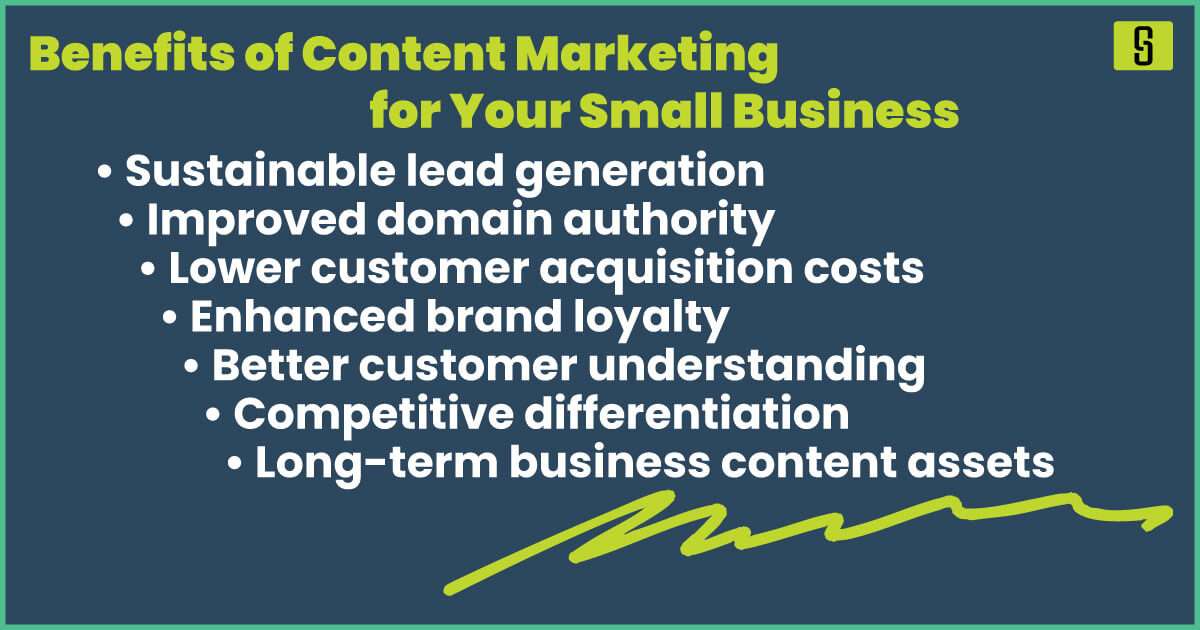
Benefits of Content Marketing for Your Small Business
Let me break down the tangible benefits I’ve seen content marketing deliver for small businesses:
- Sustainable lead generation: Unlike paid ads that stop when your budget runs out, content continues attracting leads indefinitely. I have articles from 2019 that still generate monthly inquiries.
- Improved domain authority: Consistent, quality content signals expertise to search engines. Higher authority means better rankings, more visibility, and increased organic traffic.
- Lower customer acquisition costs: Content marketing costs 62% less than traditional marketing while generating three times more leads. That’s a game-changer for small business budgets.
- Enhanced brand loyalty: When you consistently provide value through content, customers become advocates. They refer others and choose you over competitors—even at higher prices.
- Better customer understanding: Creating content forces you to deeply understand customer needs. This insight improves everything from product development to customer service.
- Competitive differentiation: Most small businesses underinvest in content. By committing to a content strategy, you immediately stand out in your market.
- Long-term business content assets: Every piece of marketing content you create becomes a business asset. Unlike rent-based advertising, you own your content forever.
Measuring Success and Adjusting Your Strategy
You can’t improve what you don’t measure.
I track these key metrics for every content marketing campaign:
- Organic traffic: How many people find your content through search engines? Use Google Analytics to monitor overall traffic and identify your best-performing pages.
- Engagement metrics: Time on page, bounce rate, and pages per session reveal whether content resonates. High engagement signals valuable content.
- Conversion rates: How many visitors take desired actions—subscribing to your email list, requesting quotes, or making purchases? This is where content marketing proves its ROI.
- Keyword rankings: Track where your target keywords rank in search results. Improving rankings indicates growing authority.
- Lead quality: Not all leads are equal. Content marketing typically attracts higher-quality prospects because they’ve already learned about you and trust your expertise.
Review these metrics monthly and look for patterns.
Which topics generate the most traffic? Create more content around those themes.
Which pages convert best? Analyze what makes them effective and replicate those elements.
Where do visitors drop off? Identify weak content that needs improvement or updating.
Content marketing isn’t set-it-and-forget-it. Markets change. Customer needs evolve. Your best practices from last year might need updating.
I audit my content quarterly, updating statistics, refreshing examples, and improving underperforming pieces. This ongoing optimization keeps content relevant and maintains search rankings.
Content Marketing Tips for Small-Sized Businesses
Starting feels overwhelming, but you don’t need to do everything at once.
Here’s my recommended implementation timeline:
Month 1: Foundation
- Define your target audience and buyer personas
- Set specific content marketing goals
- Choose your primary content channel
- Create a simple content calendar for the next 90 days
Month 2–3: Creation and Consistency
- Publish your first 8–12 pieces of content
- Establish your publishing rhythm
- Begin building your email list
- Start promoting content on social media
Month 4–6: Optimization and Expansion
- Analyze what’s working using metrics
- Double down on successful content types
- Begin repurposing content across channels
- Consider adding a secondary content format
Month 7–12: Scaling and Refinement
- Update and improve existing content
- Build relationships with other businesses for content collaboration
- Explore advanced tactics like guest posting
- Systematize your content creation process
Remember this:
Consistency matters more than volume. Publishing one quality post weekly beats sporadic bursts of content creation. Build the habit first, then increase frequency as you develop systems.
Overcoming Common Content Marketing Challenges
Every small business owner faces similar obstacles. Here’s how to navigate them:
- I don’t have time for content creation: Start smaller than you think necessary. One blog post monthly is infinitely better than zero. Block dedicated time on your calendar and protect it. Consider repurposing existing materials—customer emails, presentations, or FAQ documents—into content.
- I’m not a writer: You don’t need to be. Speak your expertise into a voice recorder and have it transcribed. Hire a freelance writer to polish your ideas. Use AI tools as starting points (but always add your unique insights and experience).
- I don’t know what to write about: Listen to your customers. Every question they ask is a content opportunity. Check competitor blogs for topic ideas. Use tools like Answer the Public to find what people search for in your industry.
- I’m not seeing results: Content marketing is a long game. Most businesses see meaningful results after 6–12 months of consistent effort. Keep publishing, keep optimizing, and trust the process. The compounding effects are worth the wait.
- My competitors are already doing this: Good. That validates the strategy. But your unique perspective, experience, and approach will differentiate your content. Nobody else has your exact story or expertise.
The Big Picture: Building a Sustainable Growth Engine
Content marketing for small business isn’t a tactic—it’s a fundamental shift in how you attract and retain customers.
Instead of interrupting potential customers with ads, you invite them in with valuable information. Instead of competing solely on price, you compete on expertise and trust. Instead of starting from zero with each marketing campaign, you build cumulative assets that work harder over time.
I’ve seen this transformation hundreds of times. Small businesses that commit to content marketing create sustainable competitive advantages that larger competitors struggle to replicate.
Your authentic voice, deep customer understanding, and genuine desire to help—these are your superpowers. Content marketing lets you leverage them at scale.
The businesses winning in 2026 and beyond aren’t necessarily those with the biggest budgets. They’re the ones creating the most helpful, authentic, and consistent content for their audiences.
Wrap Up
Content marketing for small business delivers sustainable growth by building trust, establishing authority, and attracting qualified customers through valuable content.
Start with clear goals, understand your audience deeply, and commit to consistent creation. Focus on quality over quantity, measure what matters, and adjust based on results.
The businesses that win aren’t those with the biggest budgets—they’re the ones providing genuine value to their customers through strategic, authentic content.
FAQ
How much should a small business budget for content marketing?
Most successful small businesses allocate 20–30% of their marketing budget to content creation and promotion. This typically ranges from $500–$2,000 monthly, depending on whether you create content in-house or outsource. Start with what you can afford consistently—even $200 monthly invested wisely in content beats sporadic larger investments.
How long does it take to see results from content marketing?
Most small businesses see initial traffic increases within 3–4 months, with meaningful lead generation beginning around month 6–8. Significant ROI typically appears after 12–18 months of consistent effort. Content marketing is a long-term strategy that compounds over time, so patience and consistency are essential for success.
Can content marketing work for local service businesses?
Absolutely. Local service businesses often see the best content marketing results because they can create hyper-targeted, location-specific content with less competition. Focus on local keywords, community involvement, customer stories, and area-specific guides to dominate local search results and build neighborhood authority.
What’s the biggest mistake small businesses make with content marketing?
Inconsistency. Many small business owners start strong, publish a few pieces, then stop when they don’t see immediate results. Content marketing requires sustained effort over months to build momentum. The second biggest mistake is creating promotional content instead of genuinely helpful information that addresses customer pain points.
Should I outsource content creation or do it myself?
Both approaches work. Creating content yourself is more authentic and cost-effective but time-intensive. Outsourcing to freelance writers or agencies saves time but requires budget and oversight to maintain your voice. Many successful small businesses use a hybrid approach—they provide expertise and outlines while writers handle the actual creation and optimization.