A digital marketing strategy for real estate is a comprehensive plan that uses online channels like SEO, paid ads, social media, and content marketing to attract qualified buyers and investors while generating consistent leads for brokers and developers.
I’ve spent the last four years helping companies turn their digital presence into a lead-generating machine.
And here’s what I learned:
Most real estate professionals waste thousands on marketing that doesn’t work. They run random Facebook ads, post inconsistently on Instagram, and wonder why the phone isn’t ringing.
In this guide, I’ll show you how to build a digital marketing strategy for real estate that actually drives results. You’ll get the exact tactics I’ve used to help brokers, builders, and agents dominate their markets.
One key aspect to focus on is developing effective marketing strategies for mortgage brokers that highlight their unique selling propositions. By leveraging social media and SEO, brokers can reach potential clients more effectively and establish a strong online presence. Additionally, utilizing client testimonials and success stories can greatly enhance credibility and attract more business.
Highlights
- Real estate buyers conduct 98% of their property research online before buying.
- A solid digital marketing plan combines SEO, paid ads, content, and social media.
- Organic channels like SEO deliver long-term ROI with lower costs per lead.
- Paid channels like Google Ads and Facebook provide immediate lead flow.
- Link building strengthens your authority and helps you outrank competitors.
Understanding Digital Marketing for Real Estate Business
Digital marketing for real estate means using online platforms to connect with potential buyers, investors, and tenants. It’s not just about having a website anymore.
Today’s real estate professionals need a multi-channel approach that meets prospects wherever they are in their buying journey.
Here’s the reality:
The real estate industry has changed dramatically. Mobile devices now account for 59.16% of global website traffic. Your prospects are searching for properties on their phones during lunch breaks, scrolling through listings on tablets at night, and comparing neighborhoods on their laptops.
If your marketing isn’t optimized for this behavior, you’re losing deals to competitors who get it.
Why Digital Marketing for Real Estate Companies Matters
Traditional marketing tactics like print ads and billboards still have their place. But they can’t compete with the targeting precision and measurability of digital marketing.
Here’s what a strong digital marketing strategy for real estate businesses delivers:
- Qualified Lead Generation: Instead of hoping the right person sees your billboard, you can target people actively searching for properties in specific price ranges and locations.
- Lower Cost Per Lead: Once your organic channels start working, your cost per lead drops significantly compared to traditional advertising.
- Measurable Results: You can track exactly which marketing channels bring in leads and which ones waste your budget.
- 24/7 Lead Capture: Your website works around the clock, capturing leads even when you’re sleeping.
- Build Brand Awareness: Consistent online presence establishes you as the go-to expert in your market.
Real estate companies triple their lead volume within six months by implementing the strategies I’m about to share.
How to Start Real Estate Lead Generation
You want a lead that is qualified, won’t waste your time, and knows the value of what you’re offering.
But here’s the thing:
Prior to getting these submissions, you need to take care of a lot of groundwork to see this kind of response.
Inbound lead generation is one of the most effective digital marketing strategies for real estate. Constructive strategy through channels like Google Ads, Facebook Meta Ads, Email Marketing, and other remarketing campaigns are all excellent options for increasing lead generation for your firm.
Understanding Your Target Audience
To understand how to do digital marketing for real estate, you need to understand whom you’re targeting. Whether the prospect is looking to invest for portfolio growth or to buy their first house makes all the difference.
Creating Your Ideal Lead Persona
A lead persona is a fictional representation of an ideal customer based on data and research. It helps businesses understand who their target audience is, what their needs and wants are, and how they make purchasing decisions.
Ultra-high-net-worth individuals (UHNWI): A high-paying job is often used as a factor in creating a lead persona because it can indicate that the person has a higher disposable income and may be interested in purchasing more expensive goods or services, such as luxury real estate.
Customer Interests: Understanding the interests of a lead persona can help businesses tailor their marketing and sales messages to better resonate with their target audience. For example, if a lead persona is interested in outdoor activities, a real estate company might showcase properties with large yards or nearby parks.
Other factors that can be included in creating a lead persona include:
- Demographic information: age, gender, education, location, and family status.
- Lifestyle: hobbies, interests, values, and goals.
- Behavioral data: purchasing habits, brand loyalty, and technology usage.
- Pain points: problems or challenges the target audience is facing.
- Objections: reasons why they may not buy.
By creating a detailed lead persona, real estate companies can better understand their target audience and tailor their marketing and sales efforts to better meet their needs and wants. This can lead to more effective marketing campaigns, higher conversion rates, and increased revenue.
Understanding Buyer Motivations
People buy real estate for three main reasons:
- Residence: One of the most common reasons for buying real estate is for personal residence. Owning a home can provide stability and a sense of belonging, and it can be a source of pride and personal fulfillment.
- Investment: Real estate can also be a valuable investment, as property values typically appreciate over time. Owning real estate can provide a sense of financial security and can be a good source of passive income through rental properties.
- Commercial Purpose: Real estate can also be bought for commercial purposes, such as running a business, developing a property, or building rental properties. Investing in commercial real estate can be a lucrative way to diversify a portfolio and generate income through rental income, capital appreciation, and tax benefits.
Understanding which motivation drives your prospect changes everything about how you communicate with them.
The Foundation: Building Your Real Estate Digital Marketing Plan
Before diving into tactics, you need a solid digital marketing plan for real estate that aligns with your business goals.
Start by answering these questions:
- Who are you targeting? First-time homebuyers? Luxury property investors? Commercial tenants?
- What’s your unique value proposition? Why should someone choose you over the competition?
- What’s your budget? How much can you invest in paid ads versus organic growth?
- What are your goals? More leads? Higher-quality prospects? Increased brand recognition?
A scattered approach gets scattered results. Focus on the channels that match your audience and goals. Focus on the channels that match your audience and goals. For more actionable advice, explore our essential digital marketing tips that apply across industries.
Organic Digital Marketing Strategies for Real Estate
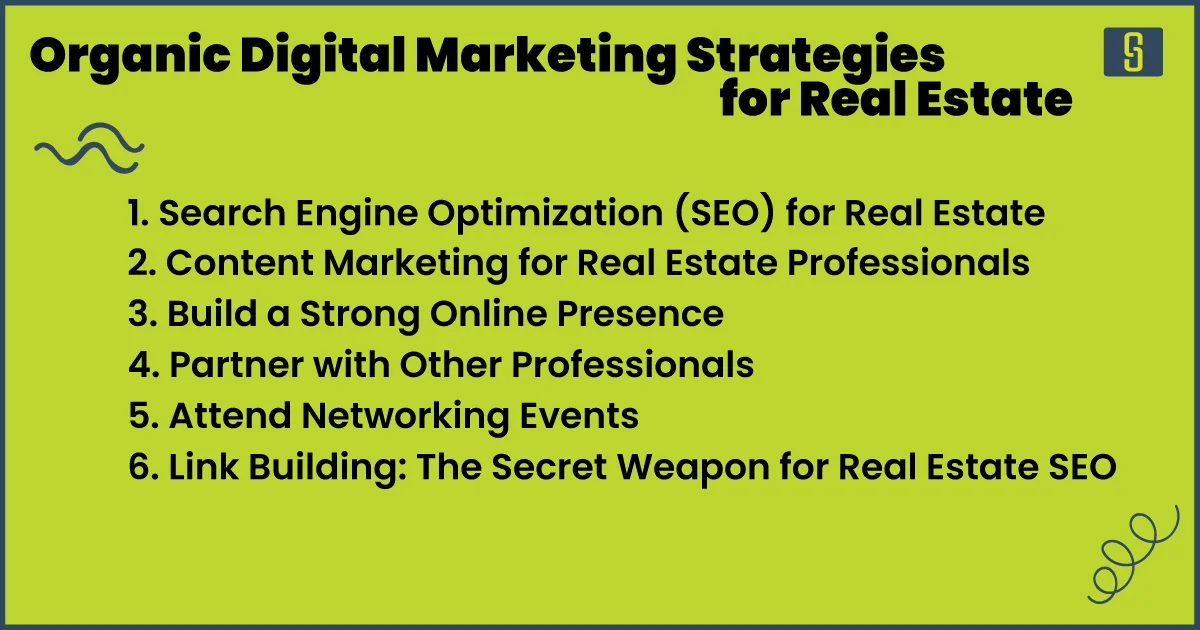
Organic channels take time to build momentum, but they deliver the best long-term ROI. Here’s how to make them work.
Search Engine Optimization (SEO) for Real Estate
SEO is the best digital marketing for real estate when it comes to sustainable growth. When done right, it brings in qualified leads month after month without ongoing ad spend.
- Keyword Research: Start by identifying what your prospects actually search for. Tools like SEMrush and Ahrefs reveal the exact phrases people use when looking for properties.
For example, someone searching “3-bedroom apartments in downtown Dubai” has completely different intent than someone searching “best neighborhoods for families in Dubai.”
- On-Page Optimization: Every property listing and blog post should target specific keywords naturally. Include them in your titles, headings, and throughout your content.
But here’s the key: Write for humans first, search engines second. Google’s algorithms are smart enough to detect keyword stuffing.
- Technical SEO: Your website needs to load fast, work perfectly on mobile devices, and have a clear structure. I’ve seen beautiful real estate websites that tank in search rankings because they take 10 seconds to load.
- Local SEO: Most real estate searches have local intent. Claim your Google Business Profile, get listed in local directories, and gather reviews from satisfied clients.
Content Marketing for Real Estate Professionals
Content marketing is how you establish authority and attract prospects before they’re ready to buy. If you’re new to content marketing, check out our guide on content marketing strategies for small business to learn the fundamentals.
Creating content is always the best investment when it comes to assets for your blog. One of the best ways to attract potential clients to your business is creating content that addresses their needs and concerns.
Create content that answers the questions your prospects are asking:
- Neighborhood guides
- Market trend reports
- Buyer’s guides for first-time investors
- Financing tips and mortgage calculators
- Property investment analysis
- Informative blog posts
- Video content
- Infographics
- Social media posts
By providing helpful information, you can establish yourself as an authority in the real estate industry and build trust with potential clients. Your content should be optimized for search engines so that it can be easily found by people who are searching for information related to real estate.
Real estate agents who blog consistently can see their organic traffic double every six months.
The secret?
Focus on genuinely helpful content, not thinly veiled sales pitches.
Build a Strong Online Presence
In addition to your website, you should also build a strong online presence on social media and review platforms. By sharing relevant information related to investment and engaging with your followers, you can attract potential clients to your business.
You should also monitor online reviews and respond promptly to any negative feedback. By building a positive online reputation, you can increase your credibility and book more organic leads.
Partner with Other Professionals
Another effective way to generate organic leads is by partnering with other professionals in the real estate industry. This can include mortgage brokers, home inspectors, and real estate attorneys. By working together, you can refer clients to each other and expand your network of potential clients.
Attend Networking Events
Networking events are a great way to meet new people and build relationships with potential clients. You should attend local real estate events and conferences to meet other professionals in the industry and showcase your expertise.
By establishing yourself as a knowledgeable and trustworthy real estate professional, you can attract more organic leads to your business.
Generating organic leads is a critical component of any successful real estate business. Remember that organic lead generation takes time and effort, but the long-term benefits are well worth it. But if you don’t want to wait and need quick lead flow, then paid channels are the way to go!
Link Building: The Secret Weapon for Real Estate SEO
Here’s something most real estate professionals miss: Link building is critical for SEO success.
When authoritative websites link to your content, Google sees your site as more trustworthy. This translates directly into higher rankings and more organic traffic.
How to Build Links for Real Estate:
- Create Link-Worthy Content: Publish original research, comprehensive neighborhood guides, or interactive tools that other websites want to reference.
- Guest Posting: Write valuable articles for real estate blogs and industry publications. Include a link back to your site in your author bio.
- Local Partnerships: Partner with mortgage brokers, home inspectors, and interior designers. Exchange links and referrals.
- Digital PR: Get featured in local news outlets by sharing market insights or commenting on real estate trends.
I’ve seen real estate websites jump from page 3 to page 1 of Google after implementing a strategic link building campaign.
Paid Digital Marketing Tactics for Real Estate Agents
While organic channels build momentum, paid ads deliver immediate results. Here’s how to make them profitable.
Google Ads for Real Estate Lead Generation
Google Ads puts your listings in front of people actively searching for properties right now.
Google is the largest search engine in the world, with over 3.5 billion searches conducted every day. It provides businesses with a unique opportunity to reach a large and highly engaged audience, making it an ideal platform for promoting products, services, or initiatives to your target audience.
- Search Campaigns: Target high-intent keywords like “luxury apartments for sale in [city]” or “commercial real estate [location].”
- Display Campaigns: Show visual ads across millions of websites to build awareness and stay top-of-mind.
- Remarketing Campaigns: Follow up with people who visited your website but didn’t convert. These campaigns typically have the highest ROI.
- Budget Considerations: In competitive markets like Dubai, cost per click can range from 1–3 AED. Plan your budget accordingly and focus on quality over quantity.
- Landing Pages: Don’t send ad traffic to your homepage. Create dedicated landing pages for each campaign with clear calls to action.
Pro Tip: Use Zapier to automate your conversions into a spreadsheet. Lead Generation On Autopilot!
Facebook and Instagram Ads for Real Estate
Social media platforms offer incredible targeting options for real estate marketing.
Facebook is the largest social network in the world, with over 2.8 billion monthly active users. It provides businesses with a unique opportunity to reach a large and highly engaged audience.
- Audience Targeting: Reach people based on income level, interests, behaviors, and life events like “recently engaged” or “recently moved.”
- Ad Formats: Use carousel ads to showcase multiple properties, video tours for immersive experiences, and lead generation forms to capture contact information without users leaving the platform.
- Retargeting: Install the Facebook Pixel on your website to retarget visitors with relevant property listings.
- Creative Best Practices: Use high-quality images, compelling headlines, and clear value propositions. Test different ad variations to see what resonates.
Lead Magnets for Real Estate
What are lead magnets? How to arrange lead magnets for real estate?
Lead generation costs can be quite high, ranging from $1-3 per click and $40-250 per lead. There is always the risk of fake clicks and other malicious tools being used.
To combat this, it is important to create landing pages for each project, as well as forms for brochure downloads.
To maximize the effectiveness of these campaigns, it is important to create lead magnets that will draw potential customers in. For example, providing reasons to buy, such as residence, investment, and commercial purposes, can be a great way to draw in leads.
Effective Lead Magnets Include:
- Property brochure downloads
- Market reports and analytics
- Neighborhood guides
- Investment calculators
- Virtual property tours
- Free consultation offers
- Pricing guides
Additionally, aggressive paid ads and competition calculators can be used to gain an edge over competitors. Demographic targeting is also essential when creating a digital marketing strategy for real estate.
Facebook Ads can be used to target different regions, while creative targeting can be used to draw in potential customers with family-oriented emotions or offers such as free site visits with taxi pickup.
Important Note: It is important to avoid using terms such as “ready to move” or “free”, as these can be misleading and could damage the credibility of the business.
Finally, it is important to use IP exclusion and fake click detectors to make sure that the campaigns are running effectively and efficiently. This will help to make sure that the lead generation costs remain low and that the leads are of high quality.
Social Media Marketing for Real Estate
Social media marketing isn’t just about posting pretty property photos. It’s about building relationships and establishing yourself as a trusted resource.
Building Your Social Media Strategy
- Choose the Right Platforms: Focus on where your target audience spends time. LinkedIn works best for digital marketing for real estate brokers targeting commercial properties. Instagram and Facebook excel for residential.
- Content Mix: Follow the 80/20 rule: 80% valuable content (market insights, tips, neighborhood features) and 20% promotional content (listings, open houses).
- Engagement: Respond to comments, answer questions, and participate in conversations. Social media is a two-way street.
- Consistency: Post regularly to stay visible. Use scheduling tools to maintain consistency without spending hours daily.
Video Marketing on Social Media
Video content dominates social media engagement. Property tours, market updates, and client testimonials perform exceptionally well.
Keep videos short and engaging. The first 3 seconds determine whether someone keeps watching or scrolls past.
Email Marketing for Real Estate Lead Nurturing
Email remains one of the most effective channels for staying connected with prospects and past clients.
- Segment Your List: Create different email sequences for buyers, sellers, investors, and past clients. Each group needs different messaging.
- Drip Campaigns: Set up automated email sequences that nurture leads over time. Share market insights, new listings, and valuable resources.
- Personalization: Use the recipient’s name and tailor content to their interests. Generic blast emails get ignored.
- Mobile Optimization: Most people read emails on their phones. Keep your design clean and your calls to action prominent.
The Digital Marketing Mix for Real Estate Success
The most successful real estate companies don’t rely on a single channel. They integrate multiple strategies into a cohesive digital marketing mix. They integrate multiple strategies into a cohesive digital marketing mix. Discover how to create an integrated digital marketing strategy that connects all your channels seamlessly.
Here’s how the pieces fit together:
- SEO and Content Marketing attract prospects at the top of the funnel who are researching and learning.
- Social Media builds relationships and keeps you top-of-mind throughout their journey.
- Paid Ads capture high-intent prospects ready to take action and retarget those who need more time.
- Email Marketing nurtures leads until they’re ready to buy and keeps past clients engaged for referrals.
- Link Building strengthens your SEO foundation and establishes authority in your market.
Think of your digital marketing strategy for real estate as a central hub where all these channels work together to guide prospects from awareness to conversion.
Real Estate Digital Marketing Problems
In the real estate industry, lead cost competition can be high, with cost per click (CPC) for Google Ads often ranging from $1 to $3. This high competition means that it can be challenging for real estate companies to effectively generate leads and drive conversions through digital advertising.
High Lead Cost Competition
When lead cost competition is high, it can be difficult for real estate companies to get their ads seen by potential buyers, as the cost of advertising can be prohibitively expensive. This can make it challenging to generate leads and drive conversions, as fewer people will see the ads.
Fake Clicks
Another challenge that real estate companies may face when advertising online is fake clicks, which are clicks that are generated by bots or other automated systems. These fake clicks can inflate the cost of advertising, as the real estate company is paying for clicks that do not come from real people.
How to Solve Real Estate Marketing Problems
To deal with these challenges, real estate companies can consider the following strategies:
- Optimize Campaigns: By carefully analyzing their campaigns and making data-driven decisions, real estate companies can optimize their ads to generate more leads and drive conversions at a lower cost.
- Use More Targeted Advertising: Targeting specific demographics, locations, and interests can help real estate companies reach the right people with their advertising, which can help drive down the cost of advertising and generate more leads.
- Utilize Alternative Marketing Channels: Real estate companies can also leverage advanced Real Estate Tech Tools along with exploring alternative marketing channels, such as social media, email marketing, or content marketing, to reach potential buyers and generate leads.
- Implement Anti-Fraud Measures: To prevent fake clicks, real estate companies can implement anti-fraud measures, such as using Google’s fraud protection system, to make sure that their advertising budget is not being wasted on fake clicks. Use IP exclusion and fake click detectors to make sure that campaigns are running effectively and efficiently.
Common Mistakes to Avoid
I’ve seen these mistakes cost real estate companies thousands in wasted ad spend and missed opportunities.
- No Clear Strategy: Running random marketing tactics without a cohesive plan leads to inconsistent results.
- Ignoring Mobile: With 59% of traffic coming from mobile devices, a poor mobile experience kills conversions.
- Weak Landing Pages: Sending ad traffic to generic pages instead of targeted landing pages with clear calls to action.
- No Follow-Up System: Capturing leads but failing to nurture them with consistent follow-up.
- Focusing Only on Listings: Constantly promoting properties without providing value turns people off.
- Neglecting SEO: Relying solely on paid ads means your lead flow stops the moment you stop spending.
- Poor Quality Content: Low-quality photos, generic descriptions, and thin content fail to engage prospects.
Wrap Up
A winning digital marketing strategy for real estate combines organic and paid channels, focuses on providing value, and adapts based on performance data.
Start with a clear plan, execute consistently, and measure everything.
The real estate companies that dominate their markets don’t rely on luck—they follow proven digital marketing strategies and continuously optimize based on results.
Whether you’re a solo agent or a large development firm, these tactics will help you generate more qualified leads and close more deals.
FAQ
What is the best digital marketing strategy for real estate agents?
The best strategy combines SEO for long-term organic growth, targeted paid ads for immediate leads, and content marketing to establish authority. Focus on channels where your target audience spends time and consistently provide value before promoting listings.
How much should real estate companies spend on digital marketing?
Most successful real estate companies allocate 7–10% of their gross revenue to marketing. New businesses or those in competitive markets may need to invest more initially. Start with a test budget, measure ROI, and scale what works.
How long does it take to see results from digital marketing for real estate business?
Paid ads can generate leads within days. SEO and content marketing typically take 3–6 months to build momentum. The key is starting with quick wins from paid ads while building your organic foundation for long-term growth.
What are the most effective digital marketing ideas for real estate?
Virtual property tours, neighborhood guides, market trend reports, client testimonial videos, and interactive mortgage calculators consistently perform well. Focus on content that helps prospects make informed decisions rather than just promoting listings.
How important is social media for real estate marketing?
Social media is essential for build brand awareness and staying top-of-mind with prospects. However, it works best as part of a broader strategy rather than as your only marketing channel. Focus on platforms where your target audience is most active and engage authentically.